

Browse · People
Tali Dekel
Computer vision researcher whose collaborative work addresses control, motion coherence and customization in image and video generation.
Tali Dekel is a computer vision researcher whose collaborative contributions include controlling diffusion models through their internal features, generating video across space and time, and transferring still-image customization to video. She is an Associate Professor at the Weizmann Institute of Science; her personal homepage also lists her as a Staff Research Scientist at Google DeepMind.[3][4][5][6][7]
Video generation: coherent motion and customization
Dekel coauthored Lumiere, submitted in January 2024, with Omer Bar-Tal, Hila Chefer and fourteen other researchers. Its Space-Time U-Net generates the full temporal duration of a low-resolution video in one model pass. Spatial and temporal down- and up-sampling let it process the video at multiple scales while drawing on a pretrained text-to-image diffusion model. The authors contrast this architecture with generating distant keyframes and then filling in intermediate frames, an approach they identify as making global temporal consistency difficult.[6]
In July 2024, Dekel, Hila Chefer, Shiran Zada, Roni Paiss, Ariel Ephrat, Omer Tov, Michael Rubinstein, Lior Wolf, Tomer Michaeli and Inbar Mosseri introduced Still-Moving. It addresses a different constraint: customizing a video model without customized video footage. For video models built over text-to-image models, the framework starts with an image model already customized using still images. Simply transferring its weights can produce artifacts or weak adherence to the customization, so the method trains lightweight Spatial Adapters to adjust the transferred features.[7]
The training examples are “frozen videos”—repeated images generated by the customized image model. Motion Adapters enable training on these static sequences while preserving the pretrained video model's motion prior. At generation time, the Motion Adapters are removed and the Spatial Adapters remain. The method therefore avoids customized video data while still requiring an image customization, adapter training and a pretrained video model.[7]
At ICML 2024's controllable video generation workshop in Vienna, Dekel presented “The Future of Video Generation: Beyond Data and Scale.” The talk was included in Latent Space's ICML 2024 compilation, published on December 10, 2024, beginning at recording timestamp 01:42:00.[2][1]
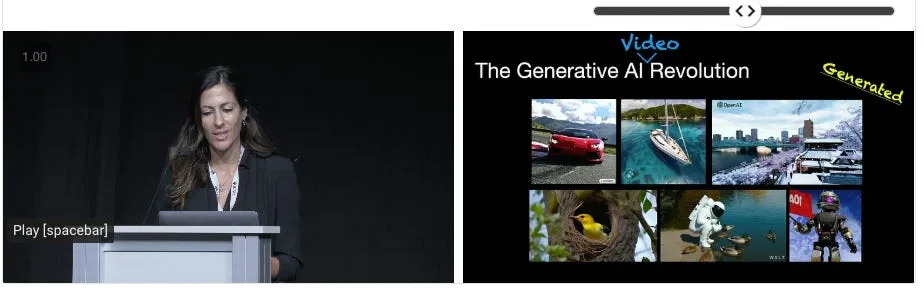
Latent.Space, ICML 2024 compilation.
Earlier foundations: image control and depth estimation
Before these video-generation projects, Dekel worked on controlling image synthesis. In the November 2022 Plug-and-Play Diffusion Features paper, she collaborated with Narek Tumanyan, Michal Geyer and Shai Bagon; Tumanyan and Geyer share equal-contribution credit. Their method uses a fixed, pretrained Stable Diffusion model to translate a guidance image according to a text prompt while preserving its structure and semantic layout. It extracts spatial features and self-attention from the guidance image and injects them into the target image's generation process, requiring no additional training or fine-tuning.[5]
The design separates structural guidance from appearance. Injecting deeper spatial features preserves more structure but also leaks the original appearance into the result. Combining intermediate layer-4 features with higher-resolution self-attention alleviates that tradeoff. Examples include turning sketches into realistic images, changing object categories and altering lighting. The method depends on a semantic association between the input and target, so it performs poorly on detailed segmentation masks whose regions have arbitrary colors. Omer Bar-Tal contributed comments and discussion, acknowledged separately from the paper's authors.[5]
Earlier still, Dekel coauthored the 2019 Learning the Depths of Moving People by Watching Frozen People with Zhengqi Li, Forrester Cole, Richard Tucker, Noah Snavely, Ce Liu and William T. Freeman. The team used thousands of Internet videos in which people hold mannequin-like poses while a handheld camera moves around them. Their stillness permits multi-view stereo reconstruction to produce depth training data. At inference time, motion parallax from static parts of a scene helps predict dense depth even when both the camera and people move. This work supplies an earlier example of Dekel's research in 3D structure and motion estimation.[8][4]
Dekel completed her PhD in electrical engineering at Tel Aviv University, supervised by Shai Avidan and Yael Moses. Before her current roles, she was a Postdoctoral Associate with Bill Freeman at MIT CSAIL. Her research interests span image and video analysis, multi-view systems, 3D structure and motion estimation, synthesis and rendering.[4]
Timeline
- research
Coauthors depth estimation research using frozen poses
Earlier still, Dekel coauthored the 2019 Learning the Depths of Moving People by Watching Frozen People with Zhengqi Li, Forrester Cole, Richard Tucker, Noah Snavely, Ce Liu and William T. Freeman.[8] - research
Coauthors Plug-and-Play Diffusion Features for image control
In the November 2022 Plug-and-Play Diffusion Features paper, she collaborated with Narek Tumanyan, Michal Geyer and Shai Bagon; Tumanyan and Geyer share equal-contribution credit.[5] - research
Coauthors Lumiere for video generation across space and time
Dekel coauthored Lumiere, submitted in January 2024, with Omer Bar-Tal, Hila Chefer and fourteen other researchers.[6] - research
Introduces Still-Moving with collaborators for video customization
In July 2024, Dekel, Hila Chefer, Shiran Zada, Roni Paiss, Ariel Ephrat, Omer Tov, Michael Rubinstein, Lior Wolf, Tomer Michaeli and Inbar Mosseri introduced Still-Moving.[7]
From the Latent Space archive
Original posts and separately reviewed explanations.
Generative Video WorldSim, Diffusion, Vision, Reinforcement Learning and Robotics — ICML 2024 Part 1
Grounded writeupFrom Denoising Images to Inferring 3D Worlds — Part 3 of 6
Grounded writeupFrom Persistent Pixels to Playable Worlds — ICML 2024, Part 1 of 6
Grounded writeupFrom Probability Flows to Reusable Representations — ICML 2024, Part 4 of 6
Grounded writeupFrom Reusable Vision Features to Actions Learned from Video — Part 5 of 6
Grounded writeupTeaching Robots More Cheaply—and Automating RL’s Hidden Labor — Part 6 of 6
Grounded writeupVideo as Tokens, Motion as Features — ICML 2024, Part 2 of 6
Sources
- 1
- 2CVG@ICML — Frontiers in Controllable Video GenerationAccessed 2026-09-20
- 3Tali Dekel — Weizmann Institute of ScienceAccessed 2026-09-20
- 4Home | Tali DekelAccessed 2026-09-20
- 5Plug-and-Play Diffusion Features for Text-Driven Image-to-Image TranslationAccessed 2026-09-20
- 6Lumiere: A Space-Time Diffusion Model for Video GenerationAccessed 2026-09-20
- 7Still-Moving: Customized Video Generation without Customized Video DataAccessed 2026-09-20
- 8Learning the Depths of Moving People by Watching Frozen PeopleAccessed 2026-09-20
Model source and teaching reviews passed. Human editorial review pending. This profile describes the sources as of 2026-09-20.