

historical engineer and technical author · as of 2026-09-15
Browse · Organizations
Organization · Latent Space wiki
Stripe
Stripe’s financial infrastructure connects payment prediction, AI usage billing, agent checkout, and developer services.
Stripe builds programmable financial infrastructure: APIs and services businesses use to accept payments and manage subscriptions, billing, tax, and money movement. Its AI work spans payment prediction, charging for model usage, and enabling agents to purchase on a buyer’s behalf. In August 2026, its agreement to acquire OpenRouter extended that direction toward model routing and inference cost management.[1][4][5][9][11]
Learning payment patterns from transaction context
At its May 2025 product keynote, Stripe introduced its Payments Foundation Model. It uses self-supervised learning to generate representations of charges for downstream payment tasks. Stripe reported training it on tens of billions of transactions. These learned representations capture relationships in payment data without requiring engineers to hand-design every relevant feature.[5]
The central modeling idea is that a payment’s meaning depends on its context. In her October 2025 interview, Emily Glassberg Sands, Stripe’s Head of Data and AI, explained that relevant sequences can connect activity across retailers, IP addresses, and cards. Card testers may hide small test charges among a large merchant’s legitimate transactions; sequences of charge embeddings help expose those clusters. Stripe reported that detection of attacks on large users rose from 59% to 97% after deploying the model. Sands said every transaction passed through it on the charge path with less than 100 milliseconds of latency.[4][5]
Sands also described using the embeddings to identify suspicious traffic that did not produce fraudulent disputes. AI customers wanted to flag and selectively block bots even when their payments succeeded. That expands the problem beyond stolen cards: free-trial, refund, and nonpayment abuse can consume expensive inference before a business receives durable payment.[4]
Processor independence and the agent checkout contract
Stripe’s 2025 keynote described a 2024 commitment to processor-independent modular services and introduced Stripe Orchestration for managing multiple payment providers. A demonstration routed UK credit-card transactions to Worldpay and the remaining transactions to Stripe. Businesses could therefore use Stripe’s checkout and other financial services while maintaining relationships with other processors; Orchestration was also offered to businesses that did not process payments through Stripe.[5]
The Agentic Commerce Protocol (ACP) brought a shared checkout contract to agent purchases. OpenAI launched Instant Checkout on September 29, 2025 using ACP, co-developed with Stripe and merchant partners. The launch required explicit buyer confirmation and kept the merchant responsible for accepting or declining orders, processing payment through its existing provider, fulfillment, and customer support.[6]
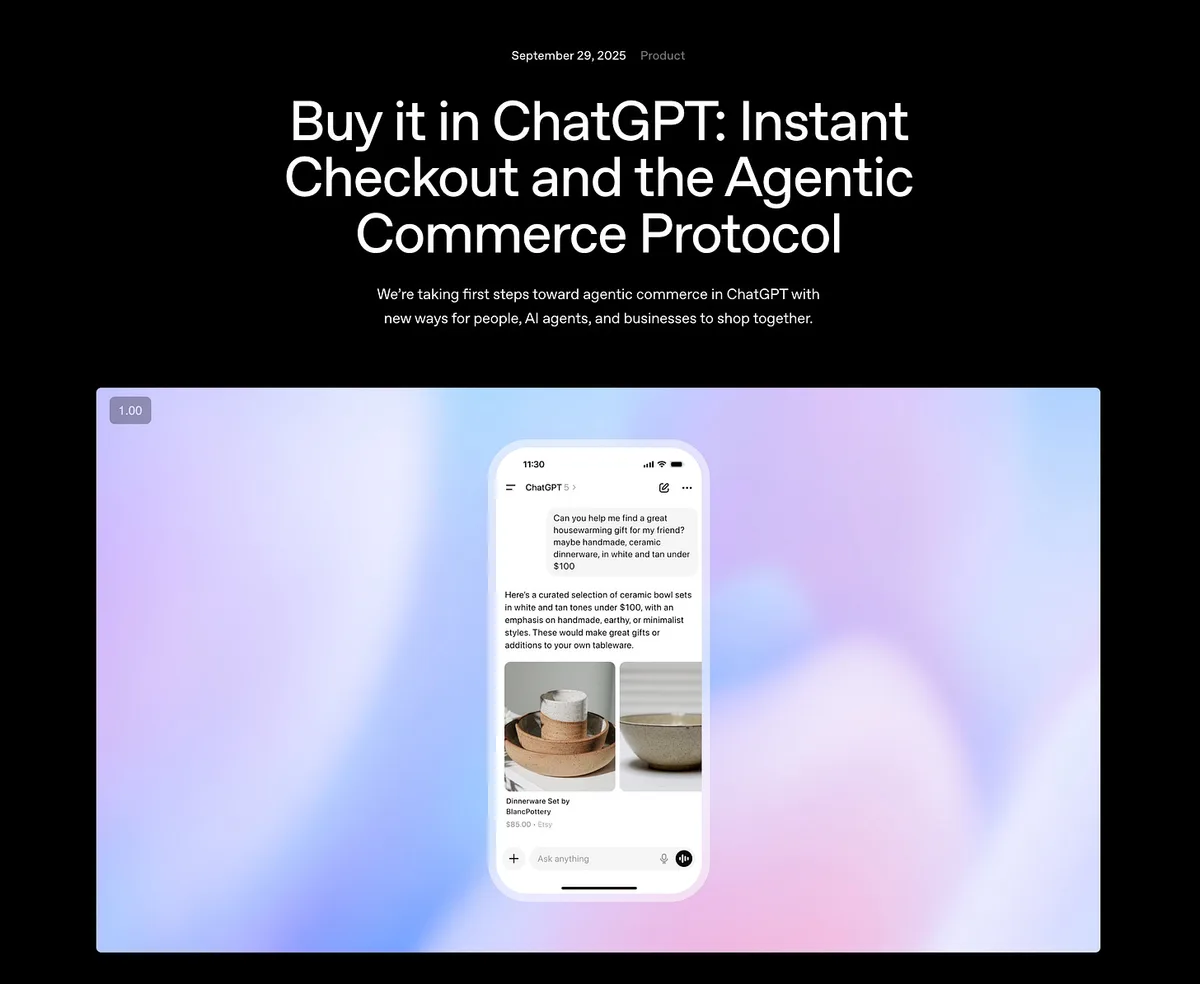
OpenAI; screenshot reproduced by Latent.Space.
The launch used encrypted payment tokens scoped to a merchant and amount to constrain delegated authority. Sands distinguished the commerce protocol—how merchants expose products, inventory, prices, and brand information—from the mechanism that moves money. She described shared payment tokens behind ChatGPT checkout and a separate Stripe Issuing approach that supplied one-time virtual cards for Perplexity’s travel booking agent.[6][4]
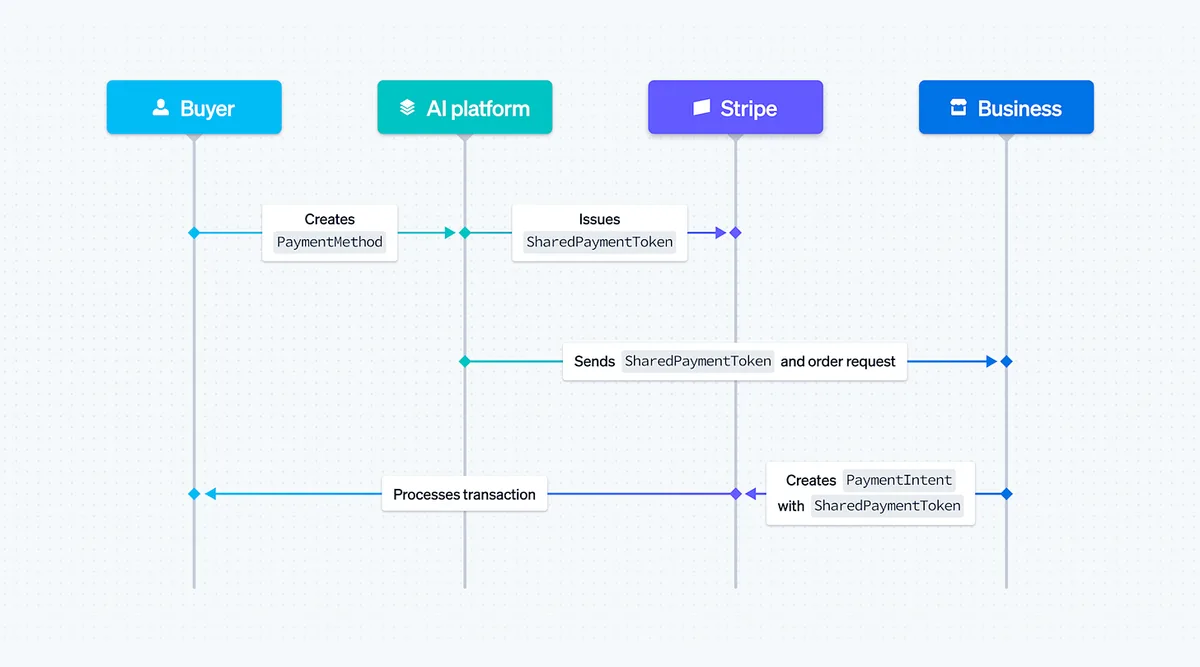
Published by Latent.Space; image creator not identified in the supplied source.
Instant Checkout initially supported US ChatGPT users buying single items from US Etsy sellers. Shopify expansion and multi-item carts were prospective at launch.[6]
The ACP repository identifies OpenAI and Stripe as founding maintainers under joint governance, labels the specification beta, and publishes Apache 2.0-licensed snapshots from September 2025 through April 2026. Stripe also participates in the UCP Tech Council and documents Universal Commerce Protocol support for checkout, OAuth 2.0 identity linking, webhook order updates, and payment-token exchange.[7][8]
Connecting AI consumption to prices and invoices
AI products face changing upstream model costs alongside subscriptions, usage charges, and outcome-based pricing. Sands described Token Billing in October 2025 as an API for tracking and pricing against inference costs in real time. Stripe Billing also supported customers such as Intercom charging for resolved support cases, using the outcome as the metered unit.[4]
Stripe completed its Metronome acquisition on January 14, 2026. Its September 2026 LLM token billing documentation directs new integrations to Metronome for usage recording, pricing, and invoice generation. It distinguishes reselling provider tokens with a markup from charging an application’s users for AI consumption.[15][9]
For token resale, Stripe synchronizes supported provider prices and the business sets its margin. Usage events sent directly to Metronome identify the customer, model, token type, and token count. Metronome evaluates usage in real time and sends invoices to Stripe for payment. The offering is in public preview for users with Metronome accounts; automatic price updates cover supported OpenAI, Anthropic, and Google models.[9]
Building businesses and infrastructure with agents
Sands attributed agent commerce and Token Billing’s origins to a roughly two-dozen-person Experimental Projects Team pursuing opportunities across product boundaries. She described embedding experimental engineers with product or infrastructure teams and customer design partners so that established teams could carry the resulting products forward. Her assessment that embedded projects were more likely to succeed was based on small, anecdotal samples.[4]
Stripe’s claimable sandboxes, launched with Replit and Vercel in 2025, let builders create products, set prices, generate test customers, and run test charges before connecting a Stripe account. Sands described a builder working inside Vercel’s v0, then opening Stripe to sign in or create an account, claim the sandbox, and take the business live.[4]
By June 2026, Stripe Projects supplied CLI-based service provisioning and management through integrations with Hermes, Factory Droids, and Warp. It added project cost visibility, per-provider spending caps, and isolated credentials for named environments. Agents default to development. Stripe reported 49 connected providers after adding 16, including Metronome, Wix, and ClickHouse.[10]
Internal AI: tools, data discovery, and ownership
In October 2025, Sands reported about 8,500 employees using LLM tools daily and 65–70% of engineers using AI coding assistants day to day. Stripe’s centrally managed Toolshed MCP layer connected agents to Slack, Google Drive, Git, its Hubble data catalog, and querying tools. Teams could add integrations without waiting for the central team. Sands described replacing Stripe’s initial homegrown chat interface with an implementation based on open-source software rather than continuing to extend it indefinitely.[4]
Hubert, Stripe’s internal natural-language interface over Hubble, had about 900 weekly users in Sands’ account. Its evaluations exposed a discovery problem: “it had a hard time finding which table and which field was best to answer the question at hand.” In that interview, Sands described an ongoing push to deprecate low-quality tables and have domain owners document high-quality ones. Organizational context improved offline results but was not yet in production.[4]
Stripe also used its Spotlight procurement program to solicit solutions for AI evaluations. Sands said more than two dozen applicants were narrowed to two finalists, with Braintrust selected after a proof of concept. Her approach was to look for products Stripe could buy, build when suitable options were unavailable, and revisit that choice as the market evolved.[4]
The OpenRouter agreement
On August 19, 2026, Stripe agreed to acquire OpenRouter, a model gateway and routing platform. The announcement described access to more than 400 models from over 80 providers and routing based on task complexity, price, speed, and reliability. Stripe’s stated aim was to connect its revenue infrastructure with tools for managing token costs and model performance.[11]
The OpenRouter team promised the “same mission, same name, same product, same roadmap” and routing driven by users’ interests. Its announcement made the transaction subject to customary closing conditions and expected closing in the coming weeks.[12]
Stripe’s earlier payments and platform products provide context for this broader infrastructure business. Its public launch preceded the AI products by more than a decade.[18][17][5]
Early history: public launch and multiparty payments
Stripe was cofounded by Patrick and John Collison and launched publicly in September 2011. Its April 2026 Sessions record listed Patrick as CEO and John as president.[2][18]
In his July 2013 essay “Do Things that Don’t Scale”, Paul Graham recalled the brothers recruiting other Y Combinator startups. When someone agreed to try Stripe, they installed it on the prospective user’s laptop immediately—the “Collison installation.” Graham also recalled that the founders initially obtained traditional merchant accounts manually behind an apparently instant signup experience.[3]
Stripe Connect debuted in 2012, expanding payments into a multiparty product for software platforms and marketplaces. It lets platforms onboard businesses, define custom funds flows, and pay out earnings. Stripe’s 2022 retrospective described more than 10,000 software companies, marketplaces, and enterprises using Connect, whose users powered more than six million businesses globally. Embedded lending, cards, and financial accounts extended that platform offering beyond payment acceptance.[17]
Stripe completed its Bridge acquisition on February 4, 2025, adding stablecoin infrastructure. At Sessions that May, it introduced Money Management capabilities spanning multicurrency balances, global payouts, stablecoin financial accounts, and stablecoin-backed card issuing with Visa and Lead Bank.[16][5]
Financing, employee liquidity, and scale
On March 15, 2023, Stripe announced signed agreements for a Series I fundraise exceeding $6.5 billion at a $50 billion valuation. The intended uses were employee liquidity and withholding taxes associated with equity awards, with share retirement offsetting new issuance. Stripe stated that it did not need the capital to operate its business.[14]
In its February 24, 2026 annual update, Stripe reported $1.9 trillion in total volume generated by businesses running on Stripe during 2025, up 34% from 2024 and equivalent to approximately 1.6% of global GDP. This measures business volume rather than Stripe’s revenue. Stripe reported serving more than five million businesses directly or through platforms.[13]
The same update announced signed employee-liquidity tender-offer agreements at a $159 billion valuation, funded mostly by investors including Thrive Capital, Coatue, and a16z, with Stripe also repurchasing shares. Separately, Stripe projected that its Revenue suite, including Billing, Invoicing, and Tax, would reach a $1 billion annual run rate in 2026.[13]
Timeline
- release
Connect expands payments to platforms and marketplaces
Stripe Connect[17] - milestone
Stripe completes Bridge acquisition, adding stablecoin infrastructure
Bridge acquisition[16] - release
Stripe introduces its Payments Foundation Model
Payments Foundation Model[5] - release
OpenAI launches Instant Checkout using ACP, co-developed with Stripe
Agentic Commerce Protocol[6] - milestone
Stripe completes Metronome acquisition
Metronome acquisition[15]
Financing
Series I fundraise agreements
On March 15, 2023, Stripe announced signed agreements for a Series I fundraise exceeding $6.5 billion at a $50 billion valuation.[14]
Employee-liquidity tender-offer agreements
The same update announced signed employee-liquidity tender-offer agreements at a $159 billion valuation, funded mostly by investors including Thrive Capital, Coatue, and a16z, with Stripe also repurchasing shares.[13]
From the Latent Space archive
Original posts and separately reviewed explanations.
Sources
- 1About Us | StripeAccessed 2026-09-17
- 2Stripe Sessions 2026 | SpeakersAccessed 2026-09-17
- 3Do Things that Don't ScaleAccessed 2026-09-17
- 4
- 5Product keynote | Stripe Sessions 2025Accessed 2026-09-17
- 6Buy it in ChatGPT: Instant Checkout and the Agentic Commerce ProtocolAccessed 2026-09-17
- 7Agentic Commerce Protocol repositoryAccessed 2026-09-17
- 8Universal Commerce Protocol | Stripe DocumentationAccessed 2026-09-17
- 9Billing for LLM tokens | Stripe DocumentationAccessed 2026-09-17
- 10
- 11
- 12OpenRouter is Joining StripeAccessed 2026-09-17
- 13
- 14Stripe announces new round of funding and plan to provide employee liquidityAccessed 2026-09-17
- 15Stripe completes Metronome acquisitionAccessed 2026-09-17
- 16Stripe completes Bridge acquisitionAccessed 2026-09-17
- 17
- 18Sequoia-Backed Stripe Wants To Disrupt The Online Payments SpaceAccessed 2026-09-17
Model source and teaching reviews passed. Human editorial review pending. This profile describes the sources as of 2026-09-17.