

historically worked at · as of 2026-09-15
Browse · People
Person · Latent Space wiki
Ryan Lopopolo
Software engineer whose harness-engineering work makes requirements, tools, and feedback accessible to coding agents, now working on cloud-operation agents at Google Cloud.
Ryan Lopopolo is a software engineer at Google Cloud whose OpenAI work developed a concrete practice of harness engineering: shaping the context, tools, constraints, and feedback around an AI agent so it can complete work reliably. He helped build an internal product under a prohibition on manually written code, shifting engineering effort toward requirements, reusable components, observability, and executable checks. As of September 2026, he describes his role as Principal Engineer, Agentic Google Cloud Platform, working on agents for cloud design, routine operations, and incident response.[1][3][14]
The no-manual-code experiment
Lopopolo authored OpenAI’s February 11, 2026 article Harness engineering: leveraging Codex in an agent-first world as a Member of the Technical Staff. Its governing principle was “Humans steer. Agents execute.” The first repository commit landed in late August 2025, with an initial scaffold generated using Codex CLI and GPT-5. Over five months, the team reported approximately one million repository lines—including application logic, infrastructure, tooling, documentation, and utilities—and roughly 1,500 opened-and-merged pull requests. Lopopolo credited Victor Zhu and Zach Brock with contributions to the article and the full team with building the product.[1]
In his April 2026 Latent Space interview, Lopopolo explained his decision to refuse to write implementation code himself: getting the agent to do the job became the only way forward. He recalled early Codex Mini attempts that could not assemble complete features, prompting him to break work into smaller, reusable building blocks. He estimated that the first month and a half was ten times slower than doing the work himself. That early slowdown concerned a different phase from the February article’s team estimate that the overall product took roughly one-tenth the time hypothetical manual development would have required.[2][1]
At the time of the April interview, Lopopolo described working on Frontier Product Exploration, developing enterprise agent products. His later biography identifies the five-month experiment as an autonomous data scientist and recounts earlier work on interaction patterns across Code Interpreter, ChatGPT Record, and ChatGPT connectors, followed by coding agents used for general knowledge work.[2][3]
Making behavior inspectable and judgment executable
Lopopolo’s team gave Codex ways to inspect the system it was changing. Agents could launch application instances in separate worktrees, operate the browser interface, and query logs, metrics, and traces. These tools let them reproduce failures and validate behavior. In the interview, he described letting Codex boot its local observability stack through skills and scripts when needed, giving the model options for investigating a task.[1][2]
The team replaced a monolithic AGENTS.md with a roughly 100-line navigation map pointing to structured, versioned documentation. Linters, CI, and recurring maintenance checked its structure and freshness. Structural tests and custom lints enforced dependency boundaries and reliability rules; their error messages supplied repair instructions. This constrained architecture while leaving agents freedom to implement within those boundaries.[1]
Review exposed another missing requirement. Lopopolo recalled reviewer agents repeatedly obstructing an implementation agent until the team explicitly instructed reviewers to bias toward merging and surface only P2-level issues or above. Authoring agents also gained permission to defer or push back on feedback that expanded scope. Human review was possible but not required before merge; in the April interview, he said releases of the native application still required a human-approved smoke test.[3][2][1]
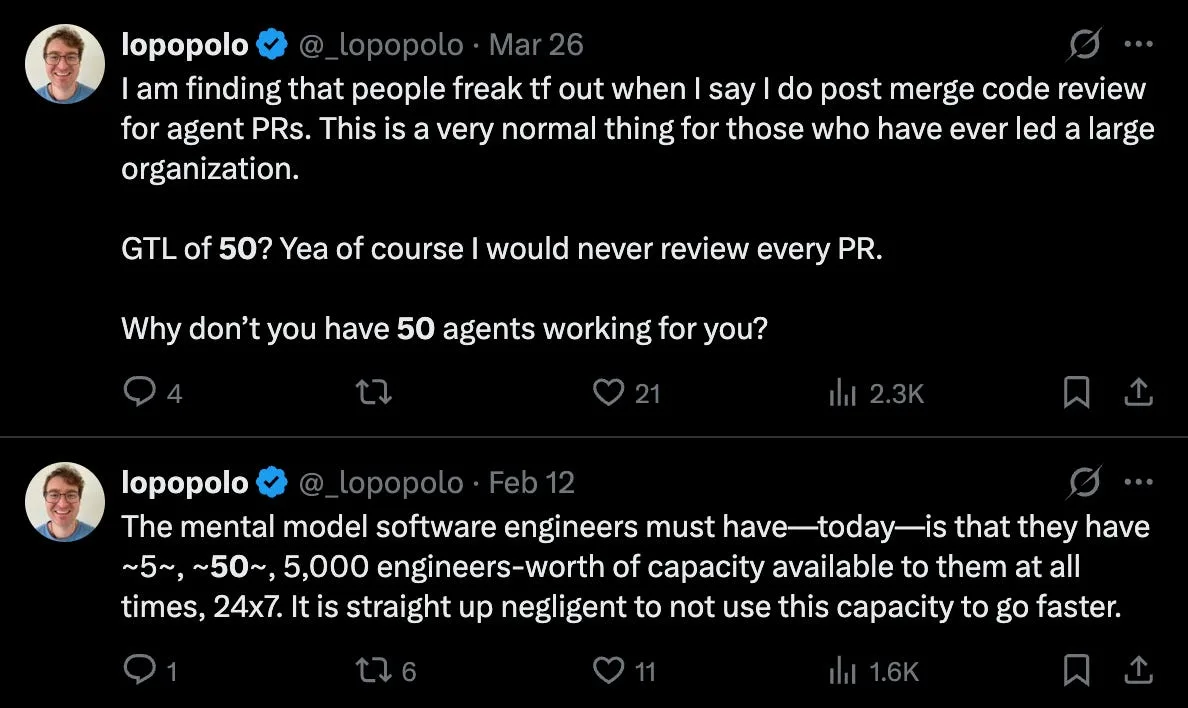
Posts: @_lopopolo on X; screenshot published by Latent Space.
Maintenance likewise moved into the feedback loop. Concentrated Friday cleanup gave way to recurring background scans and targeted refactoring changes. Lopopolo’s team used review comments, failed builds, and agent session logs to improve shared skills and repository context. His harness-engineering anthology extends this approach to organizational requirements, authority, operational state, and proof of completion. The February article nevertheless left architectural coherence over years unresolved.[1][2][12]
Symphony: managing work instead of terminal sessions
Lopopolo recalled becoming exhausted by switching among concurrent agent sessions. His team’s response developed into Symphony, which moves task dispatch and supervision into a service. Its specification describes polling an issue tracker, creating per-issue workspaces, and running coding sessions with bounded concurrency, retries, and reconciliation. A repository-owned WORKFLOW.md versions the prompts and runtime settings alongside the code.[2][10][11]
Symphony distributes a language-agnostic specification and an experimental Elixir reference implementation; the interview introduction credits Alex Kotliarskyi with that implementation. Runs can supply CI status, review feedback, complexity analysis, and walkthrough videos so engineers can assess outcomes without supervising the whole session. The project is an engineering preview for trusted-environment testing. Successful execution may end at a human-review handoff, and approval and sandbox policies depend on the implementation.[2][10][11]
Google Cloud and the limits of agent judgment
On August 25, 2026, Lopopolo announced that he had joined Google Cloud, where Google Cloud and Google accounts welcomed him. He described partnering again with Karan Sharma to build agents capable of the full job of operating a cloud, from design through routine operations and incident response. His personal biography argues that this work requires adapting agents to each customer’s knowledge, workflows, and environment.[14][15][16][3]
In his September 12, 2026 essay Aligned to whom?, Lopopolo argues that expertise helps builders recognize defects in familiar domains while leaving them unable to evaluate other risks at expert depth. He extends that concern to graders, rubrics, and evaluations, and warns that misalignments can compound through successive changes. His formulation—“What is clever optimization to one person is reckless, incorrect, or unethical to another.”—makes acceptable shortcuts a matter of local values. He describes long-term coherence of agentic work as an unsolved problem.[13]
Before his agent work, Lopopolo worked on infrastructure, developer productivity, data products, and language runtimes. Those earlier projects provide concrete context for his experience with automation, organizational coordination, and runtime design.[5][3][6][9]
Earlier career: infrastructure, developer productivity, and Artichoke
His July 2023 résumé lists Box from 2012–2016, Citadel from 2016–2017, Stripe from 2017–2021, and Brex from 2021 through the résumé’s publication. It also lists a bachelor’s degree in computer science and engineering from MIT. His later biography recounts building Snowflake’s data marketplace and describes the work as designing the system and unblocking execution across tightly coupled organizations and product surfaces.[5][3]
At Stripe, Lopopolo led the cloud cost accounting team. His June 2018 article Effectively using AWS Reserved Instances explains a SQL-and-Python process that normalized observed fleet usage, compared reservation coverage with a target band, and prepared purchases for human approval. In Productive Engineering–Finance Partnership, he described the collaboration behind it: shared cost definitions, accessible reports and forecasts, biweekly meetings between responsible owners, and reconciliation between invoices and usage data.[6][7]
Lopopolo created Artichoke Ruby, a Ruby implementation written in Rust and Ruby with a WebAssembly playground. In his RubyConf 2019 talk, he recalled a hackathon editor project that would evaluate Ruby inside a Rust server to generate CSS. He became more interested in the Ruby bindings and pursued the runtime; a Rack-compatible Sinatra server supplied a practical use case for incremental correctness. Artichoke aimed at MRI compatibility, embedding in untrusted environments, and single-binary distribution. These were goals rather than guarantees of complete compatibility or sandboxing. He says he archived the project in 2025 after six years of work.[8][9][5][3]
At Brex, Lopopolo was group tech lead for developer productivity across five teams comprising 35 engineers and five managers, serving a 350-person engineering organization. His résumé recounts canceling a failed repository migration and redirecting the effort toward build optimization, with a claimed saving of 2,520 engineering hours per quarter. In his later biography, he describes learning to allocate limited attention according to the cost of failure and keep his own attention off the organization’s critical path.[5][3]
From the Latent Space archive
Original posts and separately reviewed explanations.
Conversation
Extreme Harness Engineering for Token Billionaires: 1M LOC, 1B toks/day, 0% human code, 0% human review — Ryan Lopopolo, OpenAI Frontier & Symphony
Grounded writeupHarness Engineering, Part 2 of 2: Evidence, Context, and Control
Grounded writeupHarness Engineering: Delegating the Whole Development Loop — Part 1 of 2
Sources
- 1Harness engineering: leveraging Codex in an agent-first worldAccessed 2026-09-17
- 2
- 3Ryan Lopopolo | hyperbolaAccessed 2026-09-17
- 4lopopolo (Ryan Lopopolo) · GitHubAccessed 2026-09-17
- 5Ryan Lopopolo's ResumeAccessed 2026-09-17
- 6Effectively using AWS Reserved InstancesAccessed 2026-09-17
- 7Productive Engineering–Finance PartnershipAccessed 2026-09-17
- 8Building a Ruby: Artichoke is a Ruby Made with RustAccessed 2026-09-17
- 9Artichoke RubyAccessed 2026-09-17
- 10SymphonyAccessed 2026-09-17
- 11Symphony Service SpecificationAccessed 2026-09-17
- 12Ryan Lopopolo's harness-engineering anthologyAccessed 2026-09-17
- 13Aligned to whom?Accessed 2026-09-17
- 14AI in Cloud - Google Careers | Ryan LopopoloAccessed 2026-09-17
- 15Google Cloud | LinkedInAccessed 2026-09-17
- 16Google | LinkedInAccessed 2026-09-17
Model source and teaching reviews passed. Human editorial review pending. This profile describes the sources as of 2026-09-17.