

Research scientist at · as of 2026-09-15
Browse · People
Person · Latent Space wiki
Noam Brown
An OpenAI reasoning researcher and co-creator of poker and Diplomacy AIs, Brown studies learning, search, and strategic interaction.
Noam Brown is a research scientist at OpenAI working on reasoning, reinforcement learning, self-play, and multi-agent AI. OpenAI credits him among the foundational contributors to o1 reasoning research. Earlier, he developed Libratus and Pluribus with Tuomas Sandholm and contributed to the FAIR team’s CICERO, systems that advanced AI play in poker and Diplomacy.[1][4][6][10][12]
Reasoning at OpenAI
Brown joined OpenAI in 2023 after working at Facebook AI Research from 2018 to 2023. His work includes test-time compute: computation spent producing an answer, beyond the computation used to train a model. OpenAI’s September 2024 explanation of o1 describes reinforcement learning that improves reasoning, including correcting mistakes and breaking difficult steps into simpler ones. Brown shares foundational research credit with numerous collaborators.[2][5][4]
In his June 2025 Latent Space interview, Brown recalled a late-2021 conversation with Ilya Sutskever. Brown thought economically feasible pretraining alone would fall short of superintelligence, but expected a general reasoning paradigm to take a long time to develop. Sutskever agreed that another paradigm was needed and suggested it might be more attainable. Brown recalled becoming convinced by strong experimental signs around October or November 2023, followed by OpenAI investing heavily in scaling the approach.[16]
Brown argues that extra thinking depends on the model’s underlying capabilities and access to information. An unknown birth date, for example, cannot reliably be recovered simply by thinking longer without a way to obtain it. He also identifies cost and elapsed time as limits on scaling reasoning: experiments lasting hours or weeks slow the cycle of evaluating results and deciding what to try next. Efficiency improvements can increase what a model accomplishes with the same computation.[16]
Before OpenAI, Brown worked on AI for games with hidden information. That earlier research provides concrete examples of search during decisions—and of why methods successful in adversarial games need adaptation when an agent must cooperate with humans.[6][11][12][16]
Earlier career: financial markets and Carnegie Mellon
Brown studied mathematics and computer science at Rutgers and worked as an algorithmic trading engineer at MJM Trading Group from 2006 to 2010. He then researched algorithmic trading at the Federal Reserve Board from 2010 to 2012. In an OpenAI Forum talk posted in April 2025, he recalled planning an economics PhD before choosing computer science: “I really like building things, and so I decided to do computer science instead”.[2][1][15]
At Carnegie Mellon, Brown earned a robotics master’s degree and pursued a computer science PhD under Sandholm. He also interned at DeepMind in summer 2017. CMU records his doctoral graduation in December 2020. His dissertation, Equilibrium Finding for Large Adversarial Imperfect-Information Games, covered faster regret-minimization algorithms, pruning, neural function approximation through Deep CFR, and search techniques used in Libratus and Pluribus.[2][3]
Libratus: refining a strategy under hidden information
In January 2017, Brown and Sandholm’s Libratus defeated four specialist professionals across 120,000 hands of heads-up, or two-player, no-limit Texas hold’em. The 20-day contest ended January 30. CMU reported a collective advantage of $1,766,250 in chips; these were tournament chips, not cash winnings.[6][8]
Poker makes search difficult because an action’s value depends partly on how often it is played. A bluff works because opponents cannot distinguish it from a bet made with strong cards; bluffing constantly destroys that balance. Hidden information also means that an optimal strategy in a reached situation can depend on alternatives elsewhere in the game, including situations never reached.[6][7]
- Whole-game blueprint: Libratus first solved a simplified version of the game through self-play, producing a detailed early-game strategy and an approximation for later rounds.[6]
- Refinement during play: it solved finer-grained subgames in real time, including responses to opponent bets outside the original abstraction.[6][7]
- Missing-branch improvement: opponents’ actions identified gaps worth filling in the blueprint. Sandholm explained that the system prioritized and patched the top three holes each night during the competition.[6][8]
Brown and Sandholm’s safe and nested subgame-solving work made local refinement account for the broader strategy. The theoretically safe methods ensure that refinement does not increase exploitability relative to the blueprint. Practical variants using estimated values relax that guarantee: their solution quality depends on the accuracy of those estimates.[7][6]
Pluribus and ReBeL: multiplayer play and more general search
Brown and Sandholm developed Pluribus with Facebook AI while Brown was completing his doctorate. Announced in July 2019, it defeated professionals in six-player no-limit Texas hold’em. One experiment placed a single bot against five professionals at a time for 10,000 hands, drawing on 13 participating players. In separate experiments, Darren Elias and Chris Ferguson each played 5,000 hands against five copies of Pluribus.[10]
Pluribus built its blueprint by playing six copies of itself, then used limited-lookahead search during play. At the search boundary, it considered alternative continuation strategies rather than exploring every move to the end. Its multiplayer success was empirical; it dispensed with theoretical guarantees of success. CMU reported that blueprint computation took eight days and 12,400 core hours, while live play used 28 CPU cores.[10]
In 2020, Brown, Anton Bakhtin, Adam Lerer, and Qucheng Gong introduced ReBeL, combining self-play reinforcement learning with search during training and testing. Brown and Bakhtin shared equal-contribution credit. ReBeL uses public belief states: representations that include probability distributions over possible private information, based on public observations and players’ policies. Its paper reported superhuman heads-up poker performance with less domain knowledge than prior systems. Its convergence guarantees concern two-player zero-sum games under specified approximation conditions, rather than multiplayer cooperation generally.[11]
CICERO: connecting negotiation to executable plans
Diplomacy required a different approach. Its seven players negotiate privately, form temporary alliances, and submit simultaneous orders. Brown recalled initially applying the defensive game-theoretic approach used in poker, then recognizing the need to model human players and adapt to their styles. In his June 2025 interview, he described the change as “modeling the other players, understanding who they are, and then responding accordingly.”[12][16]
Brown was a corresponding author and one of numerous equal-contribution authors on the FAIR team’s CICERO paper. The team evaluated the agent in 40 anonymous online blitz games between August 19 and October 13, 2022, with five-minute negotiation turns. The paper reported a mean score of 25.8%, compared with 12.4% for its 82 human opponents, and a top-10% ranking among participants who played more than one game.[12]n1
CICERO coupled a strategic planner to a controllable dialogue model. The planner predicted other players’ actions from the board and conversations, then selected action intents that conditioned generated messages. Human-regularized self-play kept strategies close to human conventions, allowing people to cooperate with the agent. Unconstrained self-play could instead develop behavior incompatible with human expectations.[12][13]
A Meta demonstration shows CICERO playing Germany and negotiating peace with France: Germany requests Munich back and protection for Holland; France counters by asking for Liverpool and London while Germany takes Edinburgh. The agreement connects an immediate territorial concession to a shared campaign and division of prospective gains.[13]
CICERO’s strategic reasoning about dialogue concerned current-turn actions. It did not model how messages would affect relationships over an entire game, even though its dialogue could mention longer-term plans. Its action-based intent representation also limited deliberate control over strategic disclosure, questions, and explanations. Filters reduced errors, but messages still sometimes contradicted plans, contained grounding errors, or made poor strategic proposals. The authors hypothesized that blitz time pressure helped mistakes escape suspicion.[12]
Fast messaging created another tradeoff: incoming messages could interrupt generation so often that the agent never replied. The team used recipient-specific processes, interrupted only by messages from that recipient, accepting stale context about other conversations. The released repository includes training code and pretrained models, but omits the human training dataset. Further reinforcement learning from the pretrained models is described as possible with sufficient compute; model weights carry a separate noncommercial license.[12][14]
Brown said he studied Diplomacy to distinguish bugs in CICERO from strong moves he had not recognized, learned strategies from the agent, and continued playing after its release. He later won WDC at Whipping 2025: the final scores place him first with 673 points, ahead of Adam Sigal’s 664. Brown said he did not use CICERO during the tournament.[16][17]
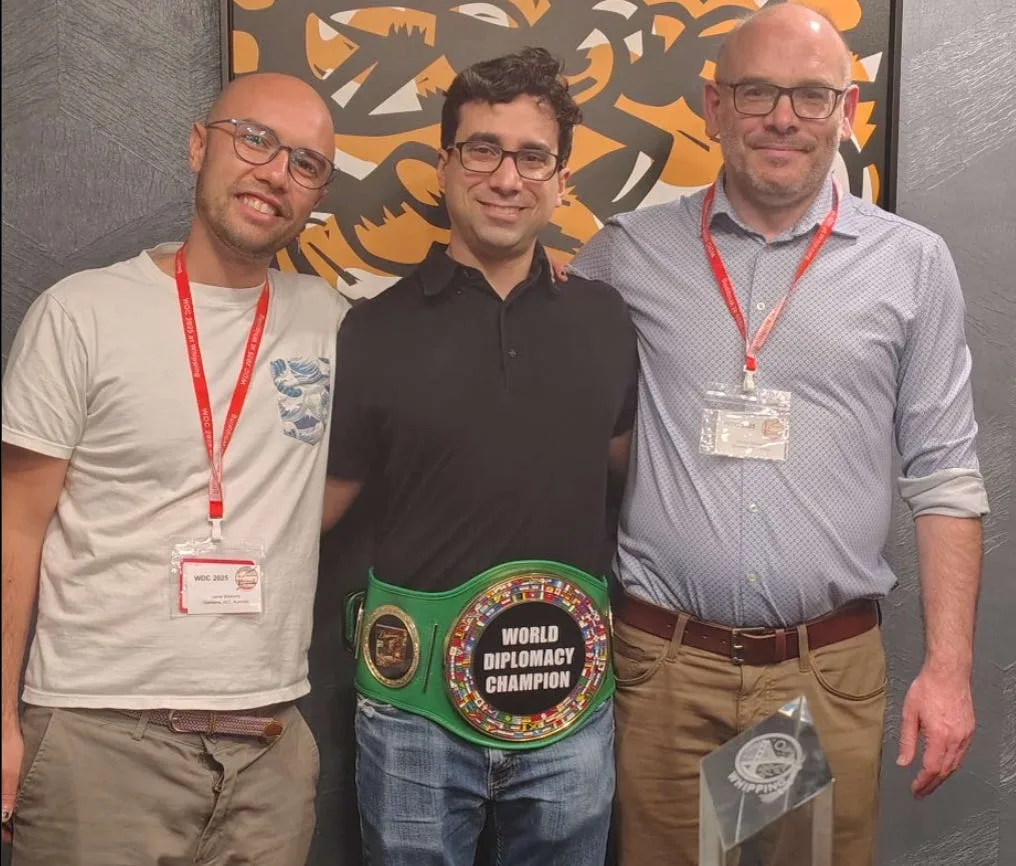
Published by Latent.Space; photographer not identified in the supplied source.
Public views: scaling agents beyond games
By June 2025, Brown favored improving general model capabilities over elaborate task-specific scaffolding. Discussing Pokémon evaluations, he preferred measuring how far o3 could get with minimal support—even if it performed poorly—rather than building a harness that concealed its limitations. He nevertheless acknowledged that scaffolds and routers could improve products immediately. He viewed reinforcement fine-tuning data as a more durable investment because it could also specialize future, stronger models.[16]
Brown cautions against assuming that AlphaGo’s self-play recipe transfers directly to general reasoning. Outside two-player zero-sum games, designers must decide what progress to optimize. A model posing difficult mathematics questions to another model could generate uninteresting challenges, such as lengthy multiplication, without advancing the capabilities people want. He also argued that research reports demonstrate reasoning can be useful where success is difficult to measure rather than easily verifiable.[16]
In the same interview, Brown described work on longer-duration reasoning and both collaborative and competitive multi-agent interaction. He proposed that large populations of AIs might accumulate capabilities through a civilization-like process. He also said his outlook had shifted from requiring explicit models of other agents toward expecting sufficiently capable models to learn such representations implicitly. These were his June 2025 research directions and hypotheses, rather than demonstrated results.[16]
Timeline
- role
Brown works at Facebook AI Research
Facebook AI Research[2]
From the Latent Space archive
Original posts and separately reviewed explanations.
Notes
- webDiplomacy carried a general notice about AI research, but participants were not explicitly informed that an AI was playing in their particular game. The team notified players after the experiments and sought consent for publication of their interactions. The reported ranking concerns the evaluated blitz league and participant group.[12]
Sources
- 1Noam BrownAccessed 2026-09-17
- 2Noam Brown — Curriculum VitaeAccessed 2026-09-17
- 3Noam Brown — Carnegie Mellon University degree recordAccessed 2026-09-17
- 4OpenAI o1 ContributionsAccessed 2026-09-17
- 5Learning to reason with LLMsAccessed 2026-09-17
- 6Superhuman AI for heads-up no-limit poker: Libratus beats top professionalsAccessed 2026-09-17
- 7Safe and Nested Subgame Solving for Imperfect-Information GamesAccessed 2026-09-17
- 8Carnegie Mellon Artificial Intelligence Beats Top Poker ProsAccessed 2026-09-17
- 9This Researcher Programmed the Perfect Poker-Playing ComputerAccessed 2026-09-17
- 10Carnegie Mellon and Facebook AI Beats Professionals in Six-Player PokerAccessed 2026-09-17
- 11
- 12
- 13CICERO — AI at MetaAccessed 2026-09-17
- 14facebookresearch/diplomacy_ciceroAccessed 2026-09-17
- 15
- 16Scaling Test Time Compute to Multi-Agent Civilizations: Noam BrownAccessed 2026-09-17
- 17WDC at Whipping 2025 Final ScoresAccessed 2026-09-17
- 18
Model source and teaching reviews passed. Human editorial review pending. This profile describes the sources as of 2026-09-17.