

Browse · People
Vipul Ved Prakash
Together AI co-founder focused on open, user-owned AI, efficient computing, and the economics of production inference.
Vipul Ved Prakash is a co-founder of Together AI, which identified him as founder and CEO in July 2026. He helped establish the company in June 2022 around a platform for open, independent, user-owned AI systems: infrastructure for open models and models that companies build and own themselves. His work at Together combines that commitment with decisions about research, computing efficiency, and accessible developer interfaces.[1][3]
Building an affordable platform for open AI
Prakash recalled discussing the cost of building models with Chris Ré before Together's founding. Their premise was that more efficient systems could reduce the capital required to train foundation models. Ré introduced him to Ce Zhang; Prakash said that within their first five minutes of conversation, he wanted to start the company. The early technical thesis involved compressing the communication needed to average gradients during distributed training, making cheaper GPUs across a network more usable. Prakash credited Zhang's decade of communication research with supplying the foundation for that approach.[1]
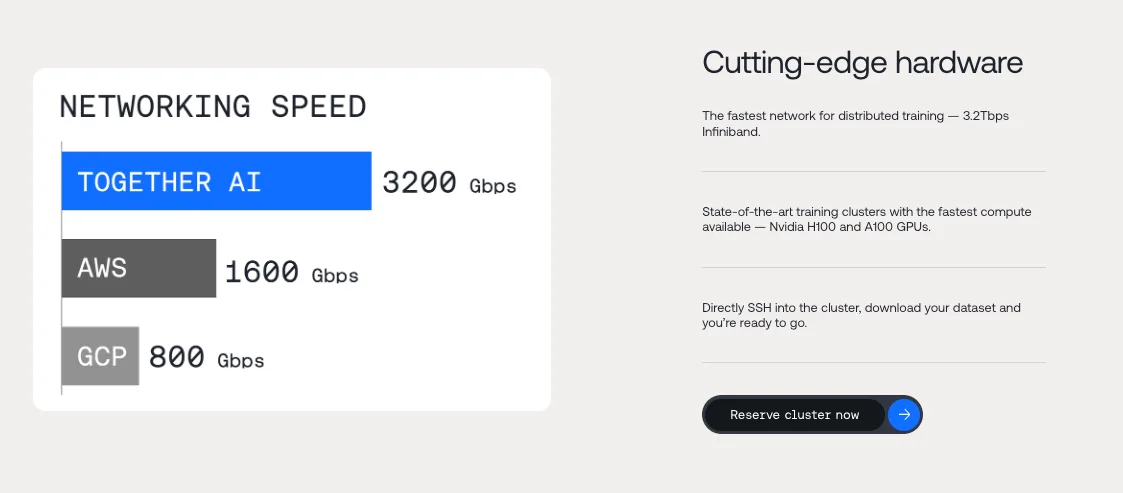
Published by Latent.Space in its February 2024 Together AI interview; screenshot presents Together AI marketing.
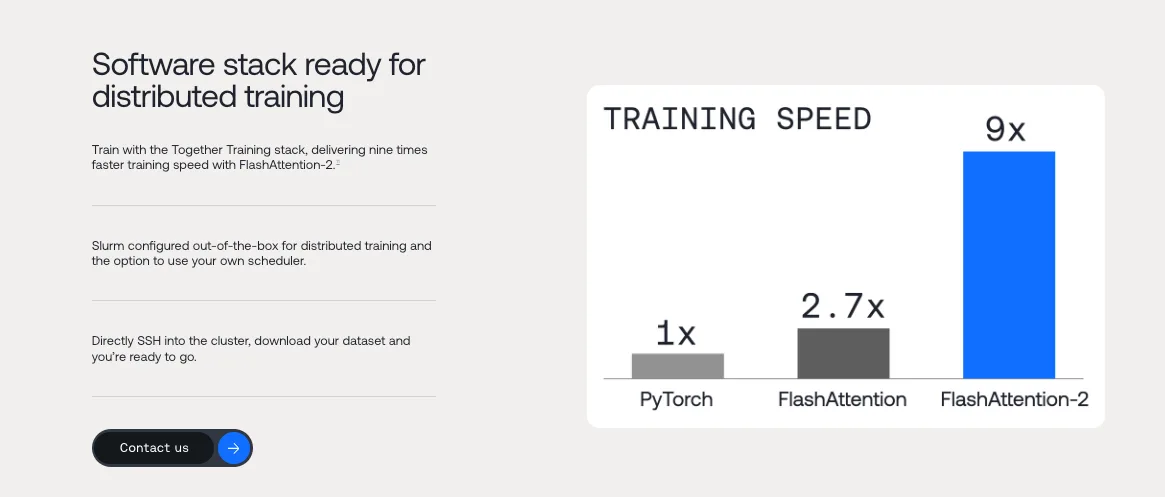
Screenshot reproduced in Latent Space’s February 2024 Together AI interview; original creator not identified.
In his February 2024 Latent Space interview with Zhang, Prakash treated data selection as part of making model development more efficient: a small target dataset could guide the selection of similar documents for training. Zhang explained the DSIR approach and associated it with Percy Liang's research. Prakash's emphasis was on making such methods available as tooling and recipes for customers building their own models.[1]
Prakash also supported research into transformer alternatives, setting an aspiration of 5,000 tokens per second in 2024. He doubted transformers alone would reach that target. His rationale extended beyond human reading speed: applications consume model outputs directly, faster generation can increase the number of applications served by a GPU, and near-immediate answers could enable different interfaces. The figure described a research goal, rather than demonstrated platform performance.[1]
His account of inference optimization emphasized matching configurations to particular models, hardware, batch sizes, and customer data streams. He described the stack as a combination of roughly 50 techniques, while observing that only some combinations compound into substantial gains. On the developer side, he advocated serverless inference and fine-tuning, with training as a further goal, so developers could begin using open models without committing thousands of dollars to compute.[1]
Openness and commercial decisions
Prakash distinguished broadly useful open research from software that gave Together a commercial advantage. In 2024, he said the company published work such as FlashAttention and FlashDecoding while retaining some inference-stack components to compete on price and performance. He described those choices as revisitable: “this is the piece that is closed for today and it may not be the case six months from now.”[1]
In his July 1, 2026 announcement, Prakash argued that agents performing continuous production work made inference economics increasingly consequential. He located those economics across models, kernels, compilers, inference systems, training infrastructure, and hardware utilization. He announced $800 million in Series C funding for Together alongside separate commitments for more than 500 MW of compute capacity to be capitalized independently by new investors. Those commitments represented planned capacity, rather than installed infrastructure.[4]
Benchmarking, data, and advanced intelligence
Following a dispute over Anyscale's inference comparisons, Prakash said in February 2024 that its team had good intentions and advocated a common industry benchmark run by an independent party. He identified concrete measurement problems: time to first token depends on where a test originates, while service load varies with the time of day and between weekdays and weekends. His proposal was to measure those conditions well enough to make comparisons useful to customers and providers.[1]
Prakash proposed data marketplaces as one possible way to connect data owners with model builders, arguing that fairer value sharing could give creators an incentive to participate. He treated this as an unresolved problem. In the same interview, he called for a positive or realistic framework, developed by experts, for understanding a world with advanced intelligence systems. He argued that such a framework could help guide the industry's direction beyond dystopian scenarios drawn from science fiction.[1]
Earlier foundations: Razor, Cloudmark, Topsy, and Apple
Before Together, Prakash worked on open-source software and commercial products. He created the collaborative spam filter Vipul's Razor and recalled building his first company, Cloudmark, around both open-source and commercial offerings. Apache's historical Razor documentation credits Prakash and Jordan Ritter with the Razor database: Unix clients shared the database used by commercial Cloudmark customers, reporting spam and checking message fingerprints.[1][6]
His self-presented Wellfound career profile lists founder, CEO, and CTO roles at Topsy during 2007–2013, followed by a senior director role at Apple during 2013–2018. Prakash said Apple's ability to hide complex technology behind fluid, simple experiences informed Together's developer platforms.[5][1]
At Apple, Prakash recalled his team building an open-domain question-answering system based on a Facebook LSTM paper from 2016. He contrasted it with a complicated information-retrieval system that, in his account, worked less well. The team's LSTM implementation took a week, he recalled, and its performance impressed him. He described that experience, along with the emergence of scaling laws, as crystallizing his sense of deep learning's importance.[1]
Timeline
- role
Serves as Topsy founder, CEO and CTO, per his career profile
His self-presented Wellfound career profile lists founder, CEO, and CTO roles at Topsy during 2007–2013, followed by a senior director role at Apple during 2013–2018.[5] - role
Serves as Apple senior director, per his career profile
His self-presented Wellfound career profile lists founder, CEO, and CTO roles at Topsy during 2007–2013, followed by a senior director role at Apple during 2013–2018.[5] - founding
Helps establish Together AI around open, user-owned models
He helped establish the company in June 2022 around a platform for open, independent, user-owned AI systems: infrastructure for open models and models that companies build and own themselves.[1] - research
Advocates targeted data selection for efficient model development
In his February 2024 Latent Space interview with Zhang, Prakash treated data selection as part of making model development more efficient: a small target dataset could guide the selection of similar documents for training.[1] - funding
Announces Together’s $800 million Series C and separate planned compute commitments
In his July 1, 2026 announcement, Prakash argued that agents performing continuous production work made inference economics increasingly consequential. He located those economics across models, kernels, compilers, inference systems, training infrastructure, and hardware utilization. He announced $800 million in Series C funding for Together alongside separate commitments for more than 500 MW of compute capacity to be capitalized independently by new investors. Those commitments represented planned capacity, rather than installed infrastructure.[4]
Financing
Together AI Series C
He announced $800 million in Series C funding for Together alongside separate commitments for more than 500 MW of compute capacity to be capitalized independently by new investors.[4]
Separate compute-capacity commitments
He announced $800 million in Series C funding for Together alongside separate commitments for more than 500 MW of compute capacity to be capitalized independently by new investors. Those commitments represented planned capacity, rather than installed infrastructure.[4]
From the Latent Space archive
Original posts and separately reviewed explanations.
Sources
- 1
- 2
- 3Together AI at RAISE SummitAccessed 2026-09-20
- 4Announcing our $800M Series C to accelerate the shift to open-source AIAccessed 2026-09-20
- 5Vipul Ved Prakash | WellfoundAccessed 2026-09-20
- 6UsingRazor - SPAMASSASSIN - Apache Software FoundationAccessed 2026-09-20
Model source and teaching reviews passed. Human editorial review pending. This profile describes the sources as of 2026-09-20.