

Browse · People
Vibhu Sapra
AI educator and community organizer whose work connects foundational research, reasoning models and practical questions about interpretability.
Vibhu Sapra helps AI engineers understand research through Latent Space Paper Club, conference presentations and technical interviews. At AI Engineer World's Fair 2025, he announced Test of Time Paper Club, a proposed foundational curriculum alongside the existing weekly discussion of new papers. He also guest-hosted Latent Space’s June 6, 2025 interpretability episode with Emmanuel Ameisen, whose publisher thanked him for making the conversation happen.[8][3]
Building a foundation beyond new releases
Sapra designed the proposed second club around a question: what does someone need to understand to be a good AI engineer? The original club would continue covering current papers, with presentations, author visits and Q&A. Test of Time would group enduring concepts into structured sessions: attention and optimizers, language-model foundations, training and distillation, and practical techniques such as speculative decoding and FlashAttention. Speech and image sessions would connect papers including Whisper, CLIP and Stable Diffusion.[8]
In his World’s Fair presentation, Sapra proposed weekly San Francisco gatherings with remote participation, invited paper recommendations and volunteer presenters, and said he would assemble a rough schedule. He wanted discussion to go deeper than a brief summary, while distinguishing the format from a hands-on course: “This is still a Paper Club.” These were announced plans rather than a record of completed sessions.[8]
Sapra emphasized shared ownership. He credited Eugene Yan as an original-club host and a contributor to the proposed evaluation coverage, and recognized regular contributors Eugene, Era, RJ and Flo, remote volunteers, visiting authors, Sam and swyx. His conference participation also included hosting the SWE-Agents track at AI Engineer World's Fair 2025.[8][2]
Reasoning, interpretability and practical limits
In his 2025 DeepSeek walkthrough, Sapra explained test-time scaling as allowing different queries to consume different amounts of computation before an answer. He distinguished reinforcement learning used to develop reasoning behavior from distillation that transfers a larger model’s reasoning traces into smaller Qwen and Llama models through supervised fine-tuning. He also separated model quality from access to its training process and hosted service: he noted the absence of training data and code, and revised his earlier enthusiasm about the API’s speed and price after finding it unreliable.[8]
As an interpretability co-host, Sapra pressed Ameisen on what discovering model features makes possible: “Finding features is cool. But what can we do about it?” He followed that practical question with methodological ones—how features receive names, how those interpretations are validated, whether labeling can be automated, and how findings feed back into training and architecture. His questions about extended reasoning also addressed how interpretability should handle models that generate long sequences rather than a single answer token.[1]
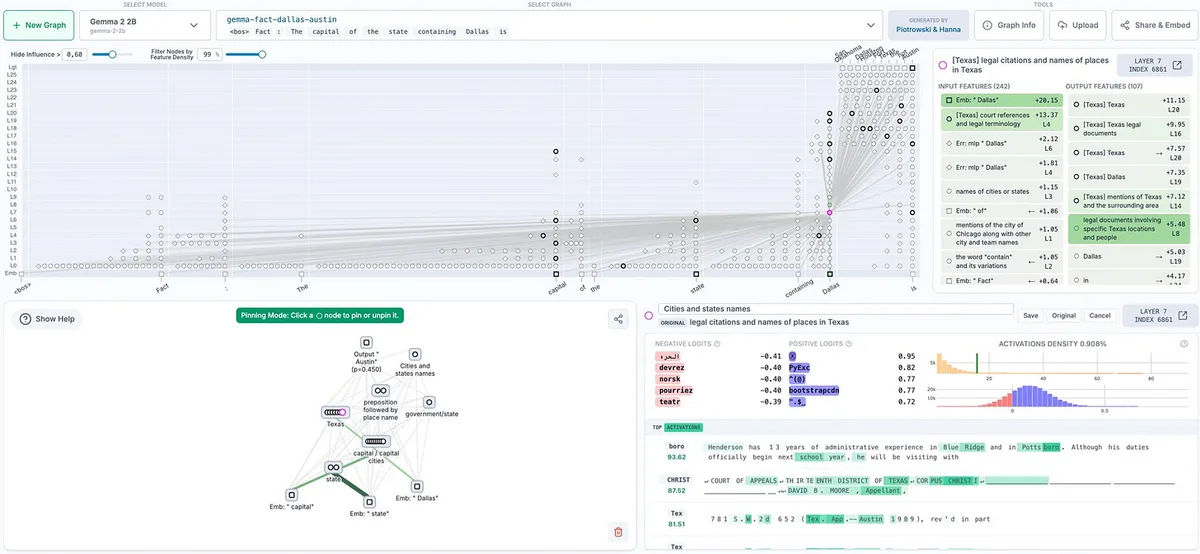
Latent.Space; Neuronpedia interface.
Sapra asked whether a model’s tendency to work backward from a supplied answer might differ between base models and models post-trained with reinforcement learning. Ameisen had not performed that comparison and offered a different hypothesis: next-token pretraining could itself encourage exploiting hints. Their exchange left the training-stage explanation open rather than establishing reinforcement learning as the cause.[1]
Earlier foundations: production NLP and developer education
Before these 2025 education and interview activities, Sapra worked on applied language models. A June 13, 2020 San Diego Machine Learning listing identified him as Byrd.ai’s founder and described his development of NLP models for production text summarization. His scheduled introduction to summarization and topic segmentation included applications, code examples and contemporary models. This earlier work supplies context for his later technical explanations of language-model behavior.[6][1]
Sapra recalled an economics and data-science background, followed by basic machine learning and LLM work as the field emerged. By March 28, 2024, an AGI Builders Meetup agenda identified him with Developer Relations at MindsDB and scheduled a presentation on building open-source AI applications with real-time data.[1][7]
As of September 20, 2026, Open Source Campus listed Sapra as Chief Scientist.[5]
Timeline
- milestone
Production NLP work documented at Byrd.ai
A June 13, 2020 San Diego Machine Learning listing identified him as Byrd.ai’s founder and described his development of NLP models for production text summarization.[6] - milestone
Scheduled to present on open-source AI with real-time data
By March 28, 2024, an AGI Builders Meetup agenda identified him with Developer Relations at MindsDB and scheduled a presentation on building open-source AI applications with real-time data.[7] - milestone
Announces proposed Test of Time Paper Club
At AI Engineer World's Fair 2025, he announced Test of Time Paper Club, a proposed foundational curriculum alongside the existing weekly discussion of new papers.[8] - milestone
Guest-hosts Emmanuel Ameisen on interpretability
He also guest-hosted Latent Space’s June 6, 2025 interpretability episode with Emmanuel Ameisen, whose publisher thanked him for making the conversation happen.[3]
From the Latent Space archive
Original posts and separately reviewed explanations.
The Utility of Interpretability — Emmanuel Amiesen
Grounded writeupThe Utility of Interpretability — Part 1 of 3
Grounded writeupThe Utility of Interpretability, Part 2 of 3: From Copying to Hidden Plans
Grounded writeupThe Utility of Interpretability, Part 3 of 3: From Experiments to Explanations
Sources
- 1The Utility of Interpretability — Emmanuel Amiesen, AnthropicAccessed 2026-09-20
- 2AI Engineering Goes MainstreamAccessed 2026-09-20
- 3The Utility of Interpretability — Emmanuel AmiesenAccessed 2026-09-20
- 4
- 5About - oscV2.hostingersite.comAccessed 2026-09-20
- 6SanDiegoMachineLearning/talks: Presentations other than book club meetingsAccessed 2026-09-20
- 7AGI Builders Meetup SFAccessed 2026-09-20
- 8
Model source and teaching reviews passed. Human editorial review pending. This profile describes the sources as of 2026-09-20.