

Browse · People
Thomas Scialom
AI researcher whose work spans Llama post-training, learning from human preferences, tool-using language models and practical agent evaluation.
Thomas Scialom is an AI researcher whose contributions include Llama post-training and collaborative research on tool use and agent evaluation. In July 2024, he was Llama 2 lead and Llama 3 post-training lead at Meta/FAIR. His work includes Toolformer, which teaches language models to call APIs, and GAIA and Gaia2, benchmarks that test assistants on practical tasks and changing environments.[1][4][5][6]
Learning from judgments rather than imitation
During Llama 2, Scialom was responsible for an annotation budget he recalled as running into millions of dollars. He initially favored collecting more human-written examples for supervised fine-tuning, alongside preference judgments for reinforcement learning with human feedback (RLHF). An early evaluation changed his understanding: he recalled that model responses often surpassed the human-written target answers, even after the team checked the annotators’ work.[1]
Scialom explains preference learning through the difference between creating an answer and recognizing a better one. Someone who struggles to write a haiku may still reliably choose between two poems. In his account, learning from those choices lets a model favor its stronger responses rather than reproduce the mistakes in human-written examples. As he put it in his July 2024 Latent Space interview: “So I can actually annotate data beyond my own skills at creating them.”[1]
For Llama 3, Scialom said the team bootstrapped post-training with answers generated by the final Llama 2 model instead of commissioning another round of human-written answers. He described human-written answers as almost absent from that process; human preference judgments and corrections still had a role. He also described teacher critic: when both sampled responses are poor, an annotator edits the better response into a correct answer, combining preference annotation with a supervised training example.[1]
Deployment costs and evaluation judgment
Scialom’s “Chinchilla trap” argument distinguishes an optimal training run from an efficient model to deploy. Training-compute calculations balance model size against training tokens; inference costs still depend on model size, while the number of tokens used to train it no longer enters each inference call. He therefore argues for spending more training compute on a smaller model when repeated use matters. His qualification is explicit: Chinchilla was not wrong, but deployment requires considering costs beyond training. He also sees large models as useful sources of better annotation data that can improve smaller models.[1]
In July 2024, Scialom described evaluating post-training through reward models, model judges, diverse prompts and benchmarks, human comparisons and his own prompt testing. He cautioned that optimizing a benchmark can make it harder to tell whether gains transfer. He also advocated measuring appropriate abstention: in his hypothetical example, two models answer half the questions correctly, but he prefers the one that says it does not know on many remaining questions over one that confidently answers everything. This was an evaluation proposal, rather than a reported benchmark implementation.[1]
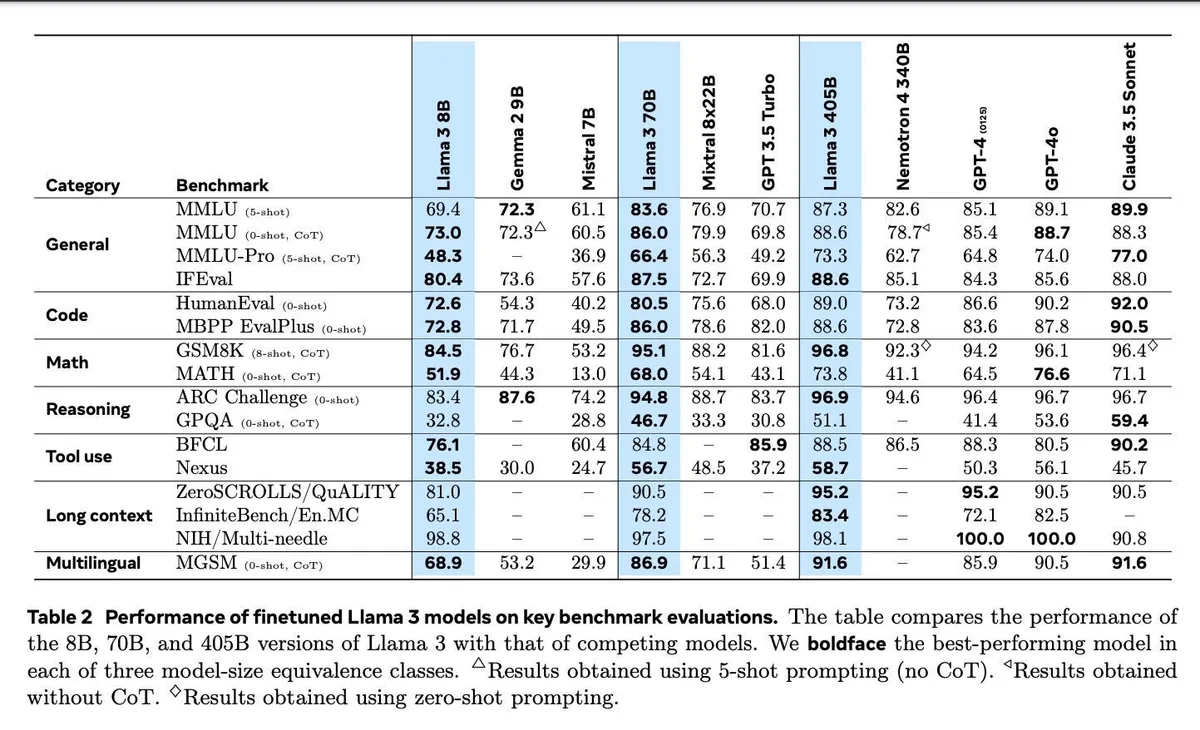
Published in Latent Space’s July 23, 2024 interview article; original table creator is not identified in the supplied evidence.
Tools and practical agent evaluation, 2023–2026
Scialom coauthored Toolformer, submitted in February 2023, with Timo Schick, Jane Dwivedi-Yu, Roberto Dessì, Roberta Raileanu, Maria Lomeli, Luke Zettlemoyer and Nicola Cancedda. The model learns which APIs to call, when to invoke them, what arguments to supply and how to incorporate results into subsequent token prediction. Its self-supervised approach needs only a handful of demonstrations per API; the tools include a calculator, question answering, search, translation and a calendar.[4]
In November 2023, Scialom coauthored GAIA with Grégoire Mialon, Clémentine Fourrier, Craig Swift, Thomas Wolf and Yann LeCun. Its questions combine reasoning, multimodal handling, browsing and tool use while remaining conceptually simple for humans. The paper reported 92% performance for its human respondents versus 15% for GPT-4 equipped with plugins. That historical comparison illustrates the benchmark’s emphasis on everyday robustness, rather than increasingly specialized questions that are difficult for people.[5]
Scialom connected this agent research to his Llama work in the 2024 interview: without a strong instruction-following model, he believed Toolformer’s extension would be limited. After Llama 3, he said he would return to agents, with interests in planning, backtracking, web navigation and code execution. He presented these as research directions, including the possibility of training models to think before producing an answer or taking an action.[1]
By February 2026, Scialom was one of 24 coauthors of Gaia2, with Romain Froger listed first. Gaia2 tests agents in asynchronous environments that evolve independently of their actions, requiring them to meet time constraints, handle noisy events, resolve ambiguity and collaborate. Built on Agents Research Environments, it pairs scenarios with write-action verifiers, allowing action-level evaluation and reinforcement learning from verifiable rewards.[6]
Earlier foundations: trading, doctoral research and Galactica
Before these large-model and agent projects, Scialom worked in quantitative trading. He recalled that AlphaGo prompted him to study machine learning, first through a six-month executive program and then through an industrial PhD with reciTAL and Sorbonne University. He described the choice of natural language generation and reinforcement learning as contingent on an offered research topic, rather than a prediction of the field’s later importance.[1]
Scialom defended Natural Language Generation with Reinforcement Learning on June 7, 2022. His supervisors were Patrick Gallinari, Benjamin Piwowarski and Sylvain Lamprier, with Jacopo Staiano as corporate supervisor at reciTAL. The thesis addressed exposure bias—the mismatch between training on supplied preceding tokens and generating from a model’s own outputs—and automatic evaluation that poorly reflects human judgment. It explored question-answering metrics as reinforcement-learning rewards, learned discriminator rewards and combining Monte Carlo Tree Search with generative adversarial networks. These were earlier investigations of training and evaluation problems that also appear in his later work.[7]
Scialom recalled beginning work on BLOOM before joining Meta, while explicitly saying he was not a main contributor. Galactica was his first major Meta project. He then worked on Galactica Instruct, including an Overleaf integration for editing LaTeX tables and inserting citations; he said it was not opened publicly following the Galactica backlash. He described Galactica Instruct as Meta’s first annotation project for RLHF. Llama 2 followed, starting from Llama 1 and work with Guillaume Lample on instruction following and chat, with Hugo Touvron also a collaborator.[1]
Scialom’s advice to AI founders follows his expectation that model capabilities will keep improving: build a business that benefits from a better next generation, rather than relying on a current weakness remaining defensible. His formulation in July 2024 was: “If your business will benefit from a new generation with better abilities, that's a good business.”[1]
Timeline
- education
Defends thesis on language generation with reinforcement learning
Scialom defended Natural Language Generation with Reinforcement Learning on June 7, 2022.[7] - research
Coauthors Toolformer on teaching language models to use APIs
Scialom coauthored Toolformer, submitted in February 2023[4] - research
Coauthors GAIA for practical assistant evaluation
In November 2023, Scialom coauthored GAIA[5] - research
Coauthors Gaia2 for agents in dynamic, asynchronous environments
By February 2026, Scialom was one of 24 coauthors of Gaia2, with Romain Froger listed first.[6]
From the Latent Space archive
Original posts and separately reviewed explanations.
Sources
- 1Llama 2, 3 & 4: Synthetic Data, RLHF, Agents on the path to Open Source AGIAccessed 2026-09-20
- 2
- 3ThomasNLG (Scialom)Accessed 2026-09-20
- 4Toolformer: Language Models Can Teach Themselves to Use ToolsAccessed 2026-09-20
- 5GAIA: a benchmark for General AI AssistantsAccessed 2026-09-20
- 6Gaia2: Benchmarking LLM Agents on Dynamic and Asynchronous EnvironmentsAccessed 2026-09-20
- 7SCIALOM ThomasAccessed 2026-09-20
Model source and teaching reviews passed. Human editorial review pending. This profile describes the sources as of 2026-09-20.