

works at · as of 2026-09-29
Browse · People
Person · Latent Space wiki
Thariq Shihipar
Engineer on Anthropic’s Claude Code team whose public work explains how to adapt agent context, verify generated software, and keep human judgment involved.
Thariq Shihipar is a member of technical staff at Anthropic working on Claude Code. His authored work explains how the team uses skills and changes agent context as models become more capable; his own workflows emphasize readable plans, interactive references, and showing reviewers the decisions behind generated code.[5][6][4][11]
Adapting context to model capabilities
In his July 2026 context-engineering article, Shihipar reported that the Claude Code team removed over 80% of its system prompt for models such as Claude Opus 5 and Claude Fable 5, with no measurable loss on its coding evaluations. He described accumulated instructions as overconstraining the model: system prompts, skills, and user requests could give conflicting advice about such details as whether to add comments.[6]
The changes replaced blanket comment restrictions with guidance to match the surrounding code’s comment density, naming, and idiom. The team moved verification and code review into skills that Claude could call selectively, deferred some tool definitions until needed, and put tool-use instructions in tool descriptions instead of repeating them in the system prompt. Shihipar recommended lightweight repository guidance focused on local gotchas, with detailed information in files the agent could load when relevant.[6]
In his September 2026 interview with Ryan Peterman, Shihipar described this reduction as sustained work by several people: removing lines, running evaluations, gathering internal reports, and adjusting behavior. He also emphasized the limits of existing evaluations: “There’s no eval for Claude telling you to go to sleep.” The example illustrated the need to catch newly emerging behavior alongside benchmark results.[11]
Skills, verification, and autonomous workflows
Shihipar’s June 2026 account of internal skills treats a skill as a folder of instructions, scripts, and resources. He recommends adding knowledge that changes the model’s behavior rather than restating what it already knows, accumulating gotchas from actual failures, and letting the agent discover detailed references as needed. Reusable scripts let the model compose operations instead of reconstructing boilerplate; session-scoped hooks can impose extra restrictions for particular tasks.[5]
He reported that verification skills had the most measurable impact on output quality internally, without supplying a numerical effect size. His examples include recordings of the agent testing a feature and programmatic assertions on state at each step. He also described Anthropic’s organic distribution process: engineers share experimental skills, move those that gain traction into an internal marketplace, and use a PreToolUse hook to identify popular skills or ones invoked less often than expected.[5]
In the Peterman interview, Shihipar defined loop engineering as setting up a system that prompts Claude. He argued that autonomous workflows require useful skills, appropriate data sources, and strong verification—and that establishing them is an investment whose value must justify the work. He also resisted treating generated code as a clean measure of autonomy: a designer’s Figma file or an engineer’s specification may contain substantial human work before the agent begins implementation.[11]
Keeping human judgment in the loop
Shihipar’s article on HTML outputs, published in May 2026, explains a personal response to increasingly capable agents: he noticed he was reading plans less closely and wanted to remain engaged with Claude’s choices. He prefers HTML for its diagrams, visual organization, browser sharing, and interactive controls. His planning workflow produces explorations, mockups, and implementation plans, then passes those files to a new implementation session and uses them as verification references.[4]
He also recommends temporary editors built for a particular problem—for example, arranging tickets or tuning animation parameters—with an export that returns the user’s choices to Claude Code as JSON, a prompt, or a diff. His accompanying HTML example repository contains standalone pages requiring no build step or dependencies. It is unmaintained sample code, and its scenarios and figures are fictional illustrations.[4][9]
For code review, Shihipar says he usually attaches an artifact containing his prompts and failed approaches to a pull request, allowing reviewers to see the alternatives considered. He labels one-shot results as such. His broader view is that technical knowledge and domain expertise remain essential to judging generated work: knowing whether software is good requires understanding systems and their constraints, even when the model performs the implementation.[11]
At the 2026 AI Engineer World’s Fair, Shihipar described model development as a process of discovery through use. Richard MacManus’s July 2 account quoted him saying, “The models are grown, not developed,” and “We sort of figure out and learn with the model as we use it.”[1]
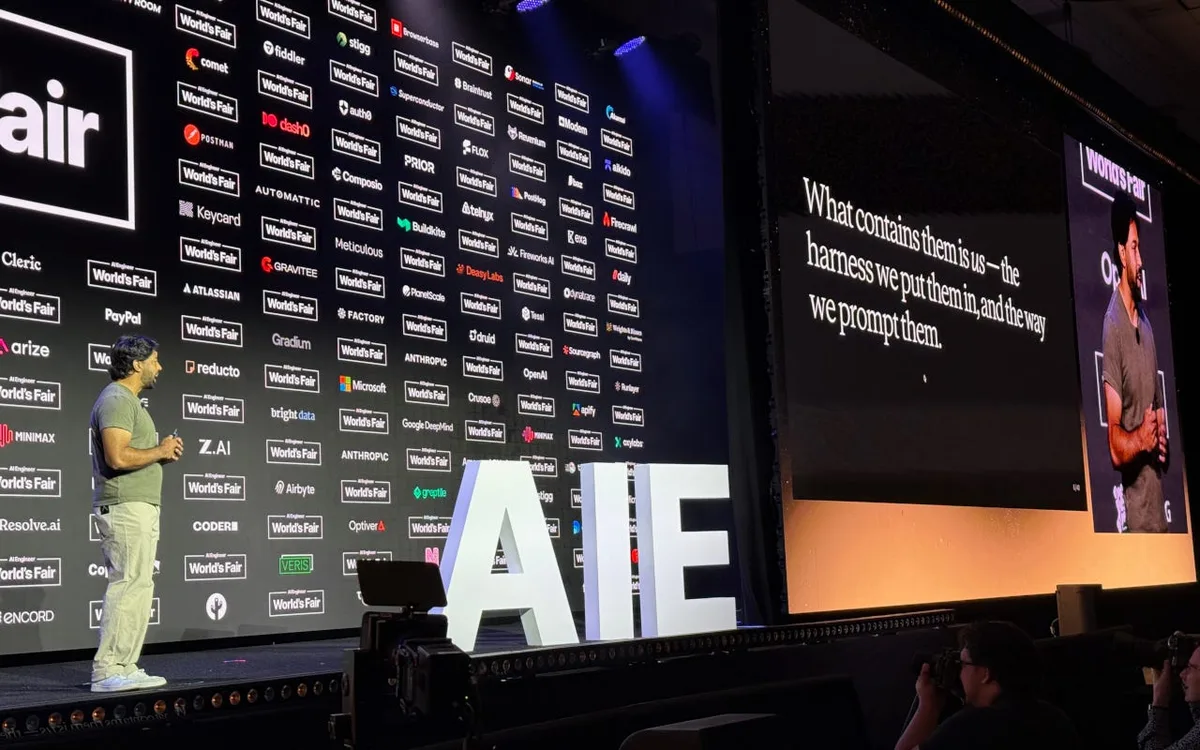
Latent.Space; photographer not identified in the supplied source.
Earlier AI work and the route to Anthropic
Before these Claude Code accounts, Shihipar explored developer control over models. In his November 2024 interpretability essay, he presented feature steering as a possible route to finer control over style, preferences, and inference-time interventions. His analogy—“Steering is like brain surgery, prompting is like asking politely.”—accompanied warnings that overweighting features could produce incoherent output, labels could be misunderstood, and interacting features could create side effects. He regarded consistent reliability as an unresolved limitation.[8]
In February 2025, he proposed combining LLM comparisons with the existing TrueSkill rating method to sort items by semantic criteria. The model repeatedly orders small batches; those results update each item’s estimated rating and uncertainty; the final ranking uses the conservative estimate μ − 3σ. His illustrative application was ranking customer feedback by actionability. He argued that this approach could accommodate new items incrementally without re-sorting the entire collection.[7]
Shihipar later recalled that a Goodfire fellowship in applied interpretability research helped him reach Anthropic. He built and publicly shared an interpretability visualization; people contacted him after seeing it, and he received an introduction to a role at Anthropic. He uses that experience to support his advice to engineers to build interesting projects, ship them, and write about the work.[11]
Earlier publishing and entrepreneurship
Shihipar’s career before this AI work included publishing platforms and gaming businesses. His personal site describes graduate study at the MIT Media Lab, cofounding PubPub, running the YC-backed gaming company One More Multiverse, and building the gaming analytics platform Edgeout.gg, which was sold to blitz.gg. It also identifies Chime as a startup he cofounded during undergraduate study that was acquired by HubSpot.[3]
In a February 15, 2018 PubPub description, Shihipar and Travis Rich presented a collaborative, evolving publishing platform supporting both static PDFs and text or illustrations that could be programs. They described working with MIT Press on active journals and books and a shared goal of improving PubPub to support full real-world publishing pipelines. This earlier work provides context for his experience with interactive documents before his later writing on agent-generated HTML.[10][4]
Checking what an agent is trying to do
In a September 2026 Latent Space interview, Shihipar described safeguards that act at different stages of an agent run. Model training can teach a refusal, while inference-time probes examine internal activations and feed a classifier that can trigger a fallback. He said those probes add cost and latency and can produce false positives; he did not present them as a complete way to read intent.[12]
He distinguished those checks from Claude Code’s Auto Mode, which evaluates proposed actions against user permissions. For example, an agent might use computer access to create a new key and change a production database while pursuing a task. A permission check should reject the write if the user did not authorize it. Shihipar also described identity and access controls as additional layers, while acknowledging that failures at any layer can still matter.[12]
Timeline
- research
Explores feature steering for developer control
In his November 2024 interpretability essay, he presented feature steering as a possible route to finer control over style, preferences, and inference-time interventions.[8] - research
Proposes semantic sorting with LLMs and TrueSkill
In February 2025, he proposed combining LLM comparisons with the existing TrueSkill rating method to sort items by semantic criteria.[7] - milestone
Uses interactive HTML to stay engaged with agent decisions
Shihipar’s article on HTML outputs, published in May 2026, explains a personal response to increasingly capable agents: he noticed he was reading plans less closely and wanted to remain engaged with Claude’s choices.[4] - milestone
Explains Claude Code’s internal skills practices
Shihipar’s June 2026 account of internal skills treats a skill as a folder of instructions, scripts, and resources.[5] - milestone
Reports Claude Code’s system-prompt reduction
In his July 2026 context-engineering article, Shihipar reported that the Claude Code team removed over 80% of its system prompt for models such as Claude Opus 5 and Claude Fable 5, with no measurable loss on its coding evaluations.[6] - milestone
Explains the collaborative work behind context reduction
In his September 2026 interview with Ryan Peterman, Shihipar described this reduction as sustained work by several people: removing lines, running evaluations, gathering internal reports, and adjusting behavior.[11]
From the Latent Space archive
Original posts and separately reviewed explanations.
Sources
- 1
- 25 Trends That Defined AI Engineering at World’s Fair 2026Accessed 2026-09-20
- 3Home • Thariq ShihiparAccessed 2026-09-20
- 4Using Claude Code: The unreasonable effectiveness of HTMLAccessed 2026-09-20
- 5Lessons from building Claude Code: How we use skillsAccessed 2026-09-20
- 6The new rules of context engineering for Claude 5 generation modelsAccessed 2026-09-20
- 7LLM-Powered Sorting with TrueSkillAccessed 2026-09-20
- 8Should Developers Care about Interpretability?Accessed 2026-09-20
- 9ThariqS/html-effectivenessAccessed 2026-09-20
- 10PubPub · Viral CommunicationsAccessed 2026-09-20
- 11How Anthropic Builds And How Engineering Will Change Soon | Thariq ShihiparAccessed 2026-09-20
- 12Claude Code’s Next Era — Thariq Shihipar, AnthropicAccessed 2026-10-18
Model source and teaching reviews passed. Human editorial review pending. This profile describes the sources as of 2026-10-18.