

Browse · People
Surya Dantuluri
Developer of ChatWithPDF and Archon, whose work spans document retrieval, computer-use model training and the economics of AI applications.
Surya Dantuluri builds AI applications and trains models for computer interaction. He created ChatWithPDF and developed Archon, a computer copilot that separates reasoning about a task from locating interface elements. His personal website, marked last updated August 2026, identifies him as Head of Labs at Long Lake and lists the handles sdan and sdand.[3][5][7]
Archon: separating planning from clicking
In “Teaching GPT-5 to Use a Computer”, dated August 12, 2025, Dantuluri described Archon's four-stage pipeline: user intent → planner → grounding → executor. GPT-5 selects a semantic action, such as clicking a blue Submit button; prava-fc-small takes that description and a screenshot and returns exact pixel coordinates. This divides the expensive problem of deciding what to do from the narrower problem of finding where to click.[7]
Dantuluri trained prava-fc-small, a fine-tuned vision transformer, with Group Relative Policy Optimization (GRPO). Clicks received a binary reward: one when they landed inside the target interface element, zero otherwise. He expanded human demonstrations into related trajectories by varying timing, interface states and interaction patterns.[7]
To reduce repeated visual computation, he cached patch embeddings and reconstructed differences between successive frames, preserving full resolution for important interface regions while downsampling others. A grounding-only fast path avoided planner calls; the router escalated when interactive regions were hard to distinguish, several targets competed, recent clicks failed or text was ambiguous—for example, multiple Submit buttons. He reported approximately 50 milliseconds per action on an A100 for this fast path.[7]
The system had concrete limits. Dantuluri reported that it struggled with bright red buttons despite handling tiny blue ones, and suspected skewed training data. A racing-game demonstration followed instructions but failed to win because of latency. Continuous frame streaming and distilling solved plans into a local executor remained proposed next steps in his August 2025 account.[7]
Models, experience and productivity
In “Training Imperative”, published September 8, 2025, Dantuluri argued that AI application companies would eventually train their own models, including those beginning as API wrappers. He identified data efficiency and reinforcement learning as the opportunity: applications could collect interaction trajectories and become training environments. His case for computer use was that “Every software interface becomes an environment and every set of actions becomes experience data.”[8]
He proposed Token Factor Productivity, defined as economic output value divided by tokens consumed, to measure useful work rather than usage alone. In this framing, model ownership matters because application companies can optimize the value produced by their own models and interaction data.[8]
Before Archon, Dantuluri built document-retrieval plugins for ChatGPT. That earlier work involved both implementing retrieval and finding ways to distribute and monetize an application inside another company's interface.[5][6][1]
Earlier work: ChatGPT plugins in 2023
Dantuluri's ChatWithPDF project record dates the project to April 2023. Its documentation describes loading publicly accessible PDF URLs, processing their contents and returning semantic matches within ChatGPT, with embeddings stored in ChromaDB. The documentation distinguished PDF deletion from embedding retention: embeddings were wiped on deployment and typically purged manually every 12–24 hours because of size and memory constraints.[5][6]
In his retrospective account, Dantuluri said he monetized his plugins through context-sensitive prompts containing Stripe links rendered as Markdown, using the user's context to encourage payment. In his November 2023 Latent Space interview, he explained that he built custom monetization infrastructure to avoid a 10 percent platform fee. He also recalled that wanting help with homework initially motivated him to make a plugin.[5][1]
At OpenAI DevDay, he worried that the new GPT interface would require existing plugin users to rediscover his work. Nevertheless, he favored GPTs as a better abstraction, highlighting shareable links, improved discoverability, custom instructions and announced revenue sharing. He described the plugins as a side project rather than full-time work. The disappearance he observed concerned the event's new interface; later in the episode, Rahul Sonwalkar said plugins had been accidentally switched off and restored.[1]
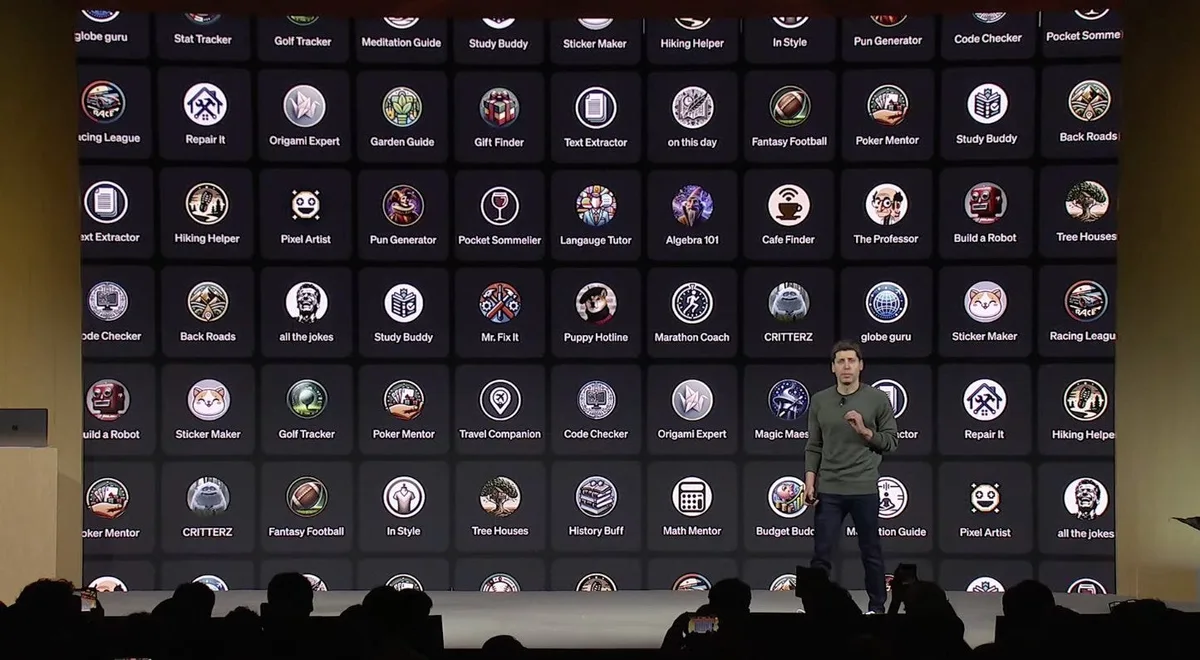
Published by Latent.Space in its OpenAI DevDay recap; original photographer not identified.
Historical foundations: GPT-2 in 2019
Going further back, Dantuluri's NotRealNews.net account, dated October 2019, describes an early model-serving experiment. He fine-tuned GPT-2 on hundreds of thousands of news articles and ran GPT-2 124M inference through Google Colab notebooks across eight Google accounts. Generated articles went to four Raspberry Pis running Ghost. He recalled that the project made him think about efficient, cost-effective model deployment.[9]
Dantuluri described the experiment's question as “could a small LLM spread fake news cheaply and easily?” He recalled users sharing generated articles based on headlines and preview images, often without reading to the bottom. He subsequently made an effort to de-index the project's pages because of AI-safety concerns.[9]
Timeline
- project
Builds ChatWithPDF for document retrieval in ChatGPT
Dantuluri's ChatWithPDF project record dates the project to April 2023.[5] - project
Explains Archon's separation of planning and click grounding
In “Teaching GPT-5 to Use a Computer”, dated August 12, 2025, Dantuluri described Archon's four-stage pipeline: user intent → planner → grounding → executor.[7] - milestone
Argues that AI application companies will train their own models
In “Training Imperative”, published September 8, 2025, Dantuluri argued that AI application companies would eventually train their own models, including those beginning as API wrappers.[8]
From the Latent Space archive
Original posts and separately reviewed explanations.
AGI is Being Achieved Incrementally (OpenAI DevDay w/ Simon Willison, Alex Volkov, Jim Fan, Raza Habib, Shreya Rajpal, Rahul Ligma, et al)
Grounded writeupAfter DevDay: Open Models, Faster Tools, and the Work of Building — Part 4 of 4
Grounded writeupFrom Assistant Demos to Dependable Systems — DevDay, Part 3 of 4
Grounded writeupOpenAI DevDay, Part 1 of 4: Managed State, Shared Context, and the Cost of Control
Grounded writeupOpenAI DevDay, Part 2 of 4: From Configuring Bots to Running Workflows
Sources
- 1
- 2AGI is Being Achieved Incrementally (DevDay Recap - cleaned audio)Accessed 2026-09-20
- 3Surya DantuluriAccessed 2026-09-20
- 4ChatWith+Accessed 2026-09-20
- 5ChatWithPDFAccessed 2026-09-20
- 6ChatWith+ — ChatWithPDFAccessed 2026-09-20
- 7Teaching GPT-5 to Use a ComputerAccessed 2026-09-20
- 8Training ImperativeAccessed 2026-09-20
- 9NotRealNews.netAccessed 2026-09-20
Model source and teaching reviews passed. Human editorial review pending. This profile describes the sources as of 2026-09-20.