

Browse · People
Suhail Doshi
Playground founder and image-generation research coauthor whose work combines model development with visual editing tools.
Suhail Doshi founded Playground to build an AI-first graphics editor that went beyond typing a prompt and receiving an image. He helped direct the decision to train Playground v2 from scratch and later coauthored the Playground v2.5 and v3 research papers. Previously, he cofounded Mixpanel with Tim Trefren and served as its CEO.[1][3][4][5]
Beyond the prompt box
In his December 2023 Latent Space interview, Doshi described choosing graphics because it offered room for a powerful visual interface. Early generative tools often consisted of a text box and settings; he wanted interactions suited to visual work, such as masking an object to remove it or expanding an image without elaborate instructions. He also deliberately pursued a tool that initially attracted hobbyists, believing that playful experimentation could develop into more useful editing capabilities.[1]
That judgment shaped Playground’s preview rendering feature. Rather than concentrate on demonstrations where a drawing continuously becomes a generated image, the team used fast consistency-based generation to show a rough preview before the user requested a final render. Doshi compared it with viewport rendering in established graphics tools: the preview gave users an early sense of the result and reduced repeated blind attempts. Playground also made prompt expansion optional, accommodating both experienced users who wanted control and newcomers who wanted help.[1]
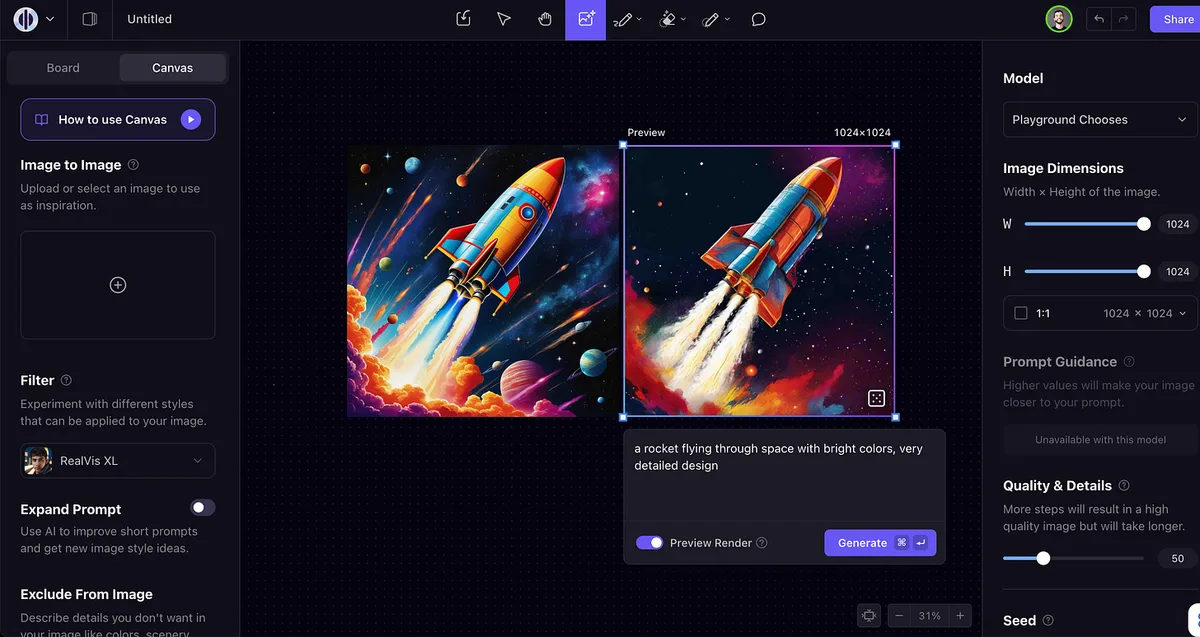
Screenshot published by Latent.Space in “The AI-First Graphics Editor - with Suhail Doshi of Playground AI.”
Doshi distinguished attractive generation from precise editing through a family example. His wife wanted to make their son smile in a holiday-card photograph by highlighting his mouth and asking for the change. In December 2023, he said existing inpainting often produced crooked results or artifacts even after repeated attempts. The request illustrated the fidelity and coherence he wanted from future tools; it was not a feature he claimed Playground had solved.[1]
Training models and preserving community tools
Doshi considered image foundation models underdeveloped for practical graphics work. Explaining Playground’s decision to train models from scratch, he asked, “do we wait for progress to occur or do we make that progress happen?” He described improvement as a combination of caption quality, dataset selection and filtering, alignment data, and systems engineering. The team also released 256-pixel and 512-pixel pretrained stages, which he hoped would let academic researchers experiment despite limited GPU access.[1]

Latent.Space; original image creator not identified in the supplied source.
Playground v2 deliberately retained SDXL’s architecture so users could adapt tools already built by the community. As Doshi explained, “We didn't want to fragment the community with different architectures.” He viewed LoRAs as a scalable way for users to develop distinctive artistic styles. He credited a collaborator named Simu with bringing LoRAs to Stable Diffusion and said Simu worked with Playground on some projects, explicitly distinguishing that contribution from inventing LoRA.[1]
Doshi’s evaluation philosophy emphasized comparison with strong alternatives and usefulness to users. In December 2023, he regarded Midjourney as the strongest image-generation product and argued for comparing against it even when Playground lost. He considered FID useful only up to a point and wanted evaluations that captured failures in lighting, color, subjects, and detailed edits. He proposed gathering post-generation user feedback to build benchmarks closer to real-world performance.[1]
Doshi coauthored Playground v2.5, submitted on February 27, 2024, with Daiqing Li, Aleks Kamko, Ehsan Akhgari, Ali Sabet, and Linmiao Xu. Their work examined three routes to better aesthetic quality: diffusion noise schedules affecting color, contrast, and visual fidelity; balanced bucketed datasets supporting different aspect ratios; and alignment with human preferences to improve human-centric details.[3]
He also coauthored Playground v3 with Bingchen Liu, Ehsan Akhgari, Alexander Visheratin, Aleks Kamko, Linmiao Xu, Shivam Shrirao, Chase Lambert, Joao Souza, and Daiqing Li. Initially submitted on September 16, 2024, and revised on October 21, the paper describes text conditioning exclusively through a decoder-only large language model. The team developed a captioner producing descriptions at different levels of detail and introduced CapsBench to evaluate detailed image captioning. The authors also reported RGB color control and multilingual understanding.[4]
Before Playground, Doshi’s work at Mixpanel and Mighty gave him experience with machine learning, large-scale infrastructure, and the limits of moving computation into data centers.[1]
Earlier work: Mixpanel and Mighty
Doshi cofounded Mixpanel with Tim Trefren; the analytics platform launched in 2009. He recalled that around 2015 or 2016, a four- or five-person machine-learning team developed churn prediction, conversion prediction, and anomaly detection. Much of the work relied on logistic regression, and he felt the results were not particularly groundbreaking. During that period, he took fast.ai courses to learn machine learning.[5][1]
At Mighty, Doshi pursued a browser streamed from a data center at very low latency, with the larger ambition of creating a new kind of computer. In his retrospective account, he abandoned that ambition because web applications depended heavily on single-threaded JavaScript, while single-core CPU performance was improving too slowly to deliver what he wanted. He believed an enterprise business might have been possible, but it would not have fulfilled the original objective. AI models renewed his interest in remote computation because they were designed for massively parallel execution.[1]
Doshi continued learning through implementation. In December 2023, he said, “I always find that just writing code helps cement my internal understanding.” His advice to self-taught founders was to choose an exciting project, build it, and learn its details along the way—including model training when the project required that understanding.[1]
Timeline
- milestone
Mixpanel launches after Doshi cofounds it with Tim Trefren
Doshi cofounded Mixpanel with Tim Trefren; the analytics platform launched in 2009.[5] - research
Coauthors Playground v2.5 research on aesthetic quality
Doshi coauthored Playground v2.5, submitted on February 27, 2024, with Daiqing Li, Aleks Kamko, Ehsan Akhgari, Ali Sabet, and Linmiao Xu.[3] - research
Coauthors Playground v3 research using LLM text conditioning
He also coauthored Playground v3 with Bingchen Liu, Ehsan Akhgari, Alexander Visheratin, Aleks Kamko, Linmiao Xu, Shivam Shrirao, Chase Lambert, Joao Souza, and Daiqing Li. Initially submitted on September 16, 2024, and revised on October 21, the paper describes text conditioning exclusively through a decoder-only large language model.[4]
From the Latent Space archive
Original posts and separately reviewed explanations.
Sources
- 1The AI-First Graphics Editor - with Suhail Doshi of Playground AIAccessed 2026-09-20
- 2Playground: Make graphics like a Pro without being one | Y CombinatorAccessed 2026-09-20
- 3
- 4
- 5Mixpanel + AI: Behavioral analytics with AI-powered insightsAccessed 2026-09-20
Model source and teaching reviews passed. Human editorial review pending. This profile describes the sources as of 2026-09-20.