

co-founded · as of 2026-09-15
Browse · People
Person · Latent Space wiki
Shreya Rajpal
Creator of Guardrails and co-founder of Guardrails AI, Shreya Rajpal develops ways to specify, validate and test language-model behavior in real applications.
Shreya Rajpal created Guardrails and co-founded Guardrails AI with Zayd Simjee. Her work addresses a practical AI engineering problem: a plausible model answer can still violate the requirements of the application using it. Guardrails makes those requirements explicit and checks inputs and outputs against them; her team's later product, Snowglobe, tests multi-turn agent conversations. In September 2026, Harvey announced its acquisition of Guardrails AI, saying the founders and their team would join its product and engineering organization and begin work on Applied AI initiatives.[1][2][9]n1
From late-2022 experiments to Guardrails
Rajpal traced Guardrails to experiments with her own LLM applications in late 2022. She found that prompting offered too little control over outputs and the resulting user experience, and wanted a tool for specifying and enforcing the constraints she cared about. By May 16, 2023, she had left Predibase to work full time on Guardrails. She said her conviction that reliability would limit production use gave her the confidence to quit.[1]
One early decision concerned how developers should express requirements. Rajpal initially tried Python classes but found them too verbose. XML-like markup let her separate field descriptions and validity criteria from nested child fields, and attach different failure handlers to individual fields. She drew on HTML-style event handling and embedded scripting, while aiming for an interface approachable to people accustomed to plain-English prompts.[1]
Rajpal continued revising that interface with users and collaborators. In May 2023, she described a forthcoming code-first API being developed through an RFC and community input, and said reported failures and feature requests generally took priority over her own feature list. The later Guardrails repository documents structured generation from Pydantic models—Python classes describing expected fields and types—with schemas supplied through function calling or added to the prompt.[1][6]
Application-specific correctness
Rajpal distinguishes a model's general capabilities from an application's definition of success. In her InfoQ interview, published in January 2024, she said, “There's no universal definition of what correctness is”. A validator checks a particular requirement; a guard combines validators around inputs or outputs. She deliberately placed these checks outside the generator so developers could change models while retaining application-level requirements.[2]
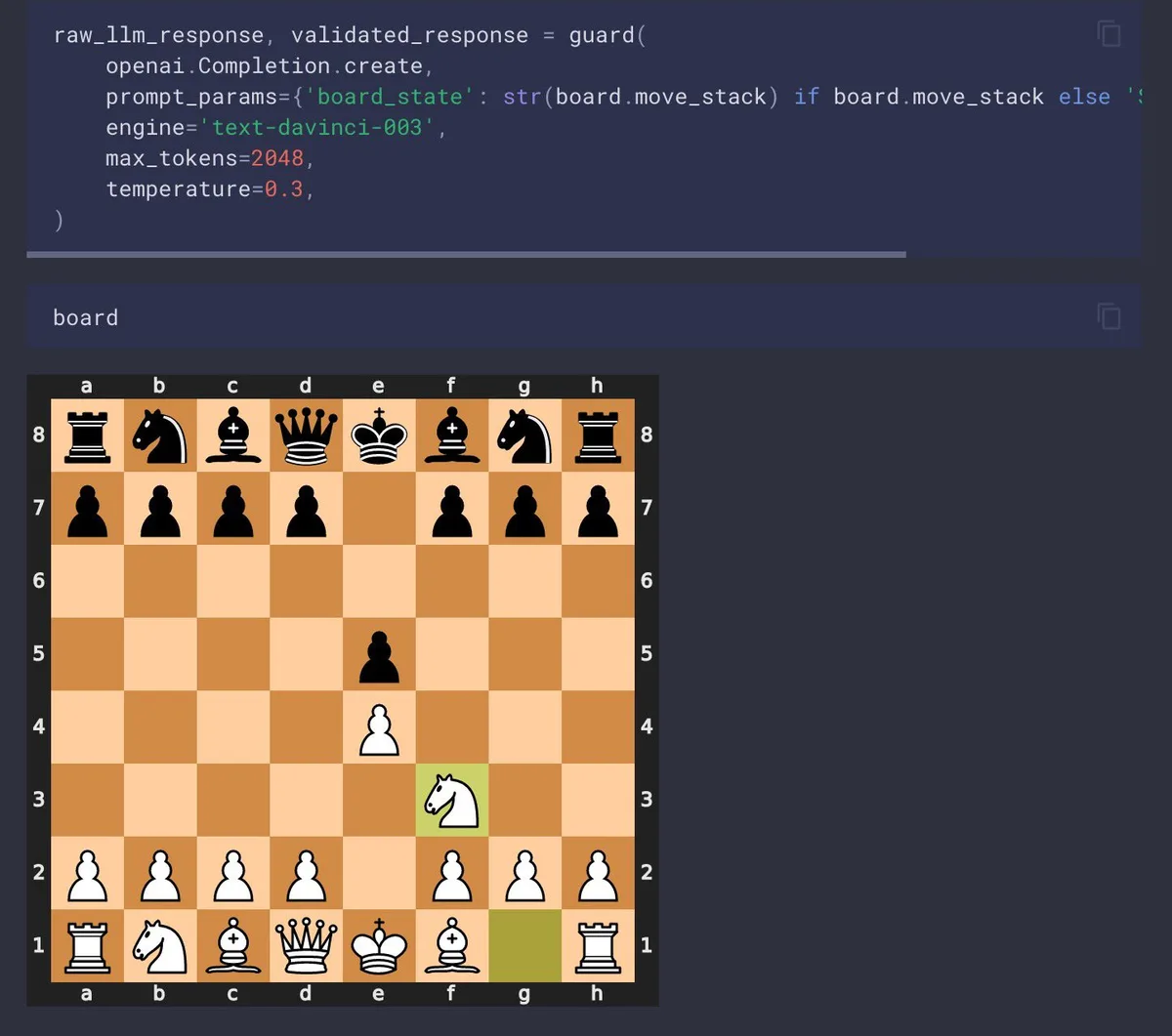
Latent.Space, “Guaranteed quality and structure in LLM outputs,” May 16, 2023.
Checks can use rules, machine-learning models or external APIs. A regular expression checks whether a string matches a required format. Grounding checks compare an answer with trusted documents using embedding similarity, LLM self-evaluation or natural language inference. These methods offer different assurances: satisfying a format rule or passing a semantic check does not establish universal correctness.[2]
A concrete early example was generated SQL. Rajpal described a validator that executes a query in a sandbox, packages execution errors and optionally returns them to the model for correction. This gives a retry a specific failure to address, although executability alone does not establish that the query answers the user's question. She also proposed repairing simpler errors programmatically—for example, matching an incorrect table name against existing names—to avoid another expensive model call.[1]
Rajpal made re-asking a core design principle: give the model its failed output and explanatory feedback, then verify the revised answer. Correction can be limited to failed fields or sentences. She also emphasized that validation adds runtime cost and latency, so failure policies should reflect the risk. Her illustrative healthcare-support example favored withholding a response and escalating to a human when suspected medical advice would be unacceptable.[2]
Developer visibility was another priority. Rajpal built notebook-friendly logs showing prompts, raw outputs, validation results and corrective actions while using Guardrails herself. Her broader advice was to combine LLMs with rules, heuristics and traditional ML around the desired task and outcome. In her November 2023 DevDay conversation, she emphasized retrieval quality in retrieval-augmented generation and described checking hallucinations, conflicting instructions and terse responses.[1][11]
Shared validators and conversational simulation
In her signed February 2024 Guardrails Hub announcement, Rajpal advocated a shared collection where developers could find, build and combine validators. Composition let applications assemble checks for their particular requirements. A July 2026 repository notice later announced a move to standard PyPI validator packages and discontinuation of hosted remote inferencing.[5][6]n2
Rajpal's team developed Snowglobe, launched in August 2025, to simulate conversational-agent behavior before deployment. It generates persona-driven, stateful conversations grounded in an application's context, including varied ordinary users rather than exclusively adversarial interactions, and supports exporting scenarios as datasets.[7][9]
Snowglobe's tool-simulation documentation describes registering tools, instrumenting agent code and running a local process so persona-driven conversations can exercise tool calls and dynamically mock their responses. This extends testing from an individual output to behavior over a sequence of interactions; the documented tool capability is in beta.[8]n3
The announced move to Harvey
The Harvey acquisition placed the team's validation and simulation work in professional legal workflows. In her statement accompanying the announcement, Rajpal identified the difficult part of shipping AI as “knowing how it behaves on the inputs nobody thought to test.” She explained the direction by pointing to the stakes of professional work: “We want to solve this problem where the standard is highest.”[9]
Before Guardrails, Rajpal worked in autonomous-driving perception and ML infrastructure. That earlier experience supplied concrete examples for her later argument that learned components need checks at their interfaces.[1][4]
Earlier career: perception, Apple and Predibase
Rajpal completed a computer-science master's at the University of Illinois, advised by David Forsyth and Aditya Parameswaran, before working as a computer vision engineer on Drive.ai's Perception team. She subsequently worked in Apple's Special Projects Group and became a founding engineer at Predibase, where she led the ML infrastructure team.[3][1][4]
At Apple, Rajpal worked with Ian Goodfellow as her manager. She recalled that, while pair programming during her first or second week, he quickly asked colleagues on Slack for help with setup problems. His example changed her assumption that she should solve a problem alone before seeking assistance. As she put it in her May 2023 Latent Space interview, “my job is not like to solve this myself. My job is to solve this period.” She also credited his creative technical feedback.[1]
Timeline
- project
LLM application experiments inspire Guardrails
Rajpal traced Guardrails to experiments with her own LLM applications in late 2022.[1] - role
Leaves Predibase to work full time on Guardrails
By May 16, 2023, she had left Predibase to work full time on Guardrails.[1] - project
Advocates shared validators through Guardrails Hub
In her signed February 2024 Guardrails Hub announcement, Rajpal advocated a shared collection where developers could find, build and combine validators.[5] - milestone
Harvey announces Guardrails AI acquisition and planned team move
In September 2026, Harvey announced its acquisition of Guardrails AI, saying the founders and their team would join its product and engineering organization and begin work on Applied AI initiatives.[9]
From the Latent Space archive
Original posts and separately reviewed explanations.
Conversation
Guaranteed quality and structure in LLM outputs - with Shreya Rajpal of Guardrails AI
ConversationAGI is Being Achieved Incrementally (OpenAI DevDay w/ Simon Willison, Alex Volkov, Jim Fan, Raza Habib, Shreya Rajpal, Rahul Ligma, et al)
Grounded writeupAfter DevDay: Open Models, Faster Tools, and the Work of Building — Part 4 of 4
Grounded writeupFrom Assistant Demos to Dependable Systems — DevDay, Part 3 of 4
Grounded writeupGuardrails: turning LLM outputs into application contracts
Grounded writeupOpenAI DevDay, Part 1 of 4: Managed State, Shared Context, and the Cost of Control
Grounded writeupOpenAI DevDay, Part 2 of 4: From Configuring Bots to Running Workflows
Notes
- Harvey's announcement is dated September 9, 2026; Guardrails' syndicated copy displays September 8. The announcement says the founders and team will join Harvey, without specifying Rajpal's individual title or a legal closing date.[9][10]
- The July 6, 2026 repository notice specified August 25 as the planned cutoff for hosted remote inferencing.[6]
- The documented beta tool simulation requires access to agent source code and Snowglobe Connect SDK v0.6.0 or later.[8]
Sources
- 1
- 2Shreya Rajpal on Guardrails for Large Language ModelsAccessed 2026-09-17
- 3Shreya Rajpal — AboutAccessed 2026-09-17
- 4Shreya Rajpal | TWIML - The Voice of Machine Learning & AIAccessed 2026-09-17
- 5
- 6guardrails-ai/guardrailsAccessed 2026-09-17
- 7Introducing SnowglobeAccessed 2026-09-17
- 8Agent Simulation with Tools (Beta)Accessed 2026-09-17
- 9Guardrails AI Joins HarveyAccessed 2026-09-17
- 10Guardrails AI Joins Harvey — Guardrails copyAccessed 2026-09-17
- 11AGI is Being Achieved Incrementally — OpenAI DevDayAccessed 2026-09-17
Model source and teaching reviews passed. Human editorial review pending. This profile describes the sources as of 2026-09-23.