

Browse · People
Sander Schulhoff
Founder of Learn Prompting and co-author of The Prompt Report and HackAPrompt, working on prompting methods, adversarial attacks, and reproducible evaluation.
Sander Schulhoff is the founder and CEO of Learn Prompting and CEO of HackAPrompt. His work combines prompt-engineering education with collaborative research: organizing prompting techniques in The Prompt Report and studying adversarial prompts through HackAPrompt.[3][4][5]
The Prompt Report: organizing prompting methods
Schulhoff is the first-listed author of The Prompt Report: A Systematic Survey of Prompt Engineering Techniques, first submitted on June 6, 2024. In his September 2024 interview, he said he led a 30-person research team over about nine months. The February 2025 revision sets out 33 vocabulary terms, 58 LLM prompting techniques, and 40 techniques for other modalities, alongside practical guidance and a meta-analysis of natural-language prefix-prompting.[4][1]
Schulhoff explained that the team classified text prompting methods by problem-solving strategy rather than application. Thought generation asks for intermediate reasoning; decomposition breaks a problem into subproblems to solve individually; ensembling combines multiple responses; self-criticism asks a model to critique and revise an answer. Because methods overlap, the team assigned primary labels to make the taxonomy clearer—for example, treating few-shot chain-of-thought chiefly as thought generation.[1]
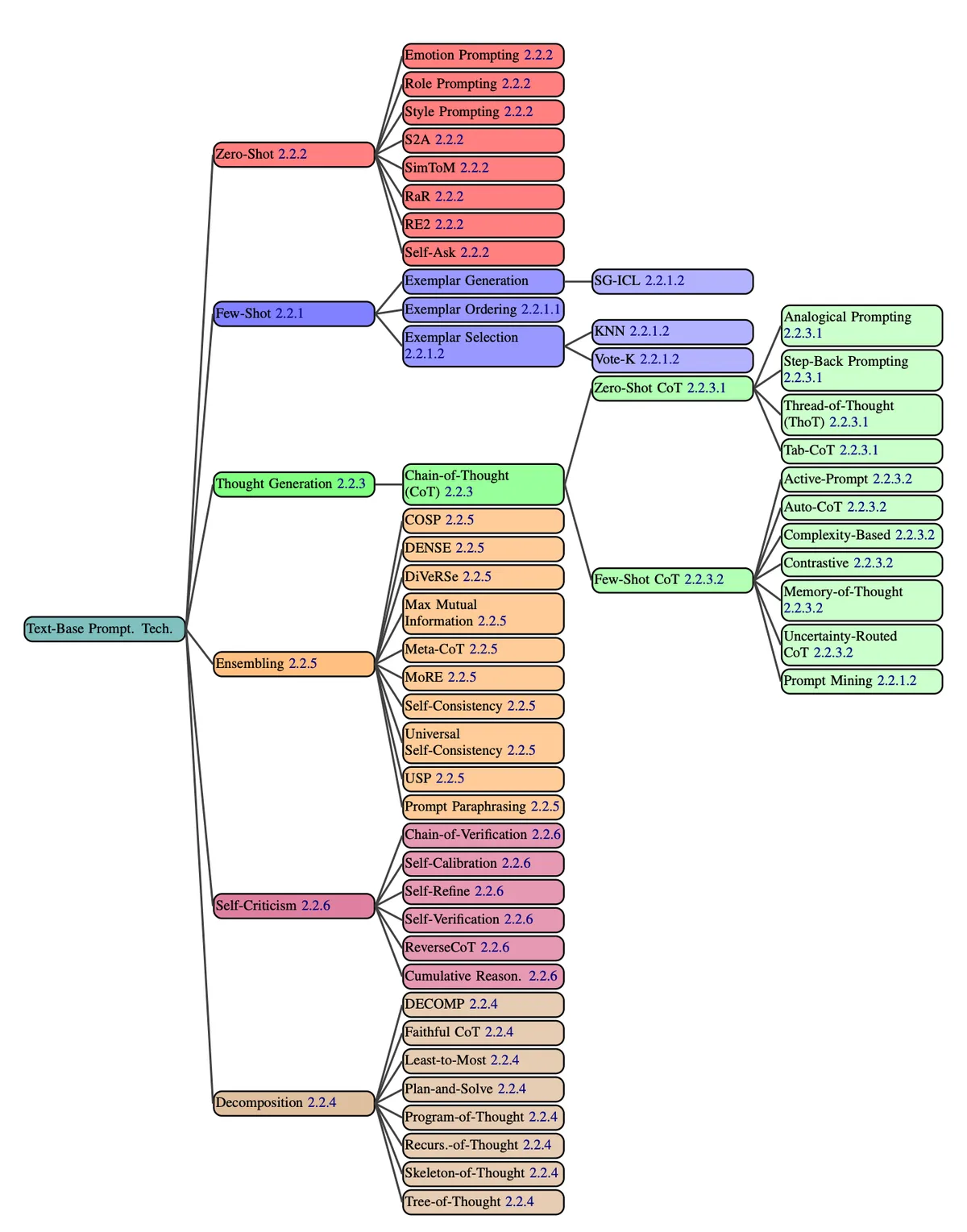
Published by Latent.Space in “The Ultimate Guide to Prompting.”
He described using the PRISMA systematic-review process and AI-assisted screening to decide which papers were relevant, with screening accuracy tested against human evaluations. The survey extended the work of Learn Prompting from collecting explanations on a website into a formal research synthesis.[1]
Prompting judgment and evaluation
A concrete experiment changed Schulhoff’s view of automated prompt optimization. In the September 2024 Latent Space interview, he recalled: “And then I spent 20 hours prompt engineering for a task and DSPy beat me in 10 minutes. And that's when I changed my mind.” He recommended DSPy while identifying a practical limitation: optimization needs ground-truth labels, making open-ended writing tasks harder to optimize.[1]
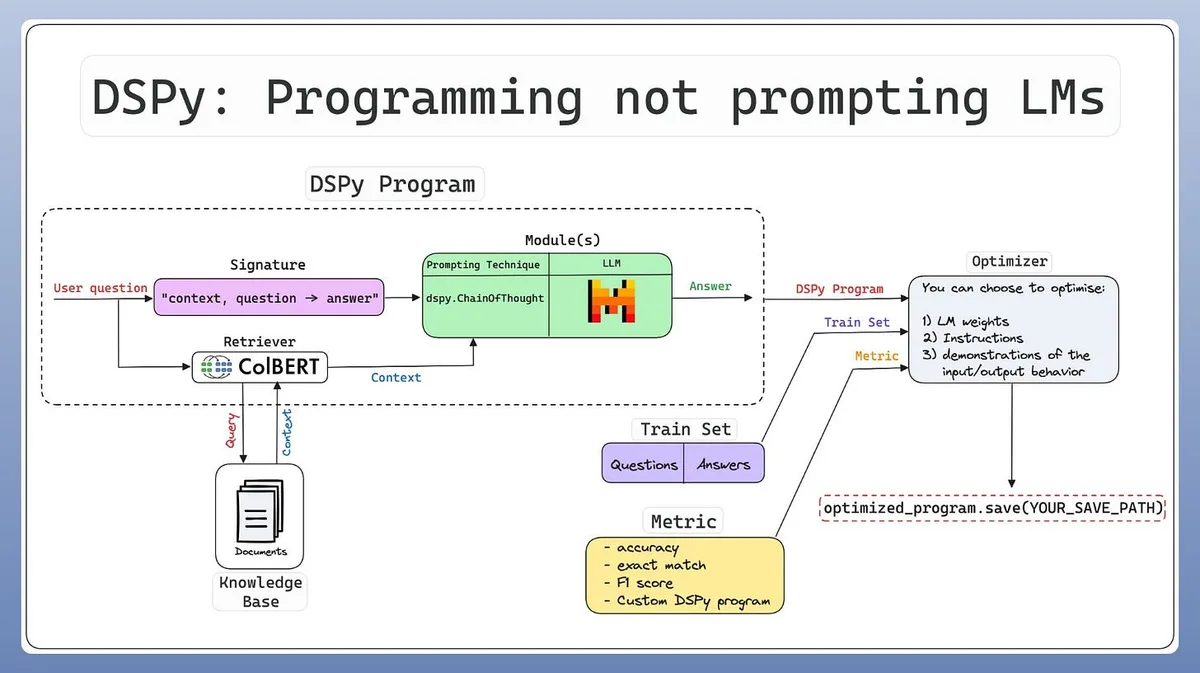
Published in Latent.Space, “The Ultimate Guide to Prompting”; diagram creator unspecified.
His skepticism about persona and emotion prompting was specifically about accuracy on modern GPT-4-class models. He accepted persona instructions for stylistic generation, such as speaking like a pirate, while questioning whether calling a model a math professor improves its answers. His preferred toolbox emphasized few-shot examples, chain-of-thought, and good information about the problem. For few-shot prompts, he recommended testing example order and using familiar input-output formats.[1]
For research tasks, Schulhoff said he often preferred direct API calls and custom code because hidden framework prompts make outputs harder to explain and experiments harder to reproduce. He also urged developers to give numerical evaluation scales explicit meanings rather than simply request a score from one to ten, and to evaluate the reliability of the scoring system itself—especially in sensitive domains such as medicine.[1]
He viewed prompt engineering primarily as a broadly useful skill: “I have always viewed prompt engineering as a skill that everybody should and will have rather than a specialized role to hire for.” He nevertheless acknowledged cases where an AI company benefits from a specialist who can answer customers’ prompting questions.[1]
HackAPrompt and adversarial research
Before The Prompt Report, Schulhoff organized HackAPrompt, which he recalled running in May 2023 after seeing early prompt-injection discussions by Simon Willison and Riley Goodside. The resulting EMNLP paper, published in December 2023, was co-authored with Jeremy Pinto, Anaum Khan, Louis-François Bouchard, Chenglei Si, and other collaborators. The authors reported collecting more than 600,000 adversarial prompts against three LLMs and presented an ontology of attack types.[1][5]
One unexpected competition technique, Schulhoff recalled, was context overflow. Participants needed a model to output only the required target phrase, but its extra commentary could fail the challenge. They used long filler prompts followed by malicious instructions to leave little room for a response, exploiting the context-window limit to cut off unwanted continuation. He credited the competition’s community and experimentation with uncovering behavior he had not anticipated.[1]
Schulhoff also credited Willison’s clarification of prompt injection with helping him recognize a definition error and revise the HackAPrompt paper. By September 2024, he used “prompt hacking” as a catch-all amid conflicting terminology. He continued the competition work: the June 2025 AI Engineer World’s Fair recap credits him with launching HackAPrompt AIE during conference week.[1][2]
Earlier foundations: Diplomacy, MineRL, and Learn Prompting
Schulhoff’s earlier college work supplies context for both his prompting research and competition experience. He recalled working at Maryland on Diplomacy with Denis Peskov and professor Jordan Boyd-Graber, mainly building data-collection and machine-learning infrastructure. Separately, while trying to build a custom Minecraft reinforcement-learning environment with MineRL, he read its codebase, contributed missing documentation through a pull request, and subsequently joined the team for about a year.[1][5]
During the Diplomacy work, he began prompting GPT-3 to translate between a game-specific bot language and English. He recalled turning his subsequent reading into an English-class instructional-guide assignment that became Learn Prompting. The organization dates the guide’s release to October 2022, before ChatGPT. It maintains a free, open-source guide alongside paid courses to support its operation; Fady Yanni is its co-founder and COO, and community contributors have helped build the resource.[1][3]
Timeline
- release
Learn Prompting guide released before ChatGPT
The organization dates the guide’s release to October 2022, before ChatGPT.[3] - project
Organizes the HackAPrompt competition
Before The Prompt Report, Schulhoff organized HackAPrompt, which he recalled running in May 2023 after seeing early prompt-injection discussions by Simon Willison and Riley Goodside.[1] - research
Co-authors HackAPrompt’s adversarial research paper
The resulting EMNLP paper, published in December 2023, was co-authored with Jeremy Pinto, Anaum Khan, Louis-François Bouchard, Chenglei Si, and other collaborators.[5] - research
The Prompt Report first submitted
Schulhoff is the first-listed author of The Prompt Report: A Systematic Survey of Prompt Engineering Techniques, first submitted on June 6, 2024.[4] - project
Launches HackAPrompt AIE at AI Engineer World’s Fair
the June 2025 AI Engineer World’s Fair recap credits him with launching HackAPrompt AIE during conference week.[2]
From the Latent Space archive
Original posts and separately reviewed explanations.
Sources
- 1The Ultimate Guide to PromptingAccessed 2026-09-20
- 2AI Engineering Goes MainstreamAccessed 2026-09-20
- 3Learn Prompting: Your Guide to Communicating with AIAccessed 2026-09-20
- 4The Prompt Report: A Systematic Survey of Prompt Engineering TechniquesAccessed 2026-09-20
- 5
Model source and teaching reviews passed. Human editorial review pending. This profile describes the sources as of 2026-09-20.