

Humanloop cofounder and former CEO · as of 2026-09-15
Browse · People
Person · Latent Space wiki
Raza Habib
Humanloop cofounder and former CEO whose work spans probabilistic machine learning, expert-guided model development and evaluation of language-model applications.
Raza Habib is a machine-learning researcher and the cofounder and former CEO of Humanloop. He helped shift the company from model-assisted data annotation toward tools for developing and evaluating language-model applications, opening its LLM product to developers in October 2022. His engineering advice emphasizes treating prompts as consequential application components and measuring success against the needs of a particular product. He joined Anthropic with his fellow executive cofounders in August 2025; Fundrise identified him as a Member of Technical Staff there in March 2026.[2][18][5][12][16]
The pre-ChatGPT decision to build for LLM applications
Habib and his collaborators initially built Humanloop around the shortage of annotated data and machine-learning expertise needed to apply NLP models. In his 2023 Latent Space interview, he described BERT and ULMFiT as important demonstrations that models pretrained on unlabeled text could be adapted to useful tasks. GPT-3’s in-context learning suggested that applications would need far fewer task-specific labels; InstructGPT made that approach feel practical. He also argued that active learning was difficult to package for customers bringing their own models.[1]
Changing direction meant leaving a product that, Habib recalled, already had paying customers and was growing. The team tested mockups of prompt-development and evaluation tools against a concrete threshold: ten paying design partners within two weeks. In a June 2024 interview published by Y Combinator, a Humanloop backer, he said they reached that threshold in two days. He recalled prospective users stitching together spreadsheets, Grafana, Mixpanel and the OpenAI Playground to version prompts, collaborate and assess subjective outputs.[1][5][10]
On 5 October 2022, Habib announced access to Humanloop for developers building with models such as GPT-3. His framing was concise: “Demos are easy but products are hard”. The product connected feedback to logged generations and their model configurations, compared prompts and models against chosen user outcomes, and let teams select fine-tuning data using that feedback. The shift also changed the intended user: from specialist ML engineers toward engineers focused on building useful products, often working alongside product managers and domain experts.[18][1]
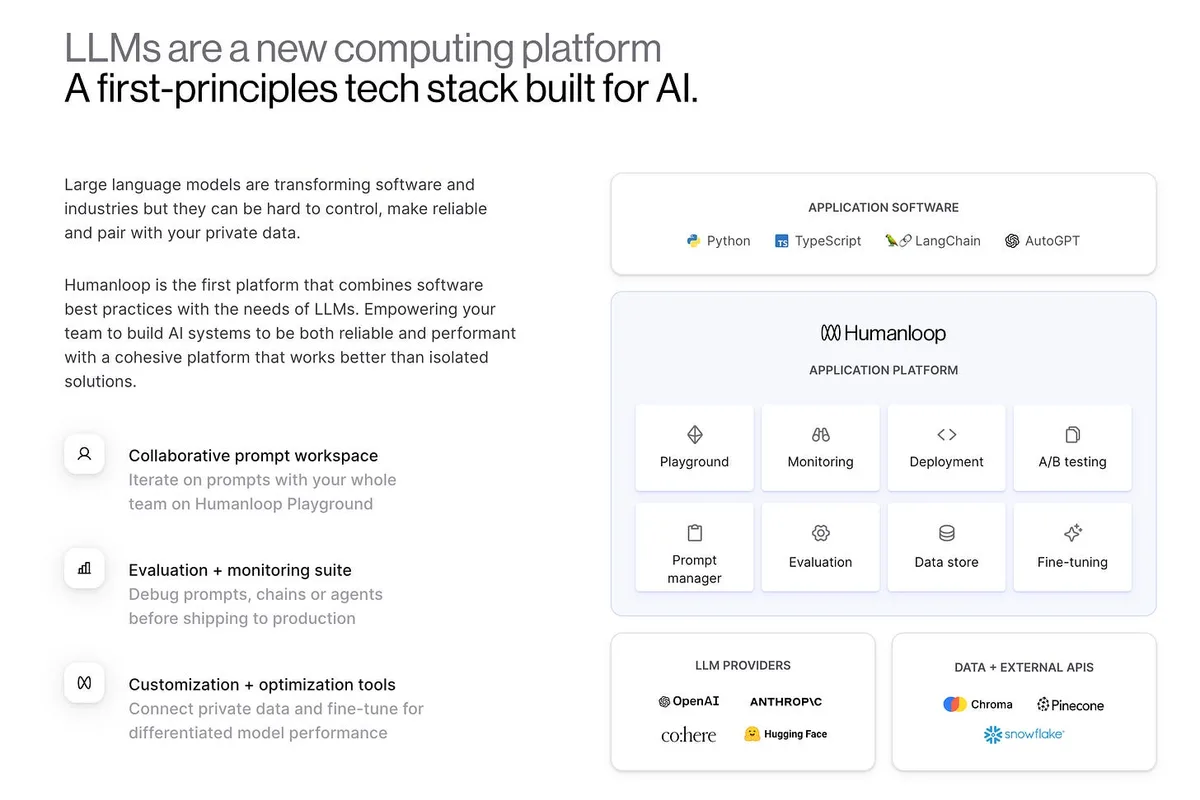
Humanloop website, reproduced by Latent Space in its September 2023 Humanloop interview.
Making product expectations testable
Habib argues that natural-language instructions affect product behavior much as code does, so prompts require versioning, change history and evaluation. In 2023 he distinguished development evaluation, which guides experiments before launch; production monitoring, which checks behavior on actual customer inputs; and regression testing, which checks whether changes damage existing behavior. For subjective applications, he regarded customer responses as the ultimate test, with development evaluations serving as proxies.[1][5]
His approach to feedback goes beyond thumbs-up and thumbs-down ratings. He distinguishes explicit votes, implicit actions—such as accepting, regenerating or editing a suggestion—and corrections that can later support evaluation or fine-tuning. Whether someone sends a generated sales email, for example, reveals a different signal from whether they rate it. He also described returning production logs to an interactive playground to investigate failures: rerunning an example with corrected retrieval context or a different model helps distinguish the causes of a poor result.[1][5]
In his 2024 advice, Habib recommends defining application-specific criteria rather than judging a few plausible-looking outputs. A language tutor might need to restrict vocabulary to a learner’s skill level; an AI coach might need to address each stated goal. He encourages domain experts to help write prompts and evaluate responses. He recommends starting with prompting and treating fine-tuning as a later optimization after validating demand, rather than making it a prerequisite for proving a product useful.[5]
Habib launched High Agency in June 2024 to interview people building AI products. In a conversation with Hamel Husain and swyx published that September, he advocated breaking evaluations into small, independent criteria. He questioned how to trust another stochastic model as a judge; Husain explained calibrating that judge against human assessments and critiques. Habib resisted offering a generic evaluation library that could fit customers’ applications poorly, while supplying examples as starting points.[5][7]
Habib’s cryptic-crossword use provides a personal example of task-specific success. In that conversation, he recalled enjoying GPT-4 as a “collaborative friend”: it helped enough to be useful without simply solving the puzzle and removing the fun.[7]
Before the LLM product launch, Habib worked on probabilistic deep learning, speech synthesis and model-assisted experiments. His physical-experiment work used active learning, a technique he also described using in Humanloop’s early annotation system.[4][8][1][6]
Earlier research: controllable speech and physical experiments
Habib began his UCL doctorate in 2017 and completed it in 2022, overlapping with his startup work. His thesis, Advances in Probabilistic Deep Learning, develops methods for approximate inference, including Markov chain Monte Carlo kernels for high-dimensional probability distributions, and applies neural variational inference to controllable speech synthesis. In 2023, he recalled finishing the write-up while running Humanloop partly because his grandfather wanted him to complete it and partly because he hoped to return to university teaching.[4][1]
In 2019 speech-synthesis research performed during his Google AI internship, Habib worked with Soroosh Mariooryad, Matt Shannon, Eric Battenberg, RJ Skerry-Ryan, Daisy Stanton, David Kao and Tom Bagby. They combined neural text-to-speech with probabilistic latent variables representing variation in delivery. Partial labels gave selected variables consistent, interpretable meanings, allowing control of attributes such as affect and speaking rate. A separate, fully unobserved variable represented other prosodic variation, so the system could vary delivery while holding a chosen attribute constant.[8][9]
During his doctorate, Habib also helped a friend start Monolith AI and hire its early team. He recalled working with McLaren on replacing expensive computational-fluid-dynamics calculations with neural-network surrogate models and selecting informative physical experiments. In the wind-tunnel example, an AI system used recent test results to recommend which experiments to run next. This was an application of active learning: choosing observations that add useful information rather than repeatedly collecting overlapping evidence.[1]
Habib recalled returning from Google convinced that he wanted the urgency and shared focus of a small startup. Side projects with Peter Hayes and Jordan Burgess became Humanloop. Their responsibilities developed organically: Burgess gravitated toward product and user experience, Hayes toward engineering leadership, and Habib toward customer conversations and external communication.[1]
Humanloop’s early annotation work, 2020–2021
Humanloop began in 2020 as a UCL spinout. A March 2021 university account identifies a collaboration involving Habib, Hayes and Burgess alongside professors David Barber and Emine Yilmaz. Its early workflow coupled annotation with live model training: the model surfaced rare categories during exploration, selected valuable examples to label during training, and highlighted confident disagreements with expert labels during review.[5][3][2][6]
In his July 2021 essay, Habib explained that faster labeling alone did not solve users’ problems. Teams discovered missing categories, rare classes worth combining, and disagreements about what labels meant. Humanloop therefore added editable labeling taxonomies, flags, comments and discussion around examples. The design supported experts refining the task during annotation, rather than assuming the categories had been settled before work began.[6]
Joining Anthropic in 2025
In August 2025, Habib, Hayes and Burgess joined Anthropic alongside other Humanloop engineers and researchers. Humanloop scheduled its platform sunset for 8 September 2025 and instructed customers to export their data. TechCrunch reported, citing an Anthropic spokesperson, that the arrangement excluded Humanloop’s assets and intellectual property. Habib publicly described Anthropic’s commitment to AI safety and responsible development as aligned with Humanloop’s vision.[11][12]
Public views on transformative AI in 2026
In a Fundrise interview published on 26 March 2026, Habib was introduced as a Member of Technical Staff at Anthropic. Speaking personally, he said his expectation of transformative AI had increased after joining. He favored assessing economically valuable tasks and explicit capability criteria over relying on an AGI label without an agreed definition. He also described trying difficult tasks with AI first to keep his understanding of model capabilities current.[16][17]
Continual learning remained an important interest. In 2023, Habib had argued that systems’ inability to keep learning after training deserved more attention, while choosing to focus Humanloop on useful products rather than fundamental model research. In the March 2026 interview, he expected progress on continual learning and considered automation of end-to-end senior software-engineering work plausible by late 2026. These were forecasts; he declined to make a reasonable prediction for 2027.[1][17]
From the Latent Space archive
Original posts and separately reviewed explanations.
Sources
- 1Building the Foundation Model Ops Platform — with Raza Habib of HumanloopAccessed 2026-09-17
- 2Humanloop — About usAccessed 2026-09-17
- 3
- 4Advances in Probabilistic Deep LearningAccessed 2026-09-17
- 5
- 6Four lessons from a year building tools for machine learningAccessed 2026-09-17
- 7Why Your AI Product Needs Evals with Hamel HusainAccessed 2026-09-17
- 8Semi-Supervised Generative Modeling for Controllable Speech SynthesisAccessed 2026-09-17
- 9
- 10Humanloop joins AnthropicAccessed 2026-09-17
- 11Humanloop joins Anthropic: Platform sunsetAccessed 2026-09-17
- 12
- 13
- 14Raza Habib announces the Humanloop team's move to AnthropicAccessed 2026-09-17
- 15Raza Habib — AnthropicAccessed 2026-09-17
- 16
- 17
- 18Announcing: Humanloop for Large Language ModelsAccessed 2026-09-17
Model source and teaching reviews passed. Human editorial review pending. This profile describes the sources as of 2026-09-17.