

Browse · People
Pranav Reddy
Conviction partner and former Neeva engineer whose writing examines AI business durability, search infrastructure and enterprise automation.
Pranav Reddy is a partner at Conviction, a venture firm focused on AI-native companies. His public writing examines where improving models create business opportunities—and where they erode them—with particular attention to learning from demonstrations, search indexes and enterprise automation. He previously worked on indexing, retrieval and language modeling at Neeva.[2][3][6][5][4]
Judging businesses as models improve
In “Avoiding the steamroller of foundation model capability”, Reddy argues that founders need a more precise test than whether they welcome the next model release. He proposes asking how their business would fare if models became roughly an order of magnitude more efficient at learning. His term “learning efficiency” concerns the demonstrations a deployed model needs to adapt to a new task or context well enough to be commercially useful; he distinguishes this practical business concept from sample efficiency during training.[6]
Reddy illustrates the framework with three contrasting businesses. Marketing-copy prompt templates lose value when models can reproduce a style from a few examples. Customer-support agents can benefit from better adaptation while still needing customer context, brand-specific behavior and integrations with internal systems. Skilled human-data providers occupy a middle regime: their services become useful when models can learn from expert examples, but their opportunity may shrink if only a handful of examples are needed. These are scenarios in his investment argument rather than measured forecasts.[6]
Why AI search still needs an index
In “An index for intelligence”, Reddy separates search into four elements: interface, query understanding, retrieval and ranking, and the index built by crawling and recrawling pages. He credits ChatGPT search with substantial improvements in understanding queries and ranking information, but argues that those capabilities cannot replace a sufficiently complete, fresh index.[5]
His examples distinguish freshness from coverage. He describes a Snowflake stock-price answer that used the previous day's price and a service-status answer that reported an ongoing outage despite a cited page showing an older incident. For “investigate 3/11,” ChatGPT returned historical events rather than recognizing an Eric Andre reference; Reddy points to missing coverage of sites explaining the meme and insufficient historical query data. He also records successes, including correctly answering a question about Chase virtual credit cards. His suggested crawl-time explanation for the stock-price error is explicitly a guess.[5]
Enterprise automation and founder judgment
Reddy and Sarah Guo jointly authored Conviction's “Investing in Sola”. They argue that computer use and vision-language models make automation more adaptable to changing websites and varied inputs, while generic computer-use agents still struggle with reliability, speed and interfaces suited to nontechnical users. Their investor statement describes Sola's approach as recording demonstrations and refining edge cases through an intuitive, Figma-like workflow canvas.[4]
Their account also explains what impressed them about founders Jessica Wu and Neil Desmukh. Reddy and Guo recall meeting them late one night after they had recently left MIT: within weeks of choosing enterprise automation, the founders could discuss unfamiliar back-office work, articulate a product vision and show signed design partners. The product and engineering work belongs to the founders and their team; Reddy's contribution here is the jointly expressed investment judgment.[4]
Reddy joined Guo for the opening “State of AI Startups” keynote at Latent Space LIVE during NeurIPS 2024 in Vancouver, reviewing developments across startups and enterprises. In its June 18, 2025 episode overview, Delta described him as investing in AI-native companies and serving on the board of HeyGen, an AI video-generation company.[1][7]
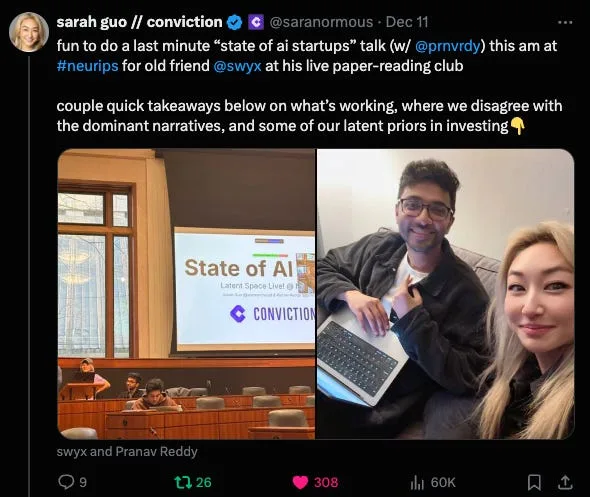
Sarah Guo (@saranormous) on X; reproduced by Latent Space.
Earlier foundations: Neeva and neuroscience
Before Conviction, Reddy worked as an engineer at Neeva. His search essay supplies concrete context for his later views: he says he helped build portions of all four search components, spending the least time on interfaces and the most on ranking and indexing. Delta's June 2025 biography describes him as a founding engineer who later became an engineering manager. Earlier still, according to his personal biography, he researched neuroscience, working on learning and epilepsy.[2][5][7]
Timeline
- milestone
Delivers State of AI Startups keynote with Sarah Guo
Reddy joined Guo for the opening “State of AI Startups” keynote at Latent Space LIVE during NeurIPS 2024 in Vancouver, reviewing developments across startups and enterprises.[1]
From the Latent Space archive
Original posts and separately reviewed explanations.
Sources
- 12024 in AI Startups [LS Live @ NeurIPS]Accessed 2026-09-20
- 2Pranav ReddyAccessed 2026-09-20
- 3Conviction PartnersAccessed 2026-09-20
- 4Investing in SolaAccessed 2026-09-20
- 5Pranav Reddy — An index for intelligenceAccessed 2026-09-20
- 6Pranav Reddy — Avoiding the steamroller of foundation model capabilityAccessed 2026-09-20
- 7Delta — Pranav ReddyAccessed 2026-09-20
Model source and teaching reviews passed. Human editorial review pending. This profile describes the sources as of 2026-09-20.