

Browse · People
Paul Klein
Founder and CEO of Browserbase, building browser infrastructure and automation tools that let AI agents work through existing websites.
Paul Klein IV, also publishing as Paul Klein, is the founder and CEO of Browserbase. His work centers on giving AI applications access to cloud browsers so they can retrieve information, navigate websites, fill forms, and act on users’ behalf. He distinguishes the infrastructure needed to run those browsers from the models and application logic that decide what to do with them.[2][1]
Browsers as infrastructure for AI
Klein identified two drivers for Browserbase: retrieving content that appears only after a website executes JavaScript, and using LLMs to adapt automation to different or changing page structures. In his February 2025 Latent Space interview, he used booking demo calls across 100 websites as an illustration: conventional automation needs site-specific scripts, while an LLM can generate the appropriate interactions from a shared instruction.[1]
The browser itself remains a stateful system: it must stay open while a user or agent works with it. Running many such sessions adds container scheduling, isolation, fonts, extensions, and session recording to what may have begun as a small automation script. In February 2025, Browserbase used Kubernetes, predictive scaling, regional browser pools, and Firecracker to offer a serverless-like connection experience. Klein qualified millisecond startup as a best-case outcome; large bursts could encounter slower cold starts.[1]
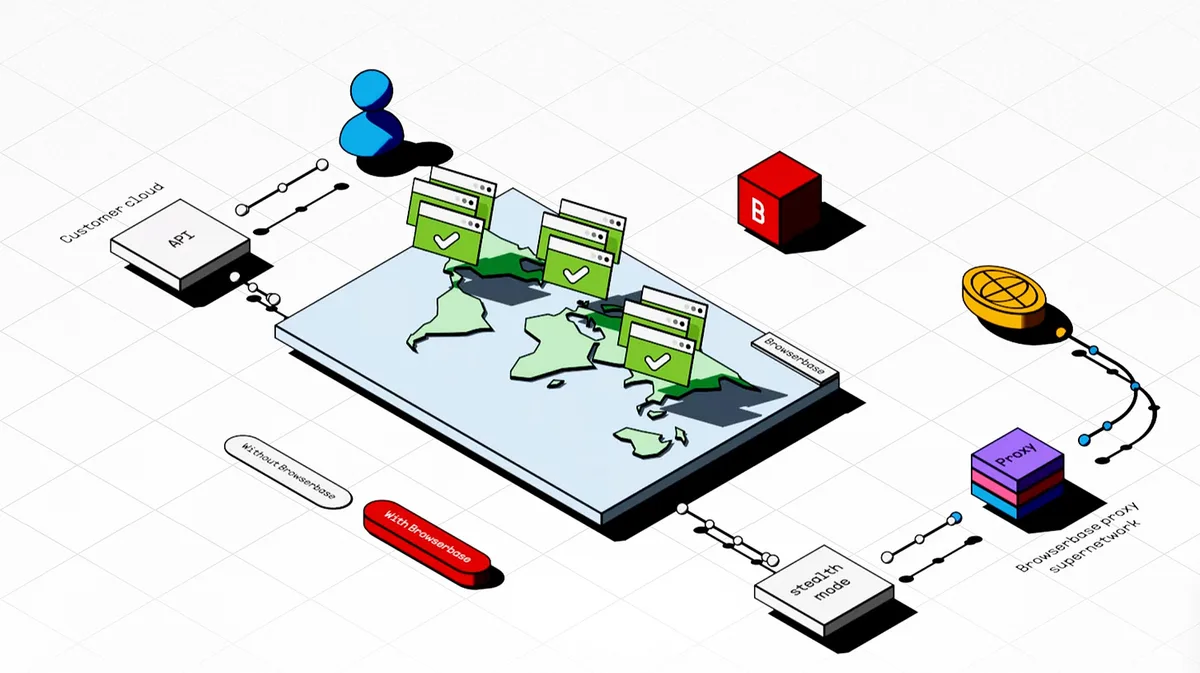
Published by Latent Space; image creator not identified in the supplied source.
Browserbase’s first version used ECS and Fargate before the company moved toward deeper control of its infrastructure. Klein’s reason was accountability: an infrastructure provider still answers to its customers when an upstream service fails. His principle was to retain deep ownership of dependencies in the critical path, even while encouraging Browserbase customers to outsource the browser infrastructure itself.[1]
Stagehand and human intervention
Stagehand grew from Klein’s experiments passing a page’s DOM to an LLM and asking it to generate Playwright code. He concluded that natural-language instructions belonged inside the browser framework. In February 2025, he described three interfaces: act to interact with a page, extract to return information against a supplied schema, and observe to identify possible actions for an application’s agent loop. As he put it, “StageHand isn't a web agent. It's a framework for building web agents.” He acknowledged Anirudh’s involvement in Stagehand; in his October 2025 retrospective, he also credited early customers with shaping accessibility-tree use and approachable syntax.[1][4]
Klein described Stagehand in February 2025 as MIT-licensed and usable with a developer’s chosen model and local browser. Browserbase earned revenue when developers chose its hosted browsers. At that point, he prioritized reliability over speed and cost optimization, positioning Stagehand as a browser tool for agents rather than a specialized bulk-scraping system.[1]
Klein also emphasized that web agents still need people to intervene. Browserbase’s Live View embeds a cloud browser in an iframe, using Chrome DevTools Protocol screencasting and remote input to let users watch, pause, click, or type before automation resumes. A person can complete a difficult CAPTCHA or enter a two-factor authentication code. Open Operator demonstrated this combination: screenshots supplied to an LLM, an agent loop, Stagehand execution, and Live View. Klein presented it as a reference project for developers; that implementation did not use a computer-use model.[1]
Access, identity, and the platform decision
In February 2025, Klein argued that authentication would obstruct agents more than CAPTCHAs. He envisioned an OAuth-like flow in which a person approves scoped access—for example, allowing an agent to book accommodation without permitting it to send messages. This was a proposed direction for agent authentication. Earlier, in a November 2024 interview, he explained that Browserbase sought Okta as a strategic investor because agents would need to navigate enterprise authentication and authorization.[1][8]
By April 2026, Klein was explaining Browserbase’s expansion from a browser component into a unified agent platform. He argued that access to everyday systems was a larger constraint than model capabilities, and that assembling separate vendors forced developers to debug boundaries between runtimes, logs, and failure modes. The platform brought search, retrieval, browsers, identity, execution, and models onto shared infrastructure. Its workflow distinguished lightweight page retrieval from escalation to a real browser for logins, dynamic content, or multi-step interaction.[5]
In that announcement, Klein credited Cloudflare, Fingerprint, and 1Password as Agent Identity partners, combining Web Bot Auth cryptographic identity, stable browser signals, and access to user credentials. His broader view remained that new protocols complement browser interaction: in October 2025, he welcomed MCP’s interoperability while arguing that it would not replace websites lacking APIs.[5][4]
Klein has revised parts of his technical outlook. Although his 2023 memo already considered GPT-4V screenshots, he said in February 2025 that he had underestimated the importance and pace of vision-driven computer-use models, having expected structured HTML to be especially suitable for automation. His management argument similarly separates personal judgment from team execution: he defended solo founding as removing an alignment layer, while emphasizing that a strong team needs agency and ownership of daily decisions.[3][1]
Earlier foundations: Twilio, Stream Club, and Mux
Before Browserbase, Klein worked on authentication and browser infrastructure in other settings. He joined Twilio as an intern in 2016 and later became technical lead on its login, identity, and access-management team. He said that experience informed his thinking about agent authentication: existing protocols and authentication services offered foundations that could be adapted for delegated access.[1]
Klein co-founded Stream Club with Lan Paje and served as CTO, building internal headless-browser infrastructure for livestreaming. Mux’s December 22, 2021 acquisition announcement credits Klein with demonstrating Stream Club Cloud, an embeddable studio that let users broadcast from within another application. Phil Cluff worked alongside the Stream Club team during the partnership discussions and integration planning; the shared technical stack included Headless Chrome, WebRTC, and canvas.[1][6][7]
At Mux, Klein led teams and worked on developer tools and developer marketing. In his October 2025 retrospective, he connected those experiences with Twilio engineering and Stream Club’s browser work as preparation for Browserbase. He recalled circulating his November 2023 memo to trusted readers; encouraging responses and investment interest helped him recognize that the proposal could become a company.[4]
That memo, “An Internet Browser for AI”, framed the problem in a compact line: “The internet is nondeterministic, but we’re using deterministic tools to navigate it.” Klein proposed cloud-native browser infrastructure, AI-assisted page interpretation, and new developer interfaces, while preserving familiar interfaces for migration. He advocated open source and developer education, and proposed opt-in LLM features so developers could control costs and use conventional automation where it sufficed.[3]
Timeline
- milestone
Stream Club joins Mux
Mux’s December 22, 2021 acquisition announcement credits Klein with demonstrating Stream Club Cloud, an embeddable studio that let users broadcast from within another application.[7] - milestone
Explains Stagehand’s act, extract, and observe interfaces
In February 2025, he described three interfaces: act to interact with a page, extract to return information against a supplied schema, and observe to identify possible actions for an application’s agent loop.[1] - milestone
Expands Browserbase into a unified agent platform
By April 2026, Klein was explaining Browserbase’s expansion from a browser component into a unified agent platform.[5]
From the Latent Space archive
Original posts and separately reviewed explanations.
Sources
- 1Open Operator, Serverless Browsers and the Future of Computer-Using AgentsAccessed 2026-09-20
- 2Paul Klein IVAccessed 2026-09-20
- 3🦾 An Internet Browser for AIAccessed 2026-09-20
- 4🌐 Two Years Later: An Internet Browser for AIAccessed 2026-09-20
- 5APIs see 15% of the web. Unlock the other 85% with the Browserbase PlatformAccessed 2026-09-20
- 6Going live is too hard.Accessed 2026-09-20
- 7Stream Club is joining Mux!Accessed 2026-09-20
- 8Founders in Focus: Paul Klein IV of BrowserbaseAccessed 2026-09-20
Model source and teaching reviews passed. Human editorial review pending. This profile describes the sources as of 2026-09-20.