

Browse · People
Olivier Godement
OpenAI product leader known for explaining the design choices behind realtime audio, automated caching, and developer evaluation workflows.
Olivier Godement is an AI product leader whose work at OpenAI includes multimodal deployment and developer tools. He led the Dev Day 2024 keynote and explained the team's choices behind the Realtime API, automated prompt caching, and evaluation workflows. OpenAI also credits him among the contributors to GPT-4V's launch partners, product, and deployment management.[1][2]
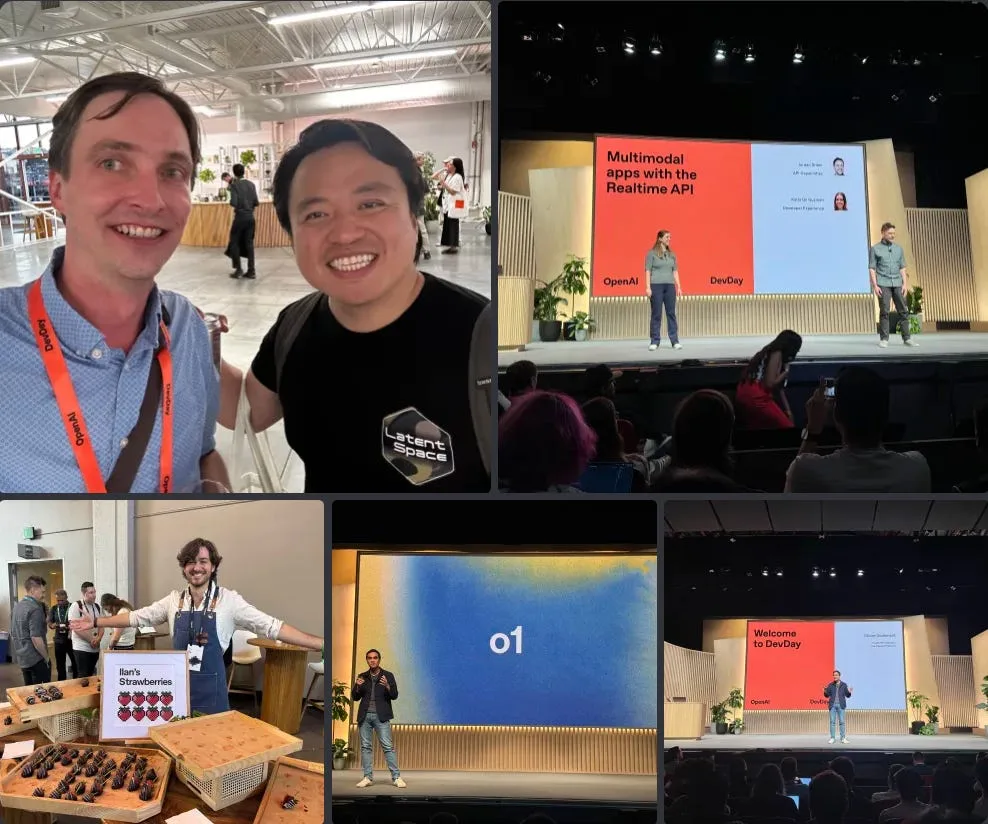
Published by Latent.Space; photographer not identified in the supplied source.
Designing for conversation
In his Dev Day 2024 interview with Latent Space, Godement described the Realtime API's starting point as “human level latency.” The team worked backward from conversational timing, evaluated transport options, and chose WebSockets. He cited roughly 300 milliseconds as a human conversational reference, rather than an API performance measurement. Realtime required particularly substantial launch work because it introduced both a new modality and OpenAI's first WebSocket-based API, including adapting safety mitigations to realtime audio input and output.[1]
In 2024, Godement's stated ambition was to make audio and multimodality a first-class application experience. He argued that voice should offer a compelling product experience in its own right, pointing to the emotional expression and convenience of everyday voice messages.[1]
Making good developer workflows easier
Godement described automated prompt caching as a deliberate decision to require “zero code change from the developer.” For distillation and evaluation, he emphasized a “pit of success”: minimizing the steps inexperienced developers needed to evaluate and fine-tune correctly. His concern was that a poor evaluation could tell the wrong story about a model, leaving developers without reliable grounds for deciding whether an application worked.[1]
He explained subsidized evaluations as an opt-in exchange with two intended benefits: lowering developers' evaluation costs and giving OpenAI task-specific tests to help detect regressions in new model releases. In the 2024 interview, he said API data was not used for training unless developers opted in, and accepted that many would decline to share it. His principle for becoming developers' source of truth was that OpenAI had to earn that role rather than compel data sharing.[1]
Godement envisioned a future in which models would be automatically fine-tuned and evaluated as developers used them, reducing the manual testing required whenever a new model snapshot arrived. He explicitly qualified that ambition: “That's a direction. We are pretty far away from it.”[1]
His platform strategy concentrated on tools closest to the model, including fine-tuning, distillation, and evaluation. Godement argued that OpenAI could not build the entire application stack and questioned whether it had a strong advantage in more distant LLMOps tools such as elaborate prompt management. He described meeting developers where they wanted OpenAI to be as the practical basis for those choices.[1]
Developer control and frontier feedback
Asked about excessive voice refusals in the 2024 interview, Godement proposed API controls over sensitive themes and refusal thresholds, allowing developers to permit legal uses such as vulgar language in a Hollywood script. He distinguished those choices from behavior prohibited by law or OpenAI's terms, which would remain restricted.[1]
Godement sought developer feedback about applications just beyond then-current model capabilities. Endorsing advice he attributed to Sam Altman, he encouraged founders to build something that sometimes worked but remained a little too difficult for the model. Those concrete gaps, he said, supplied useful goalposts for future releases and helped inform priorities across reasoning, multimodality, and tool use.[1]
Earlier career: Stripe and the move to OpenAI
Before this developer-platform work, Godement spent more than eight years at Stripe, where he previously led the core payments product. In a personal announcement published June 28, 2023, he said he had recently left Stripe and joined OpenAI's product team.[3][4]
OpenAI's 2023 GPT-4V contribution credits place Godement in the launch partners, product, and deployment management group alongside Joanne Jang, Angela Jiang, Raul Puri, Jessica Shieh, Natalie Staudacher, and Nicholas Turley.[2]
Timeline
- milestone
Credited for GPT-4V launch and deployment work
OpenAI's 2023 GPT-4V contribution credits place Godement in the launch partners, product, and deployment management group alongside Joanne Jang, Angela Jiang, Raul Puri, Jessica Shieh, Natalie Staudacher, and Nicholas Turley.[2] - role
Announced his move from Stripe to OpenAI
In a personal announcement published June 28, 2023, he said he had recently left Stripe and joined OpenAI's product team.[3] - milestone
Led OpenAI's Dev Day keynote
He led the Dev Day 2024 keynote and explained the team's choices behind the Realtime API, automated prompt caching, and evaluation workflows.[1]
From the Latent Space archive
Original posts and separately reviewed explanations.
Sources
- 1Building AGI in Real Time (OpenAI Dev Day 2024)Accessed 2026-09-20
- 2GPT-4V authorship, credit attribution, and acknowledgmentsAccessed 2026-09-20
- 3Olivier Godement’s personal announcement of joining OpenAIAccessed 2026-09-20
- 4Olivier Godement | UNBOUND 2026Accessed 2026-09-20
Model source and teaching reviews passed. Human editorial review pending. This profile describes the sources as of 2026-09-20.