

Browse · People
Matt Pocock
AI engineering educator and creator of Skills for Real Engineers, a collection of small, composable tools for planning, testing and designing software with coding agents.
Matt Pocock is an educator and engineer who creates tools and training for software developers working with AI. He teaches AI engineering full-time and is building AI Hero to help web developers retrain as AI engineers. His Skills for Real Engineers collection turns practices such as design interviews, domain modeling and test-driven development into instructions for coding agents.[2][3]
Keeping engineering judgment in the workflow
Pocock built the collection to address failure modes he saw with Claude Code, Codex and other coding agents: misunderstanding the requested change, struggling with project terminology, producing code without adequate feedback and accumulating architectural complexity. He favors small, inspectable, composable skills that developers can adapt. His objection to large process frameworks is that they can obscure instructions and make failures in the workflow harder to diagnose.[3][4]
One response is to have the agent interview the developer before building. Another is to establish a shared domain language. His AI Skills for Real Engineers overview, updated April 27, 2026, gives a concrete example: if a plan refers to an “account,” the planning skill asks whether that means a Customer, User, Organization or Workspace. Resolved terms go into a glossary; consequential trade-offs can become architectural decision records. In an August interview, Pocock described the need plainly: “Between me and the agent, there is a communication barrier.”[4][1]
Pocock recommends static types, browser access and automated tests as feedback loops for agents. His April-dated overview specifies tests of behavior through public interfaces, followed by a red-green-refactor cycle: one failing behavior test, the minimal implementation, then the next behavior. It also recommends vertical slices—narrow but complete paths through the system that can be demonstrated or verified independently. Each slice distinguishes work an agent can perform unattended from work requiring a human design review or architectural decision.[3][4]
Wayfinder: planning across agent sessions
In Richard MacManus’s August 20, 2026 interview, Pocock explained that preparing work for agents to run virtually overnight had made planning onerous. He had to track session handoffs and how far he had progressed into the context window. He wanted an orchestration layer to split planning into separate conversations, prototypes and research, then bring the results together. This became /wayfinder, which he reported using for course planning as well as engineering.[1]
Wayfinder separates a shared map, individual tickets and the sessions that resolve them. The map records the destination, summarizes settled decisions and identifies uncertainty—the “fog of war.” Detailed decisions live in their tickets; the map links to them rather than duplicating them. A session loads the overview and retrieves ticket details as needed, allowing planning to continue without loading the entire history into every conversation. Pocock argues that precise names for these entities help the agent understand the information flow.[6][1]
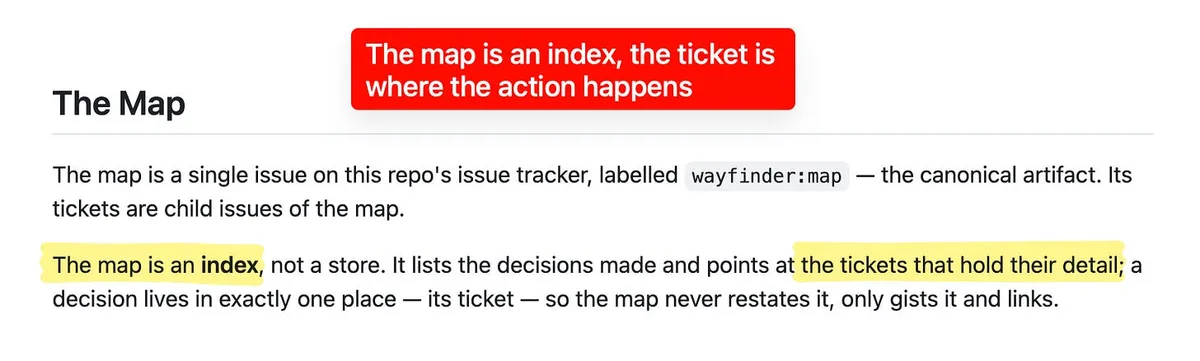
Latent Space, from “The /wayfinder Skill: Navigating the ‘Fog of War’ of Planning.”
Pocock reserves wayfinder for planning that exceeds one session and has an unclear route. Its tickets normally resolve questions rather than deliver implementation; once the map clears, the workflow hands off to specification and implementation planning. The documentation distinguishes human-led discussion and prototype review from unattended research. It also acknowledges a weakness in the planning boundary: an agent can write an exemption into the map’s Notes and later treat that text as permission to implement. The intended separation is therefore not a hard safeguard.[6]
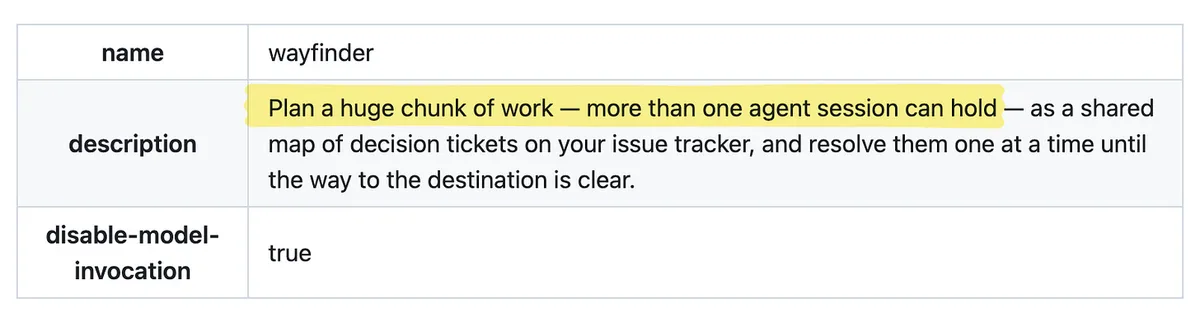
Latent Space, from Richard MacManus’s August 20, 2026 interview.
Before his current AI teaching, Pocock worked in TypeScript development and education. That earlier work provides context for his experience as a library maintainer and for the practical teaching format he developed in Total TypeScript.[5][2]
Earlier career and Total TypeScript
Pocock previously worked as a voice coach. Before creating Total TypeScript, he was a member of the XState core team and a developer advocate at Vercel. His TypeScript experience also includes work as a lead fullstack developer and library maintainer.[2][5]
Pocock says he built Total TypeScript to make the knowledge of open-source maintainers and industry experts available to everyone. Its teaching centers on exercises: learners receive problematic code and a concise explanation of the task, attempt a solution using documentation and their editor, then watch a worked solution. The exercises revisit concepts in different application and library contexts, including generics, type transformations and advanced React typing.[5]
Timeline
- project
Explains the planning burden behind /wayfinder
In Richard MacManus’s August 20, 2026 interview, Pocock explained that preparing work for agents to run virtually overnight had made planning onerous.[1]
Sources
- 1The /wayfinder Skill: Navigating the “Fog of War” of PlanningAccessed 2026-09-20
- 2Matt PocockAccessed 2026-09-20
- 3mattpocock/skills — Skills For Real EngineersAccessed 2026-09-20
- 4AI Skills for Real EngineersAccessed 2026-09-20
- 5Professional TypeScript Training by Matt PocockAccessed 2026-09-20
- 6The /wayfinder SkillAccessed 2026-09-20
Model source and teaching reviews passed. Human editorial review pending. This profile describes the sources as of 2026-09-20.