

Browse · People
Leo Tronchon
Coauthor of OBELICS and the Idefics vision-language models, with research focused on open multimodal data and experimentally justified model design.
Leo Tronchon, who publishes research as Léo Tronchon and uses Leyo on Hugging Face, is a coauthor of OBELICS and the Idefics family of vision-language models. His published work spans open datasets that interleave images and text, experiments on model design, and practical guidance for building models that take images and text as inputs and generate text.[2][5][4][6]
Testing what matters in vision-language models
In the May 2024 paper What matters when building vision-language models?, Tronchon, Hugo Laurençon, Matthieu Cord and Victor Sanh argued that important design choices were often insufficiently justified. Their concern was practical: unsupported choices make it harder to identify what actually improves performance. The team conducted experiments across pretrained models, architecture, data and training methods, consolidating its findings into Idefics2, an 8-billion-parameter vision-language model.[4]
The authors reported that Idefics2 achieved state-of-the-art performance within its size category across several multimodal benchmarks and was “often on par with models four times its size.” Tronchon also coauthored the April 15, 2024 release announcement with Laurençon and Sanh.[4][3]
In August 2024, Tronchon, Laurençon, Andrés Marafioti and Sanh extended this work in Building and better understanding vision-language models: insights and future directions. The paper combines an overview of competing approaches and unresolved development questions with a practical walkthrough for building Idefics3-8B. The team reported training exclusively on open datasets through a straightforward pipeline, with performance substantially exceeding Idefics2-8B.[6]
Earlier foundations: OBELICS and IDEFICS in 2023
Before the Idefics2 and Idefics3 studies, Tronchon coauthored the 2023 OBELICS paper with Laurençon and a larger research team. This earlier work supplied an open corpus of interleaved image-text documents: the authors reported 141 million Common Crawl web pages, 353 million associated images and 115 billion text tokens. They documented the dataset’s creation and filtering rules, trained 9-billion- and 80-billion-parameter models named IDEFICS to demonstrate its viability, and released the dataset, models and code.[5]
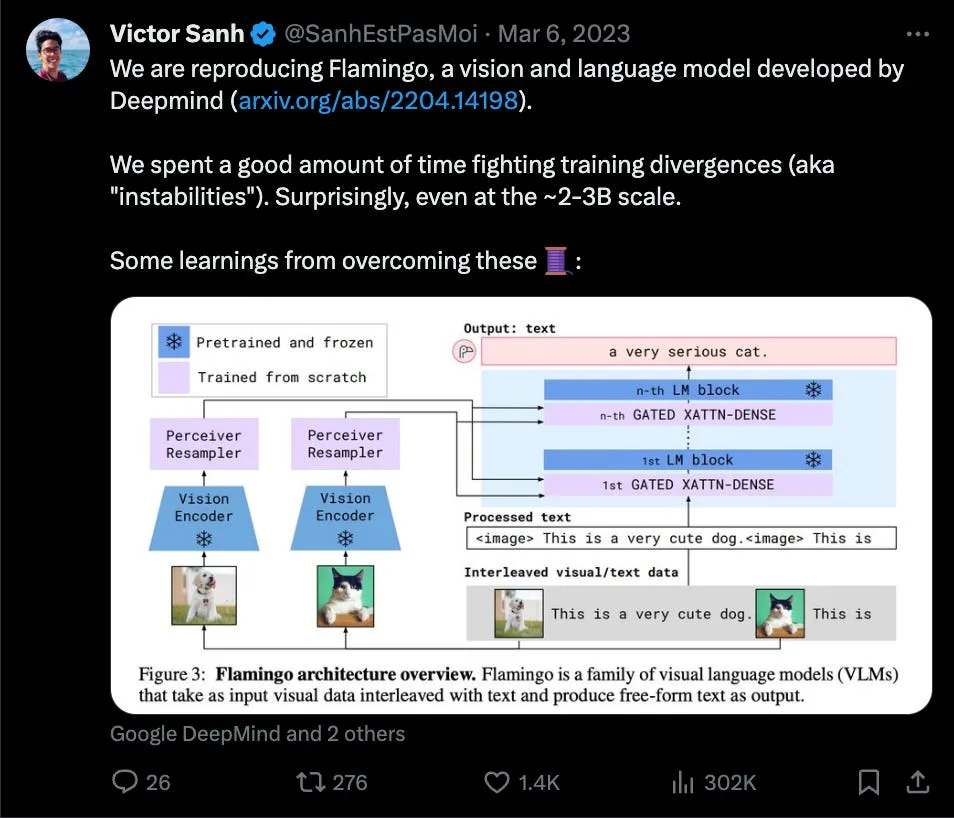
Victor Sanh; diagram credited to DeepMind in the post. Screenshot reproduced by Latent Space.
On January 19, 2024, Latent Space featured Tronchon and Laurençon as HuggingFace M4 guests in How to train your own Large Multimodal Model, placing their multimodal research in a public discussion about building such models.[1]
Timeline
- research
Coauthors OBELICS, an open interleaved image-text corpus
Before the Idefics2 and Idefics3 studies, Tronchon coauthored the 2023 OBELICS paper with Laurençon and a larger research team.[5] - milestone
Discusses building multimodal models on Latent Space
On January 19, 2024, Latent Space featured Tronchon and Laurençon as HuggingFace M4 guests in How to train your own Large Multimodal Model, placing their multimodal research in a public discussion about building such models.[1] - release
Coauthors the Idefics2 release announcement
Tronchon also coauthored the April 15, 2024 release announcement with Laurençon and Sanh.[3] - research
Tests the design choices behind Idefics2
In the May 2024 paper What matters when building vision-language models?, Tronchon, Hugo Laurençon, Matthieu Cord and Victor Sanh argued that important design choices were often insufficiently justified.[4] - research
Coauthors Idefics3 research and a practical model-building walkthrough
In August 2024, Tronchon, Laurençon, Andrés Marafioti and Sanh extended this work in Building and better understanding vision-language models: insights and future directions.[6]
From the Latent Space archive
Original posts and separately reviewed explanations.
Sources
- 1
- 2Leyo (Leo Tronchon)Accessed 2026-09-20
- 3Introducing Idefics2: A Powerful 8B Vision-Language Model for the communityAccessed 2026-09-20
- 4What matters when building vision-language models?Accessed 2026-09-20
- 5
- 6
Model source and teaching reviews passed. Human editorial review pending. This profile describes the sources as of 2026-09-20.