

co-founded · as of 2026-09-15
Browse · People
Person · Latent Space wiki
Jeremy Howard
Researcher, educator and entrepreneur whose work spans transfer learning, practical deep-learning education and tools for building with AI.
Jeremy Howard co-founded fast.ai with Rachel Thomas and is Answer.AI’s founding CEO. His work makes model adaptation, deep-learning education and application development more accessible. It includes ULMFiT, developed with Sebastian Ruder; the fastai library, described with Sylvain Gugger; and FastHTML and Solveit, tools for turning technical ideas into applications while developing an understanding of how they work.[1][3][4][11][13]
fast.ai: working models first
Howard and Thomas publicly launched fast.ai on October 7, 2016. Howard had founded Enlitic to apply deep learning to medical diagnostics and treatment planning. In the fast.ai launch announcement, he said he had resigned as Enlitic CEO about six months earlier and described the slow, uncertain training and immature tools he had encountered there: “Creating a deep learning model is, ironically, a highly manual process.” He and Thomas wanted domain experts to have the tools and knowledge to solve problems themselves, drawing on their own data and experience.[2]
Howard’s Practical Deep Learning for Coders begins with a working model for a real problem, then explores the machinery beneath it. The free course targets people with coding experience and teaches the necessary mathematics along the way. Transfer learning supports this practical starting point: an image model already trained to recognize useful features can be adapted to a new task with less data and computation than training from scratch. Howard recalled making transfer learning part of the first lesson.[5][6]
Howard and Sylvain Gugger’s 2020 fastai paper presents a layered Python library built on PyTorch. High-level components provide convenient training workflows; lower-level components let researchers compose and modify those workflows. Its data-block API organizes model inputs, while two-way callbacks can inspect and change the data, model or optimizer during training. The architecture gives beginners a concise starting point without closing off deeper customization.[4]
DAWNBench: competitive results with basic resources
In May 2018, The Verge reported that fast.ai-affiliated researchers held the top three CIFAR-10 positions for training speed and cost in Stanford’s DAWNBench competition. The report connected their work to Leslie Smith’s super-convergence research. Results differed on the larger ImageNet benchmark: Google led training time, while fast.ai placed fourth in time and third in cost. Howard emphasized the importance of accessible hardware and rejected the idea that good research required joining a large technology company: “I don’t want deep learning to remain the exclusive venue of a small number of privileged people.”[17]
ULMFiT: adapting a language model to classification
Howard and Sebastian Ruder’s ULMFiT paper, published at ACL in 2018, developed a systematic transfer-learning recipe for text classification. They shared equal contribution credit: Howard focused on algorithm development and implementation, and Ruder on experiments and writing. The method has three stages:[3]
- General-text pretraining: train a language model on a broad text corpus.[3]
- Domain adaptation: continue language-model training on text from the target domain.[3]
- Classifier fine-tuning: add classifier layers and fine-tune using labeled examples.[3]
For sentiment classification, domain adaptation familiarizes the model with review text before supervised training teaches it to distinguish positive and negative reviews. To preserve useful representations during adaptation, ULMFiT uses different learning rates for different layers, a slanted triangular schedule that raises the learning rate before lowering it, and gradual unfreezing during classifier training. Its original implementation uses AWD-LSTM, a recurrent architecture. The paper acknowledges earlier language-model fine-tuning work; Howard and Ruder’s contribution was a coordinated method for making it effective across classification tasks.[3]
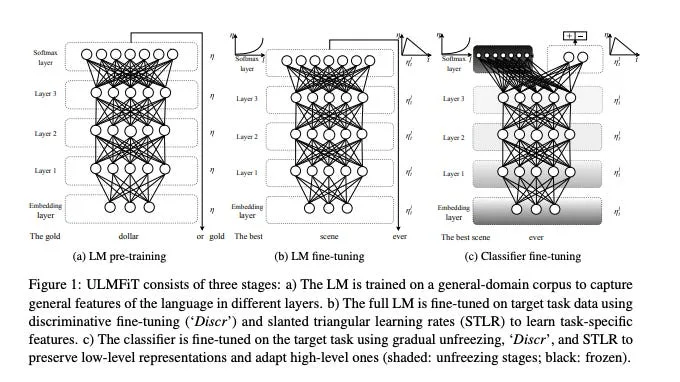
Figure 1 from Jeremy Howard and Sebastian Ruder’s ULMFiT paper, published by the Association for Computational Linguistics (2018); reproduced by Latent Space.
Howard and Ruder reported improvements over the prior state of the art on six text-classification tasks, with 18–24% error reductions on most datasets. On IMDb, using 100 labeled examples and 50,000 unlabeled examples, ULMFiT matched training from scratch with 100 times as much labeled data.[3]
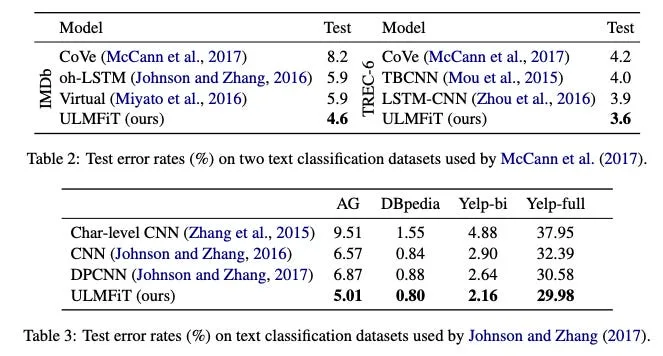
Jeremy Howard and Sebastian Ruder, ACL 2018; published by the Association for Computational Linguistics, reproduced on Latent Space.
Reconsidering how models learn
In September 2023, Howard and Jonathan Whitaker investigated abrupt training-loss drops at epoch boundaries while fine-tuning a model on science-exam questions. An epoch is one pass through the training data. They initially suspected a Hugging Face Trainer bug, but reports of similar curves from custom loops and full fine-tuning weakened that explanation. Follow-up experiments with a cyclical learning-rate schedule supported their preliminary hypothesis of rapid example memorization. They also distinguished confidence from task performance: validation loss could worsen while the competition’s ranked-answer metric continued to improve.[8]
In his October 2023 Latent Space interview, Howard argued for “continued pre-training” instead of sharply separated stages. He proposed retaining diverse data throughout training while gradually increasing its quality and relevance to desired tasks, rather than discarding earlier data. His concern was that narrow later training could cause catastrophic forgetting. This was a revision of his view of training practice; ULMFiT’s original domain-adaptation and supervised-classification stages remain distinct from instruction tuning and reinforcement learning from human feedback.[6][3]
Answer.AI: development shaping research
Howard and Eric Ries launched Answer.AI on December 12, 2023, with Howard as founding CEO, Ries as founding director, and an announced $10 million investment from Decibel VC. Howard proposed a small, remote team of technical generalists building useful products from existing AI models. Ries’s formulation, quoted in the announcement, was that “development should inform research and vice-versa”: practical development goals would help identify research worth pursuing.[9]
In an interview published in August 2024, Howard described Answer.AI as an experiment without managers assigning colleagues’ work. He recalled Benjamin Clavié assembling a BERT collaboration without seeking his permission, followed by Benjamin Warner contributing a customizable implementation. Howard described his role as helping rather than directing. He also said that he and Ries had embedded long-term-value commitments into investor arrangements and adopted a public-benefit corporate structure to help preserve the company’s mission.[7]
FSDP–QLoRA: adapting large models on gaming GPUs
Answer.AI’s March 2024 FSDP–QLoRA preview reported fine-tuning a 70-billion-parameter model on two or more 24 GB gaming GPUs. QLoRA saves memory by keeping base weights quantized and training small low-rank adapters; FSDP shards model storage across GPUs. CPU offloading and activation checkpointing further reduce GPU memory requirements. The result concerned adapting an existing model, rather than pretraining a 70B model from scratch.[10]
Howard discussed combining FSDP and QLoRA with Tim Dettmers, then worked with Hugging Face’s Titus von Koeller to investigate their integration. He studied Meta’s Llama-Recipes implementation, built a minimal fine-tuning script and benchmarked the original implementation across hardware. The release credits Johno Whitaker’s test script, Warner’s storage and loading changes, and Kerem Turgutlu’s integration work, alongside collaboration with Dettmers, von Koeller and Sourab Mangrulkar. The preview still had sequence-length and batch-size limitations in its bitsandbytes implementation and introduced an HQQ alternative.[10]
FastHTML and llms.txt
Howard originated FastHTML at Answer.AI partly because fast.ai students struggled to turn AI project ideas into working applications. It builds web applications in Python using Starlette, Uvicorn and HTMX. Python components generate HTML, and HTMX lets server responses update parts of a page. Howard used FastAPI as a design reference for a framework centered on hypermedia applications, with advice from FastAPI creator Sebastián Ramírez.[11]
Howard’s September 3, 2024 llms.txt proposal addresses how tools find useful website context for language models. A Markdown file at /llms.txt supplies background, guidance and curated links; clean Markdown counterparts make linked pages easier to ingest. Site authors identify pertinent material, while downstream tools choose how to assemble it for a particular application. Howard presented this as a proposal, leaving context-processing methods open.[12]
Solveit: small steps and human understanding
On November 7, 2024, Howard announced that fast.ai was joining Answer.AI and introduced the beta course How To Solve It With Code, taught with Johno Whitaker and Audrey Roy Greenfeld. He argued that LLMs had made AI usable without model-training expertise, but users could still become stuck when modifying or debugging generated code. His proposed practice, Dialog Engineering, combines small pieces of code, selective AI assistance and continuing human understanding.[13]
Whitaker’s October 2025 launch account traces Solveit through a late-2024 Advent of Code trial and subsequent internal use for software, system administration and writing. The approach draws on George Pólya’s four stages: understand the problem, devise a plan, carry it out and reflect. A coding example breaks a task into splitting input lines, extracting numbers and sorting them, checking each output before combining the steps into a function.[14]
Solveit names both the method and its associated platform; the method can be followed with other tools. The platform provides an AI-integrated Linux environment and editable dialogs in which users can remove dead ends, revise earlier responses and manage what remains in context. Suggested code requires a user decision before it is added or run. These choices express Howard’s preference for AI assistance that develops the user’s abilities rather than accumulating code the user cannot understand.[14][15]
Earlier career: consulting, FastMail and Kaggle
Before his deep-learning research and teaching, Howard spent eight years in management consulting at McKinsey and A.T. Kearney and founded FastMail and Optimal Decisions Group. He later became Kaggle’s president and chief scientist after two years as its top-ranked competition participant. This earlier career includes experience operating a small software service and participating in competitive machine learning.[1][5][16]
In Rob Mueller’s 2010 recollection, Howard prototyped FastMail around 1999 and brought Mueller aboard to develop the website. Both were programmers without web-development experience; Mueller built a framework because they disliked the CGI development model. They targeted a paid, professional email service with a fast interface, no advertising and open POP and IMAP access. It began on one server, offered free access during development while making the eventual paid model explicit, and started billing in 2002. Mueller credits Howard’s savings with financing the early work and identifies him as the company’s entrepreneurial driving force.[16]
Timeline
- founding
Launches fast.ai with Rachel Thomas
fast.ai launch[2] - research
Develops ULMFiT with Sebastian Ruder for text classification
ULMFiT[3] - research
Presents fastai’s layered architecture with Sylvain Gugger
fastai paper[4] - project
Proposes llms.txt to guide language models through website context
llms.txt proposal[12]
From the Latent Space archive
Original posts and separately reviewed explanations.
Conversation
The End of Finetuning — with Jeremy Howard of Fast.ai
ConversationAI Magic: Shipping 1000s of successful products with no managers and a team of 12 — Jeremy Howard of Answer.ai
Grounded writeupAnswer.AI’s small-team bet: reuse models, remove friction, build better tools
Grounded writeupThe End of Finetuning: Reusing Capabilities Without Erasing Them
Sources
- 1About fast.aiAccessed 2026-09-17
- 2Launching fast.aiAccessed 2026-09-17
- 3Universal Language Model Fine-tuning for Text ClassificationAccessed 2026-09-17
- 4fastai: A Layered API for Deep LearningAccessed 2026-09-17
- 5Practical Deep Learning for CodersAccessed 2026-09-17
- 6The End of Finetuning — with Jeremy Howard of Fast.aiAccessed 2026-09-17
- 7
- 8Can LLMs learn from a single example?Accessed 2026-09-17
- 9A new old kind of R&D labAccessed 2026-09-17
- 10You can now train a 70b language model at homeAccessed 2026-09-17
- 11FastHTML: Modern web applications in pure PythonAccessed 2026-09-17
- 12/llms.txt—a proposal to provide information to help LLMs use websitesAccessed 2026-09-17
- 13A New Chapter for fast.ai: How To Solve It With CodeAccessed 2026-09-17
- 14Launching Solveit, the antidote to AI fatigueAccessed 2026-09-17
- 15How To Solve It With CodeAccessed 2026-09-17
- 16FastMail sale to Opera: the story from one of the ownersAccessed 2026-09-17
- 17
Model source and teaching reviews passed. Human editorial review pending. This profile describes the sources as of 2026-09-17.