

Browse · People
Jacob Effron
Redpoint investor and Unsupervised Learning host examining how AI capabilities become useful products, particularly in enterprise software and healthcare.
Jacob Effron is a managing director at Redpoint Ventures, focused on growth-stage investing across AI, enterprise software and healthcare. He also leads Unsupervised Learning with Patrick Chase, combining interviews with public analysis of AI products and investment theses. His work addresses how companies turn improving models into useful customer workflows—and when specialized models, proprietary context or engineering provide advantages.[3][4][1][7]
When temporary model improvements are worth building
In the April 2026 Latent Space crossover, Effron described becoming more open to post-training for quality improvements. He had long accepted training smaller models to reduce latency and cost, but doubted the value of improving quality when general models might catch up within three to six months. His revised view was that even a temporary improvement could justify the investment if it materially improved customer outcomes during that period.[1]
His test remained practical: “is that the single best thing you can do to solve a customer problem?” Post-training should compete with adding data, connecting additional sources and improving backend engineering. Effron compared a bounded training investment with staffing engineers to build something for three months. In the exchange, swyx supplied a further distinction: model results might be discarded while the raw data remained; Effron agreed that the training could then be run again.[1]
Effron also argued that model volatility creates different challenges for applications and infrastructure. An application company can replace its implementation while retaining a customer relationship; an infrastructure company must repeatedly win over developers as building patterns change. He described vertical applications as a “translation layer” between model capabilities and customers, and emphasized that enterprise implementation requires more than providing model access.[1]
Clinical context and evaluation
In the May 2026 Abridge crossover, Effron and swyx interviewed Janie Lee and Chaitanya “Chai” Asawa. Effron framed clinical decision support partly as a search problem across many data sources. He connected incorporating a hospital’s established guidelines with a broader application opportunity: bringing the accumulated expertise of a law firm or bank into an AI tool. Discussing evaluations, he stressed that healthcare comprises “dozens and dozens of sub-markets,” rather than one uniform market. Lee and Asawa supplied the detailed accounts of Abridge’s product, engineering and evaluation practices.[2]
Earlier foundations: product work and AI publishing, 2020–2024
Before these 2026 discussions, Effron worked in product at Flatiron Health, following earlier work at Off Grid Electric and McKinsey. He joined Redpoint in 2020. That product and healthcare background provides context for his later investing and interviews about clinical workflows.[3][2]
On February 27, 2023, Effron and Chase published Using Large Language Models Effectively, drawing on conversations with ten founders and executives who had deployed LLM-based features. They emphasized user control, lower-stakes starting points, safety layers, additional context and flexible model choices. Their synthesis treated the product experience as at least as consequential as the underlying model.[5]
Two examples made the technical choices concrete. Mem cofounder Dennis Xu described using embeddings to retrieve customer context, allowing an instruction such as “send an email to John” to identify the relevant person. Neeva cofounder Sridhar Ramaswamy described generating summaries with OpenAI’s DaVinci model, then using those outputs to train a smaller summarization model that met Neeva’s latency requirements. Effron and Chase explained these deployment approaches; the implementations belonged to the companies and people they interviewed.[5]
On February 23, 2024, Effron announced that Redpoint was co-leading Abridge’s $150 million Series C. His investment rationale paired AI expertise with industry knowledge: application data could support specialized or smaller models, while domain experts could embed those capabilities in daily clinical workflows. He credited founder Shiv Rao with the framing that everything flows from the doctor-patient conversation, and Zack Lipton with leading the technical team.[7]
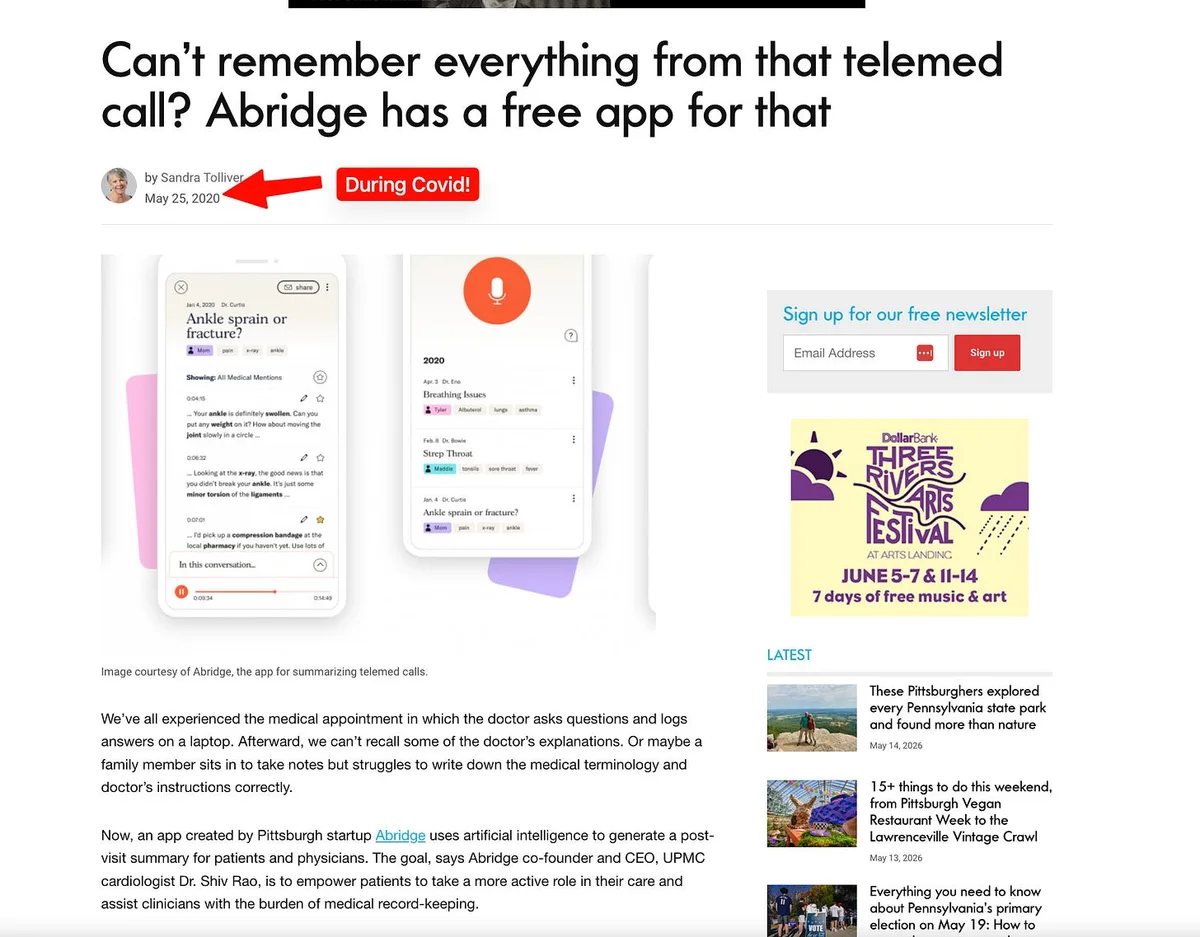
Reproduced by Latent Space; the pictured article credits the app image to Abridge. Original publisher is not identified in the screenshot.
Effron highlighted Abridge’s Linked Evidence feature, which traces each sentence in a generated note to a specific part of the clinical conversation, alongside integration with Epic. For him, traceability and workflow integration were reasons to back the company: clinicians needed both a way to inspect generated output and a product that fit their existing work.[7]
In April 2024, Effron, Chase, Jordan Segall and Crystal Liu published Eight Key Lessons for Rocket-Shipping AI Products. Their recommendations extended from experimentation into production: launch to gather feedback, keep customers involved in creation, understand cost levers and test features internally before external rollout. They described Adobe’s explicit and implicit user-feedback signals as inputs for improving Firefly, and Intercom’s comparisons across models as a way to route some calls to cheaper alternatives. These were collaborative lessons drawn from guests’ experience, rather than systems Effron built himself.[6]
Timeline
- role
Joined Redpoint
He joined Redpoint in 2020.[3] - release
Published practical lessons on deploying LLM features with Patrick Chase
On February 27, 2023, Effron and Chase published Using Large Language Models Effectively, drawing on conversations with ten founders and executives who had deployed LLM-based features.[5] - funding
Announced Redpoint’s co-lead of Abridge’s Series C
On February 23, 2024, Effron announced that Redpoint was co-leading Abridge’s $150 million Series C.[7] - release
Coauthored lessons on taking AI products into production
In April 2024, Effron, Chase, Jordan Segall and Crystal Liu published Eight Key Lessons for Rocket-Shipping AI Products.[6] - milestone
Reconsidered the value of temporary post-training improvements
In the April 2026 Latent Space crossover, Effron described becoming more open to post-training for quality improvements.[1] - milestone
Interviewed Abridge leaders on clinical AI with swyx
In the May 2026 Abridge crossover, Effron and swyx interviewed Janie Lee and Chaitanya “Chai” Asawa.[2]
From the Latent Space archive
Original posts and separately reviewed explanations.
AIE Europe Debrief + Agent Labs Thesis: Unsupervised Learning x Latent Space Crossover Special (2026)
ConversationAI-Native Healthcare: 100M Doctor Visits, 10–20 Hours Saved, Prior Auth in Minutes — Janie Lee & Chai Asawa, Abridge
Grounded writeupAbridge: From Clinical Notes to Decisions During the Visit
Grounded writeupThe Agent Lab Playbook: Build at the Frontier, Specialize Around the Work
Sources
- 1
- 2
- 3Jacob Effron | Redpoint VenturesAccessed 2026-09-20
- 4About - Unsupervised LearningAccessed 2026-09-20
- 5Using Large Language Models EffectivelyAccessed 2026-09-20
- 6Eight Key Lessons for Rocket-Shipping AI ProductsAccessed 2026-09-20
- 7Investing in AbridgeAccessed 2026-09-20
Model source and teaching reviews passed. Human editorial review pending. This profile describes the sources as of 2026-09-20.