

Browse · People
Ivan Leo
AI engineer and Instructor contributor whose work spans structured outputs, retrieval evaluation and general-purpose agents.
Ivan Leo works on language-model applications, from Pydantic-based structured outputs in Instructor to general-purpose agents at Manus. As of September 2026, his personal site describes his work in Developer Experience at Google DeepMind: making Gemini easier to build on and evaluating autonomous agents. He uses the GitHub handle ivanleomk.[2][3]
In his September 1, 2026 essay “Value Maxxing”, Leo argues that useful outcomes matter more than token consumption. After joining DeepMind, he recalls using Gemini for daily and weekly reflection: reviewing his calendar, discussing progress against priorities and having the model update markdown files. This modest workflow illustrates his advice to begin with everyday friction before attempting larger automation.[6]
Leo also emphasizes verification and collaboration over raw code-generation speed. In the same essay, he warns that producing code without tests or context shifts the cognitive burden onto teammates. He recommends deterministic validation, reproducible test cases, clear accounts of failure modes and documentation that helps others use the work.[6]
Earlier work: structured outputs and evaluation, 2024–2025
Before his DeepMind work, Leo contributed to Instructor, which makes it easier to obtain reliable structured outputs from language models using Pydantic. He shares author credit with Jason Liu in its package metadata. This shared project provides context for Leo’s earlier writing about checking model behavior with simple, explicit tests.[2][4][5]
In “Write Stupid Evals”, published November 26, 2024, Leo describes his evaluation philosophy as “start simple, start now, and improve through practice.” A basic assertion that an output is valid JSON can expose formatting problems or a response schema that is too complex for the model. He favors suites that are quick, understandable and easy to run locally, so evaluation becomes a habit during development.[5]
Leo describes comparing text-to-SQL retrieval approaches, including raw snippets, generated summaries and changes to the input of a Cohere reranker. Using a metric he calls recall@k gave the team a concrete signal for comparing approaches and tradeoffs; his simplified example checks whether one relevant snippet appears among the top k results for each query. For agents, he recommends first testing whether the model selects the right tool, then adding multiple-tool selection, argument validation and chain verification while retaining baseline checks for regressions.[5]
Leo was announced as joining Jason Liu for a free special edition of their premium RAG workshop at the AI Engineer Summit in its February 20, 2025 announcement. Their workshop’s improvingrag.com context emphasized a framework for improving application performance, quality and user experience.[1]
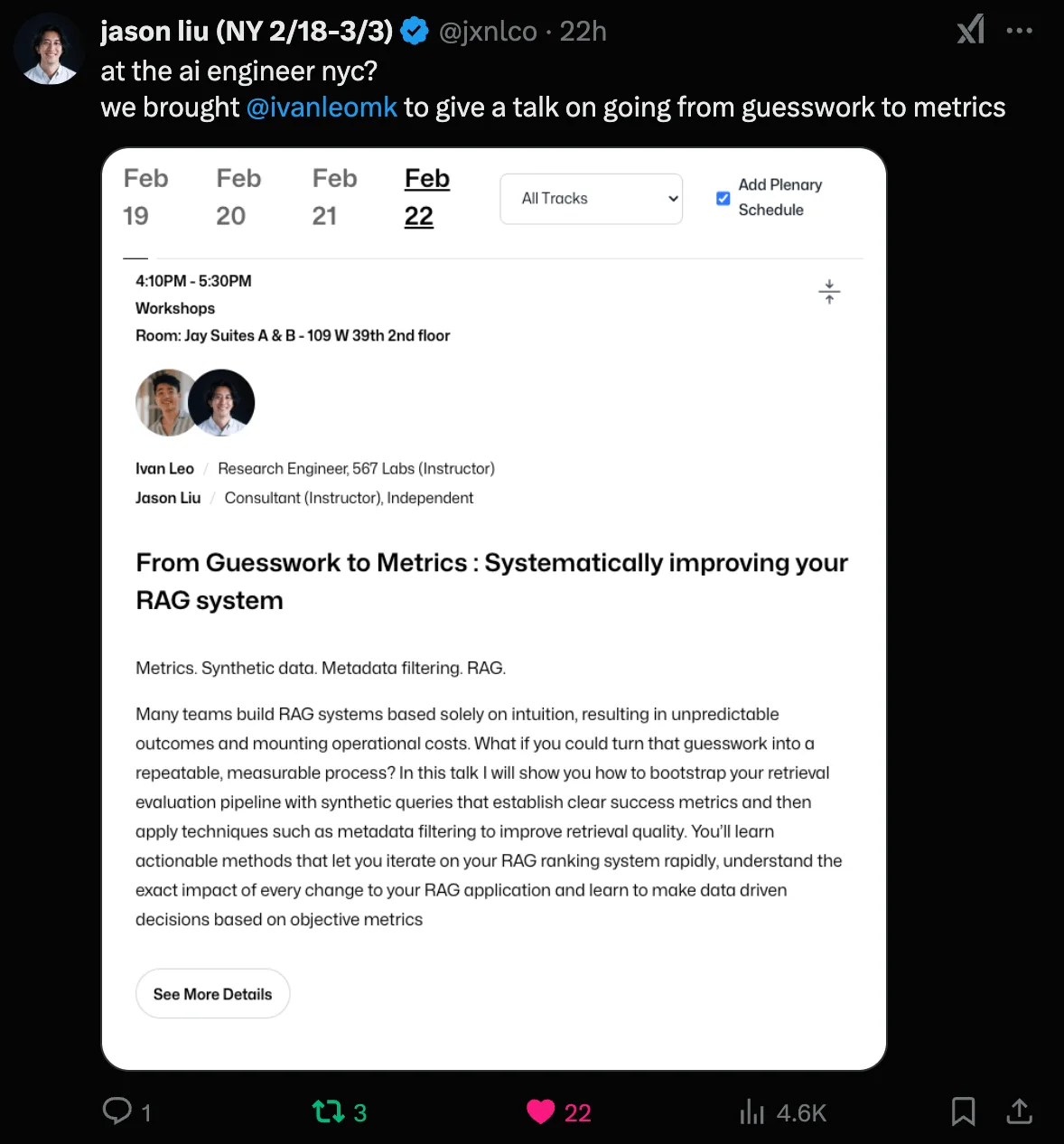
Jason Liu (@jxnlco) on X; screenshot published by Latent.Space.
Building and owning agent features at Manus
In his December 22, 2025 Manus retrospective, Leo recounts being asked to demonstrate triggering an agent task through email. He initially proposed a script, but his boss, 潘潘, pushed for something real. Leo says he made a live prototype that accepted an email and triggered a task, giving colleagues something usable to react to. After shipping Mail Manus, he filmed a demonstration, followed up on documentation and answered users’ questions.[7]
Leo’s account also describes reworking file suggestions after a sequential upload-and-processing flow left users waiting through a seven-second spinner. For a new Stripe integration, he used real charges on his own credit card to verify that websites built by Manus could move money correctly. He presents these decisions as part of ownership extending beyond a merged pull request to the people using the feature.[7]
After the Manus API launched, Leo says he fixed attachment-handling and connection bugs and became its main developer. The work involved maintaining changes to the internal agent framework while writing production Go for the first time. He learned through reading the codebase and pull requests, using models to explain unfamiliar patterns, rebuilding things to test his understanding and seeking feedback.[7]
Leo also brought Kura, a clustering library he had helped build before joining Manus, into internal analysis of customer-support tickets. He says it became essential to understanding failure modes across 17 or more locales. His broader engineering judgment was that prototypes reveal a model’s tendencies and the help it needs: “Too much scaffolding constrains what the model can do. Too little and it flails.”[7][3]
Timeline
- release
Publishes “Write Stupid Evals,” advocating simple, practical checks
In “Write Stupid Evals”, published November 26, 2024, Leo describes his evaluation philosophy as “start simple, start now, and improve through practice.”[5] - milestone
Announced alongside Jason Liu for an AI Engineer Summit RAG workshop
Leo was announced as joining Jason Liu for a free special edition of their premium RAG workshop at the AI Engineer Summit in its February 20, 2025 announcement.[1] - release
Publishes Manus retrospective on prototyping and feature ownership
In his December 22, 2025 Manus retrospective, Leo recounts being asked to demonstrate triggering an agent task through email.[7] - release
Publishes “Value Maxxing,” prioritizing useful outcomes over token consumption
In his September 1, 2026 essay “Value Maxxing”, Leo argues that useful outcomes matter more than token consumption.[6]
Sources
- 1AI Engineer Summit Online (UPDATED)Accessed 2026-09-20
- 2Ivan LeoAccessed 2026-09-20
- 3ivanleomk (Ivan Leo) · GitHubAccessed 2026-09-20
- 4instructor/pyproject.toml at main · 567-labs/instructorAccessed 2026-09-20
- 5Write Stupid EvalsAccessed 2026-09-20
- 6Value MaxxingAccessed 2026-09-20
- 7Three Lessons I've Learned at ManusAccessed 2026-09-20
- 8How I Broke Into AI Without a RoadmapAccessed 2026-09-20
Model source and teaching reviews passed. Human editorial review pending. This profile describes the sources as of 2026-09-20.