

Browse · People
Ian Livingstone
Keycard cofounder focused on task-scoped access, accountable delegation, and control over autonomous AI agents.
Ian Livingstone is a cofounder of Keycard, identified as its CEO in January and April 2026. His work centers on identity and authorization for autonomous AI agents: defining what an agent may do on someone’s behalf, limiting access to the task, and retaining the ability to trace and revoke that access.[3][2]
Access should follow the task
In an April 28, 2026 interview with Swapnil Bhartiya, Livingstone argued that agents need access across many systems, but their permissions should change with the task and stage of work. His example was an agent asked to locate a database containing particular information: that request should not also authorize exporting, deleting, or modifying the data. He distinguished this need from broad human permissions based on trust in a person’s judgment and narrowly scoped workload permissions designed for static services.[2]
Livingstone advocates execution-time authorization, asking whether an agent may perform a particular action in the current session rather than relying only on whether the user has access to a system. The decision should consider the user’s prompt, whom the agent represents, its task, the requested application and action, and organizational policy. He also calls for a distinct, stable agent identifier and delegation rules that specify which users may grant which agents access—and when a human must participate in a decision.[2]
He identifies “consent fatigue” as a risk of asking people to approve every tool call: repeated prompts can encourage indiscriminate approval. Keycard describes its approach as combining user, device, agent, and task identity, checking policy when access is requested, and issuing short-lived, task-scoped credentials. The agent then calls the downstream API directly; Keycard issues credentials rather than proxying the data. This provides technical context for Livingstone’s approach to governing access.[2][5]
Revocation and an independent audit trail
In an August 28, 2026 post on his public LinkedIn profile, Livingstone described an agent access “kill switch” as requiring a stable identifier, centralized tracking, and authority to revoke access wherever the agent operates. On September 1, he argued that “the log of what an agent did must live outside of its control.” He linked that principle to Keycard’s audit logging, which he said records credential grants and actions through delegation chains, including the acting agent, the person represented, permissions, and whether a request succeeded or failed.[4]
An enterprise-first decision
On September 2, 2026, Livingstone said on his public LinkedIn profile that Keycard had spent the preceding 18 months working with enterprises with demanding security, control, and scale requirements. He described the choice as deliberate: meeting those enterprises’ requirements would help Keycard serve other customers. He announced plans to bring that work to a broader builder audience that fall, welcoming Ethan Schechter and Jenny Liang to help. Later that month, he expressed agreement with Joel de la Garza that the eventual layers of agent infrastructure remained uncertain.[4]
Verifiability and coding loops
At the AI Engineer World’s Fair debate reported by Richard MacManus on July 3, 2026, Livingstone presented the pro-loop case alongside Geoffrey Huntley. Allie Howe moderated; Dex Horthy and Greg Pstrucha presented the skeptical case. Livingstone argued that verifiability matters regardless of how code is produced, and framed loops as accelerating an established development process: “A loop is at the core of ‘I try something, I learn something, I apply something.’ And all we’re really talking about is how quickly we can expedite that process.”[1]
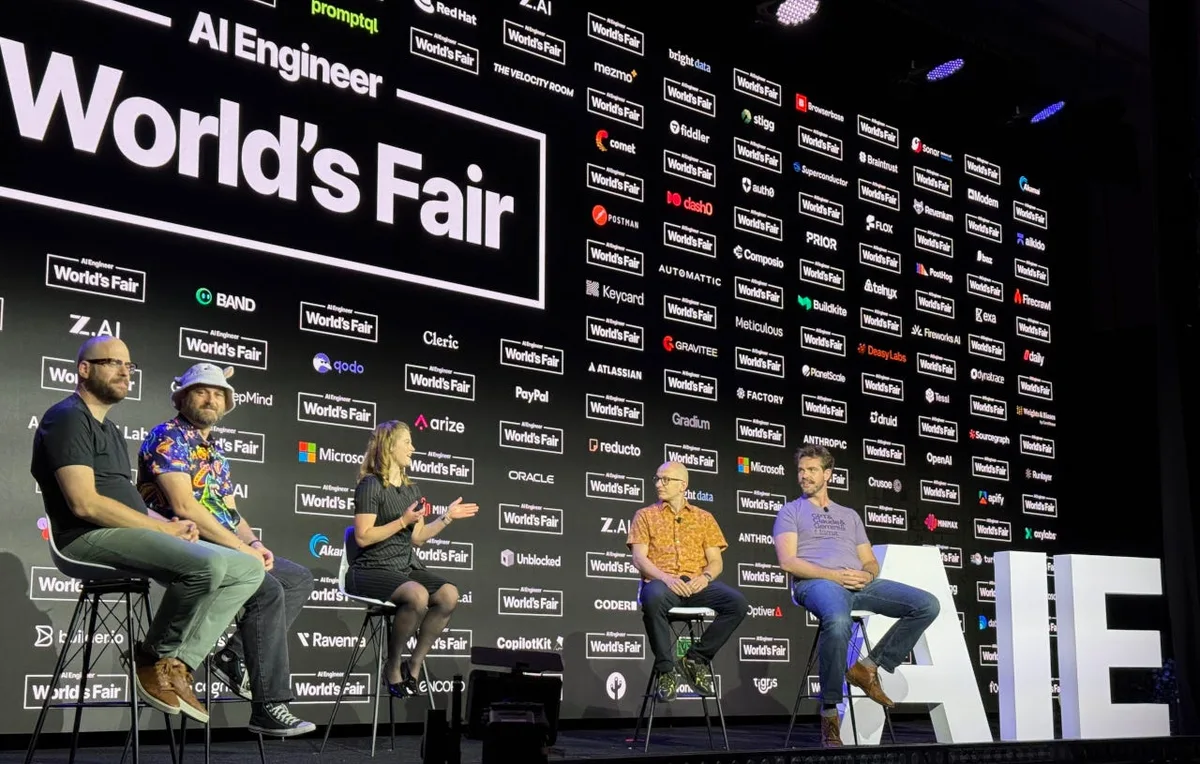
Latent.Space; photographer not identified in the supplied source.
Timeline
- milestone
Argues that agent permissions should follow the task
In an April 28, 2026 interview with Swapnil Bhartiya, Livingstone argued that agents need access across many systems, but their permissions should change with the task and stage of work.[2] - milestone
Reported debate: presents the pro-loop case with Geoffrey Huntley
At the AI Engineer World’s Fair debate reported by Richard MacManus on July 3, 2026, Livingstone presented the pro-loop case alongside Geoffrey Huntley.[1] - milestone
Defines requirements for an agent access kill switch
In an August 28, 2026 post on his public LinkedIn profile, Livingstone described an agent access “kill switch” as requiring a stable identifier, centralized tracking, and authority to revoke access wherever the agent operates.[4] - milestone
Calls for audit logs outside an agent’s control
On September 1, he argued that “the log of what an agent did must live outside of its control.”[4] - milestone
Explains enterprise-first strategy and plans broader builder access
On September 2, 2026, Livingstone said on his public LinkedIn profile that Keycard had spent the preceding 18 months working with enterprises with demanding security, control, and scale requirements. He described the choice as deliberate: meeting those enterprises’ requirements would help Keycard serve other customers. He announced plans to bring that work to a broader builder audience that fall, welcoming Ethan Schechter and Jenny Liang to help.[4]
Sources
- 1AIEWF Daily Dispatch: The great loops debate and the state of AI engineeringAccessed 2026-09-20
- 2
- 3Keycard: 2026 is the Year of AgentsAccessed 2026-09-20
- 4Ian Livingstone - Keycard | LinkedInAccessed 2026-09-20
- 5Keycard — The Control Plane for Autonomous AgentsAccessed 2026-09-20
Model source and teaching reviews passed. Human editorial review pending. This profile describes the sources as of 2026-09-20.