

Co-founder and Chief Science Officer of · as of 2026-09-15
Browse · People
Person · Latent Space wiki
Guillaume Lample
Mistral’s co-founder and Chief Science Officer has contributed to efficient language models, unsupervised translation and neural symbolic mathematics.
Guillaume Lample is a co-founder and Chief Science Officer of Mistral AI and a co-author of the original LLaMA and Mixtral papers. His contributions include learning translation without paired sentences, generating training data for symbolic mathematics, and designing language models around practical inference budgets. At Mistral, he has advocated accessible models and research, specialist models for economical deployment, and formal proof checking as a source of reliable feedback.[1][8][9][4][6][10]
LLaMA’s serving costs and Mixtral’s sparse routing
At Meta AI, Lample co-authored LLaMA: Open and Efficient Foundation Language Models, published in February 2023, alongside Hugo Touvron, Timothee Lacroix and other researchers. The team distinguished a model optimized for a fixed training budget from one that is economical to serve repeatedly. Training a smaller model longer can require more development computation while reducing the cost of subsequent requests. LLaMA comprised models from 7B to 65B parameters, trained on publicly available datasets and initially released to the research community.[8]
Lample subsequently co-founded Mistral with Arthur Mensch and Timothee Lacroix. Mensch is its CEO, Lacroix its CTO, and Lample its Chief Science Officer.[1][8]
At Mistral, Lample co-authored Mixtral of Experts, published in January 2024. Its sparse architecture separates model capacity from computation per token: each layer contains eight feedforward expert blocks, but a router selects two for each token and combines their outputs. Different tokens can use different experts. Mixtral has approximately 47B total parameters and uses 13B active parameters per token; memory requirements still depend on the full model, and routing adds overhead. The team released its base and instruction-tuned weights under Apache 2.0.[9]
In his March 30, 2026 Latent Space interview, Lample connected Mistral’s release policy to his experience with LLaMA. He argued that access to model weights allowed university researchers and others to develop post-training methods, accelerating the wider research community. He also advocated detailed technical reports that share unsuccessful approaches alongside successful ones, and opposed a future in which access to the most capable models is controlled by a few companies.[10]
Developing speech capabilities separately
Lample described Mistral’s audio priorities as decisions made jointly with its audio team: begin with transcription, develop speech generation, and optimize each capability before combining them. The intended destination was a full-duplex system that could listen and speak concurrently. Mistral had announced Voxtral TTS on March 23, 2026 as a 4B-parameter text-to-speech model supporting nine languages; the combined full-duplex system remained an intended direction in the interview.[10][13]
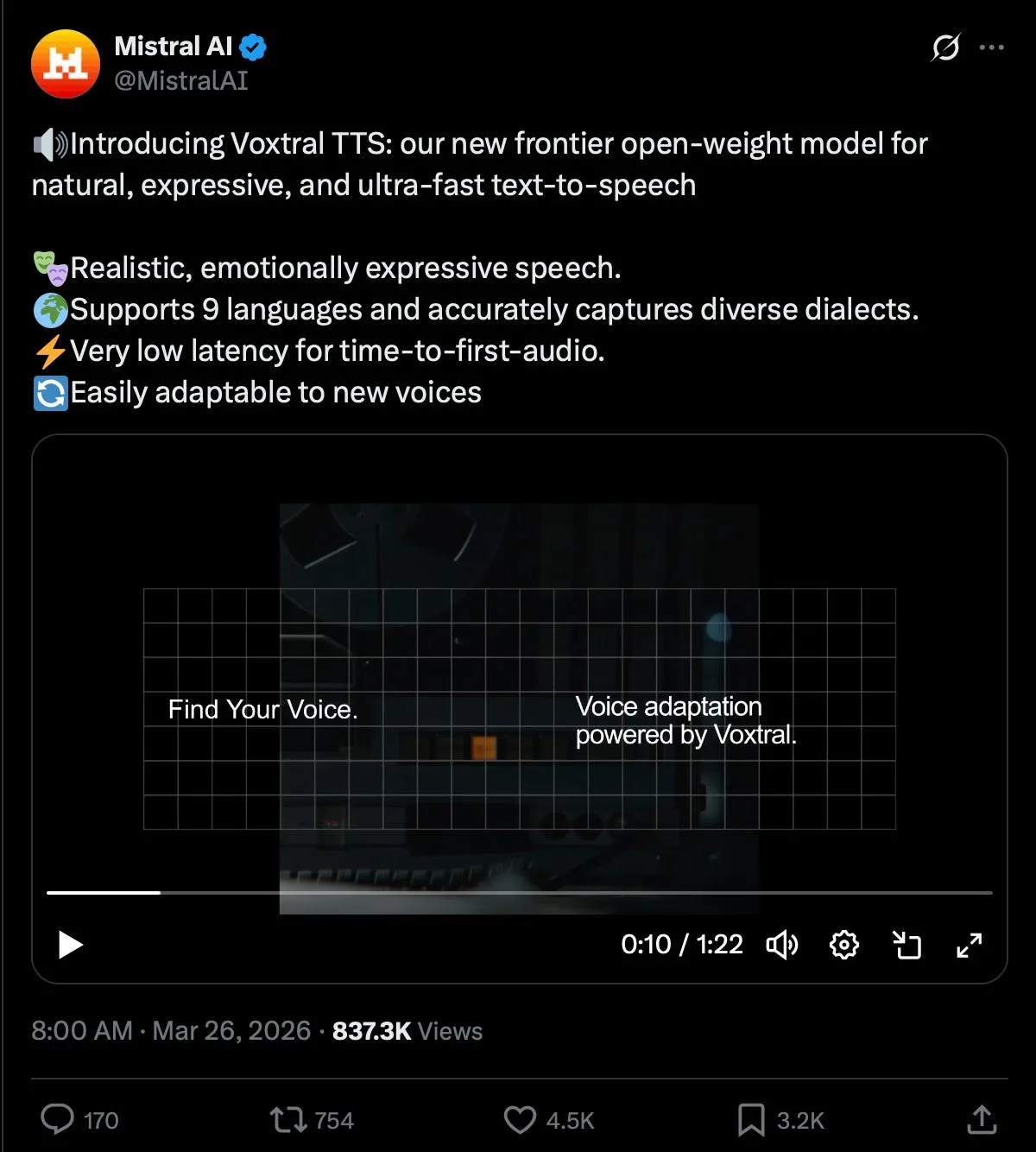
Mistral AI (@MistralAI), via Latent Space.
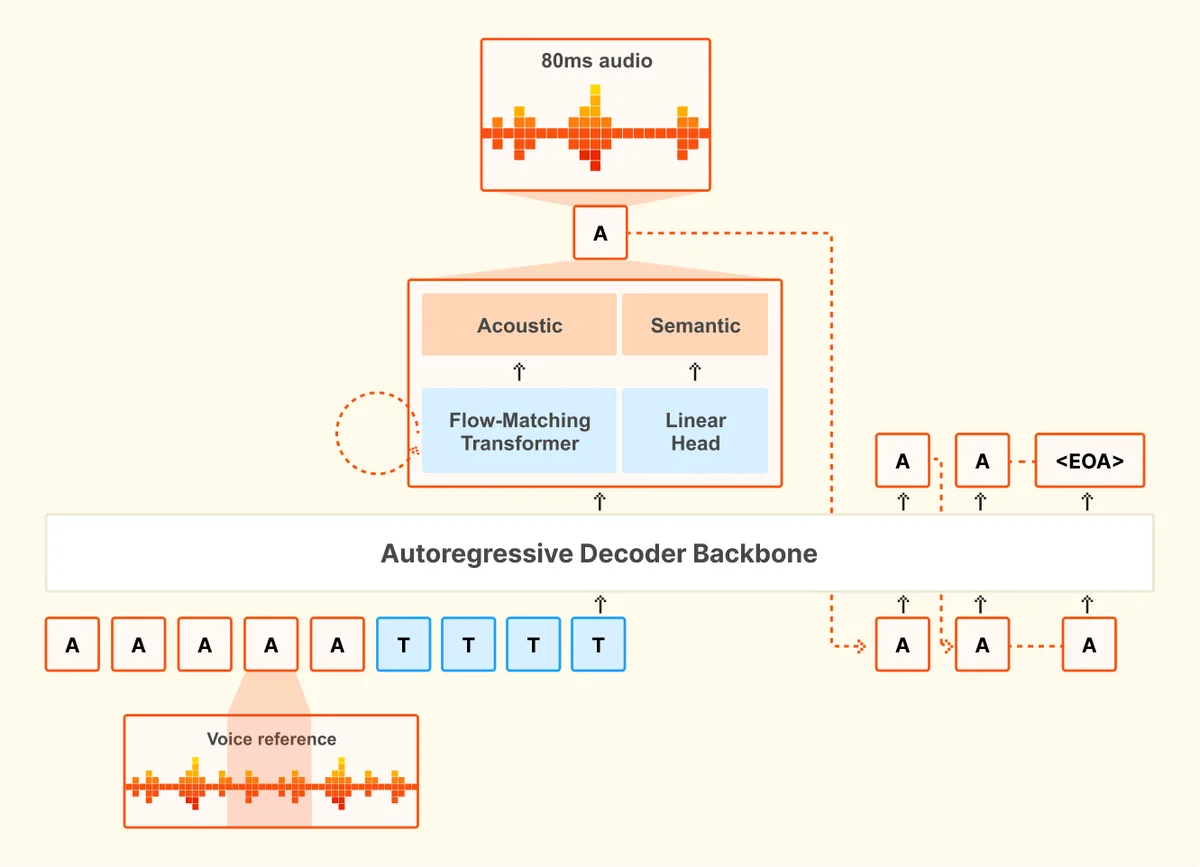
Published by Latent Space in its Voxtral interview; diagram creator not identified in the supplied evidence.
Lample also defended retaining specialist models alongside general models. For a task such as transcription or OCR, he argued, a small model dedicated to that capability can be more economical than a general model containing capabilities the user does not need.[10]
Customer deployment changed his understanding of the work required beyond releasing a model. Lample recalled that Mistral initially underestimated the difficulty of connecting models to company knowledge and production workflows. He described customer-facing engineers and researchers sharing tools and data pipelines, with customer failures supplying edge cases for subsequent models. In his account, this feedback exposes weaknesses that public benchmarks may miss.[10]
Formal proofs as a correctness signal
In the same interview, Lample explained his interest in mechanically checked proofs. An informal proof is difficult to judge automatically: comparing it with a reference can penalize a valid alternative, while a model judge can introduce unreliable rewards. Lean provides a clearer signal by checking whether a proof establishes the specified formal statement under its assumptions.[10][11]
Mistral’s Leanstral launch on March 16, 2026 brought that approach into an agent for formal proof engineering in Lean 4 repositories, with Apache 2.0 weights and Mistral Vibe integration. Lample argued that reducing the expertise barrier could broaden formal software verification. That is an ambition about adoption; a checked proof establishes the formal specification, rather than ensuring that the specification captures every intended behavior.[11][10]n1
Before LLaMA and Mistral, Lample worked on reinforcement learning, translation and symbolic mathematics. These earlier projects provide concrete context for his later work on multilingual models and verifiable mathematical outputs.[3][4][5][6][10]
Earlier research: Doom and unsupervised translation, 2016–2019
Lample and Devendra Singh Chaplot contributed equally to Playing FPS Games with Deep Reinforcement Learning, first submitted in September 2016. Their Doom agent addressed a first-person environment where the current screen reveals only part of the game state. They combined recurrent Q-learning with auxiliary enemy detection during training and separate networks for navigation and combat. Enemy labels helped train visual features but were unavailable at test time. The authors reported outperforming built-in bots and human players in their deathmatch experiments.[3]
In Unsupervised Machine Translation Using Monolingual Corpora Only, published at ICLR 2018, Lample, Alexis Conneau, Ludovic Denoyer and Marc’Aurelio Ranzato investigated translation from separate collections of text in each language. Conventional supervised translation relies on aligned sentence pairs, which are costly to obtain and scarce for many language pairs.[4]
Their system began with word-by-word translation using a dictionary learned from monolingual data. It learned to reconstruct corrupted sentences, used adversarial training to align the languages’ internal representations, and applied iterative back-translation: translate a sentence into the other language, then train the reverse direction to recover the original. Imperfect translations supplied provisional training pairs that improved as the models improved. The authors credited earlier back-translation work and acknowledged that their system did not match supervised approaches with abundant parallel data.[4]
Lample’s doctoral thesis, supervised by Denoyer and defended on October 17, 2019, addressed unsupervised machine translation. That year, he and Conneau also introduced Cross-lingual Language Model Pretraining, extending pretraining across languages through approaches using monolingual and parallel text. This work developed multilingual representations for tasks beyond translation alone.[2][5]
Symbolic mathematics and generated exercises, 2019–2020
In Deep Learning for Symbolic Mathematics, first submitted in December 2019, Lample and François Charton contributed equally to treating integration and differential equations as sequence-learning problems. They represented expressions as trees, with operators at internal nodes and variables or numbers at the leaves, then learned mappings from expressions to their solutions. A central engineering problem was producing enough useful training examples.[6]
- Forward generation: generate random functions and ask a computer algebra system to integrate them, discarding failures. This is slow and restricts examples to problems that the algebra system can solve.[6]
- Backward generation: generate a function, differentiate it, and reverse the pair to create an integration exercise with a known answer. For example, differentiating x³ produces 3x²; reversing the pair supplies an integration problem without first requiring an integration solver.[6]
The cheaper backward method introduced a distribution bias: it tended to create longer problems with shorter solutions. Models trained only on those examples performed poorly on forward-generated tests. Mixing generation methods, including integration-by-parts examples, improved coverage. The paper’s comparisons with algebra systems concerned its generated test distributions and experimental settings; performance across generators showed why correct synthetic answers alone were insufficient.[6]
Explaining the work to Quanta in May 2020, Lample said: “We think the model tries to find clues in the symbols about what the solution can be.” He also said theorem generation and proving were under investigation.[7][10]
Timeline
From the Latent Space archive
Original posts and separately reviewed explanations.
Notes
- The March 2026 Leanstral API model was retired on June 30, 2026. Its version-specific documentation directs new integrations to Leanstral 1.5.[12]
Sources
- 1About MistralAccessed 2026-09-17
- 2LAMPLE Guillaume — LIP6Accessed 2026-09-17
- 3Playing FPS Games with Deep Reinforcement LearningAccessed 2026-09-17
- 4Unsupervised Machine Translation Using Monolingual Corpora OnlyAccessed 2026-09-17
- 5Cross-lingual Language Model PretrainingAccessed 2026-09-17
- 6Deep Learning for Symbolic MathematicsAccessed 2026-09-17
- 7Symbolic Mathematics Finally Yields to Neural NetworksAccessed 2026-09-17
- 8LLaMA: Open and Efficient Foundation Language ModelsAccessed 2026-09-17
- 9Mixtral of ExpertsAccessed 2026-09-17
- 10
- 11Leanstral: Open-Source foundation for trustworthy vibe-codingAccessed 2026-09-17
- 12Leanstral — Mistral model documentationAccessed 2026-09-17
- 13Speaking of VoxtralAccessed 2026-09-17
- 14Text to Speech — Mistral documentationAccessed 2026-09-17
Model source and teaching reviews passed. Human editorial review pending. This profile describes the sources as of 2026-09-17.