

Browse · People
Greg Pstrucha
Engineer and Subroutine cofounder working on AI agents, trusted skill distribution, and development tools that make agent behavior easier to test and constrain.
Greg Pstrucha is an engineer on Sentry’s AI/ML team and a cofounder of Subroutine. His AI work includes developing dotagents with colleagues, experimenting with specification-driven skills, and testing how malicious skills can compromise coding-agent environments. He favors deterministic checks and constrained environments while questioning whether more autonomous agent loops reliably produce better software.[2][4][6][7]
Production agents and engineering guardrails
At Sentry, Pstrucha works on Seer, an agent that investigates production issues using telemetry and source code. In his July 2026 interview on The Task at Hand, he described a workflow that examines crashes, metrics, and logs, identifies a likely cause, and proposes a fix or hands work to Claude Code or Cursor. The team was also experimenting with overnight investigations that could leave pull requests ready for review. He distinguished these production agents from local coding agents: production access is limited through sandboxing and permissions, including proxy-mediated access that keeps credentials off the agent’s machine.[7]
Pstrucha argues that codebases should be prepared so agents have fewer opportunities to make mistakes. His preferred first line of defense includes tests, strict typing, and custom lint rules, with LLM-based review serving as a secondary check. He reported that a rule preventing two functions from sharing a name helped expose and reduce duplication. These checks have limits: he said that deciding when an abstraction is needed, and judging higher-level complexity, still require experienced judgment.[7]
That distinction informs his skepticism about unattended coding loops. In the interview, he argued that software takes multiple passes because engineers discover what they want while building it. At the 2026 AI Engineer World’s Fair, he also questioned the economic sustainability of agentic loops. Richard MacManus’s conference dispatch quoted his warning that developers cannot “orchestrate your problems away by buying more tokens.”[7][1]
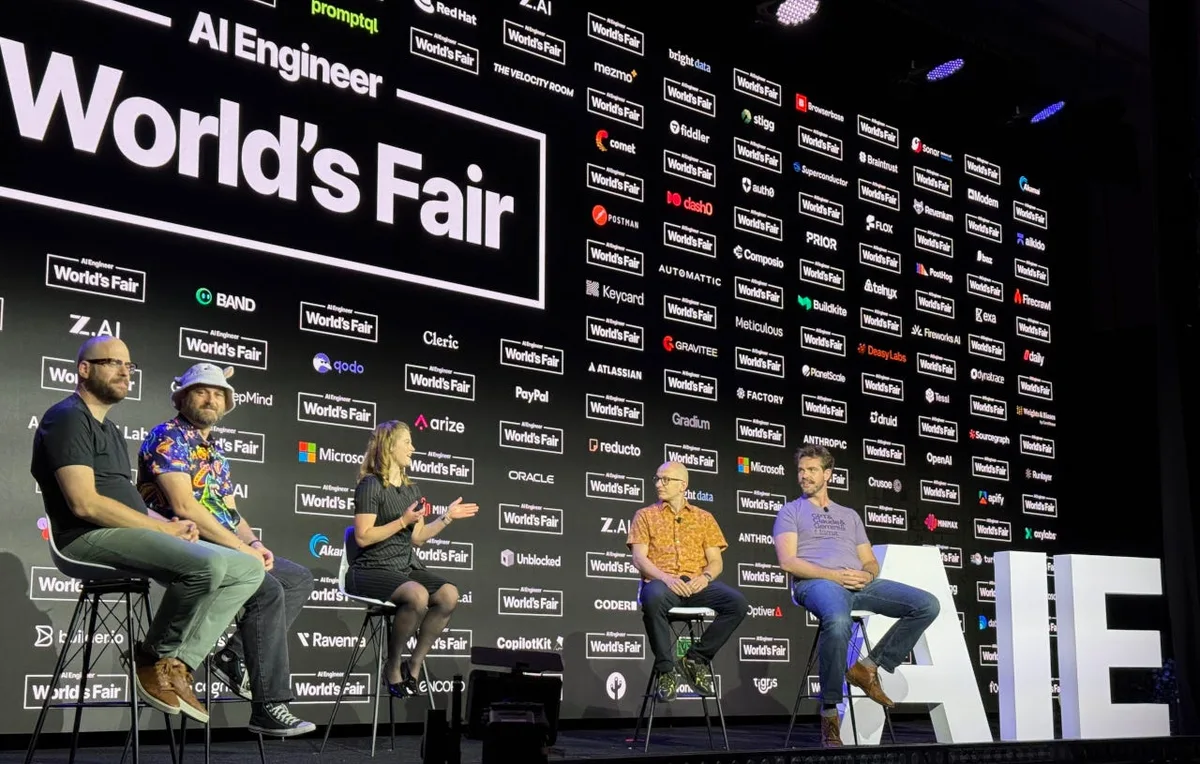
Latent.Space; photographer not identified in the supplied source.
Skills, provenance, and maintainability
In Dangerous Skills, published March 24, 2026, Pstrucha described experiments testing malicious skills through Claude Code and OpenCode after those skills reached a host machine. He reported that instructions embedded in a PNG induced Opus 4.6 and Codex 5.3 to run a custom script. His central distinction was between instructions a model might reject and execution paths outside that judgment: a harness can execute commands while loading a skill, and pytest can automatically execute a bundled conftest.py when tests run.[4]
The experiments reinforced his preference for internally written skills or sources he already trusts. He said Sentry wrote its skills in-house with a few exceptions from major labs, and that he did not allow agents to discover and install new skills on their own. His practice also contains a tension: he advised avoiding Claude Code’s --dangerously-skip-permissions flag because permission prompts could interrupt some exploits, while acknowledging that he used it himself.[4]
Pstrucha and colleagues developed dotagents to manage trusted agent tools across coding harnesses. In July 2026, he described it as distributing skills, subagents, hooks, plugins, and MCP configuration across tools rather than providing a marketplace or autonomous discovery ecosystem. He deliberately left the choice of trusted sources with users and teams. He also described a change from explicit updates and pinned versions to automatic updates by default, with optional pinning, repository allowlists, and a minimum release age. He regarded release delays as a useful mitigation, while noting that they can also delay an urgently needed security fix.[4][7]
When dotagents’ bundled skill drifted behind changes to its CLI, Pstrucha implemented the experimental tool Skillet. His July 29, 2026 account describes a Markdown specification containing intent, behaviors, constraints, and triggers. That specification supplies both generated SKILL.md prose and evaluation cases; the CLI uses the user’s agent rather than making its own LLM calls. He presented Skillet as a way to test and maintain skills, explicitly saying his comparisons had not shown improved accuracy over skills generated from a single prompt. Generated prose remained nondeterministic, with passing evaluations as his acceptance criterion.[6]
Earlier foundations: infrastructure and Subroutine
Before his work on AI agents, Pstrucha worked on mobile infrastructure and developer tooling. His career record lists Facebook from 2013 to 2019, where he worked on memory usage and iOS startup performance and created FBRetainCycleDetector. His project record dates the library to 2016 and describes it as detecting runtime retain cycles that cause memory leaks in Objective-C iOS applications. From 2019 to 2022, he led Robinhood’s API Platform team, helping engineers contribute to the API service and build on its backend.[2][3][7]
Pstrucha recalls leaving in 2022 to start a company that initially pursued gaming marketplaces, then moved into AI experiments around early 2023. At Subroutine, the team built an early application builder focused on simple Slack bots rather than user interfaces. Unreliable JSON output required repair attempts and deterministic response checks. Although he expected better models to improve the builder, he said the team did not double down on it. His career record lists Subroutine from 2022 to 2025; in the July 2026 interview, he recalled that he and his cofounder joined Sentry at the beginning of 2026.[2][7]
His October 2025 article Cubicles for agents explains another practical development decision: git worktrees separate code but leave agents sharing a host runtime, with potential service-port conflicts and access to unwanted tools. He created a Docker-based workspace CLI to reproduce development environments in separate containers, typically running two or three agents at once. He still reported friction around agent credentials, and the setup included access to host resources, so the containers were not an absolute security boundary.[5]
Pstrucha credited his cofounder Jeremy with aggressively automating away developer friction. Their service CLI started containers, watched files, and ran supporting processes such as GraphQL type regeneration, giving agents a shorter feedback loop. The team continued reviewing AI-written code and converted recurring problems into ESLint rules. Pstrucha also constrained available tools—for example, leaving kubectl out of an agent sandbox—rather than relying entirely on written instructions.[5]
Timeline
- role
Worked on iOS performance and created FBRetainCycleDetector at Facebook
His career record lists Facebook from 2013 to 2019, where he worked on memory usage and iOS startup performance and created FBRetainCycleDetector.[2] - role
Led Robinhood’s API Platform team
From 2019 to 2022, he led Robinhood’s API Platform team, helping engineers contribute to the API service and build on its backend.[2] - research
Published experiments on malicious coding-agent skills
In Dangerous Skills, published March 24, 2026, Pstrucha described experiments testing malicious skills through Claude Code and OpenCode after those skills reached a host machine.[4] - project
Described Skillet’s specification-driven approach to maintaining skills
When dotagents’ bundled skill drifted behind changes to its CLI, Pstrucha implemented the experimental tool Skillet. His July 29, 2026 account describes a Markdown specification containing intent, behaviors, constraints, and triggers.[6]
Sources
- 1AIEWF Daily Dispatch: The great loops debate and the state of AI engineeringAccessed 2026-09-20
- 2Work | gricha.devAccessed 2026-09-20
- 3Projects | gricha.devAccessed 2026-09-20
- 4Dangerous SkillsAccessed 2026-09-20
- 5Cubicles for agentsAccessed 2026-09-20
- 6Spec-driven skill generationAccessed 2026-09-20
- 7Greg Pstrucha on Practical AI - Episode 3Accessed 2026-09-20
Model source and teaching reviews passed. Human editorial review pending. This profile describes the sources as of 2026-09-20.