

Browse · People
Fred Schott
Astro creator and Flue developer bringing composable hooks, dynamic capabilities and a built-in harness to AI agents.
Fred Schott is the creator of Astro and the developer behind Flue, an open-source agent framework. At Cloudflare, his AI work centers on making agents programmable without fixing all their capabilities in advance. He is also publicly credited as Fred K. Schott and uses the handle FredKSchott.[1][2][4]
From issue triage to dynamic agents
Flue began in 2026 as an issue-triage system inside Astro’s repository. It initially used an LLM to review issues, then gained the ability to take actions in the repository. Schott described the transition as wanting to take the Claude Code experience, “make it headless, make it hostable and run it in the cloud.” That shift made an agent’s operating environment—the harness—a central part of the framework.[1]
Schott’s first Flue API defined agents through static configuration. In his July 31, 2026 launch post, he said beta testing with developers showed that this approach worked for simple uses but broke down for more complex agents and multi-step workflows. The team chose to make a breaking API change while the project was still early. Flue 2.0, its first stable release, replaced that configuration with React-style Agent Hooks authored in TypeScript.[2]
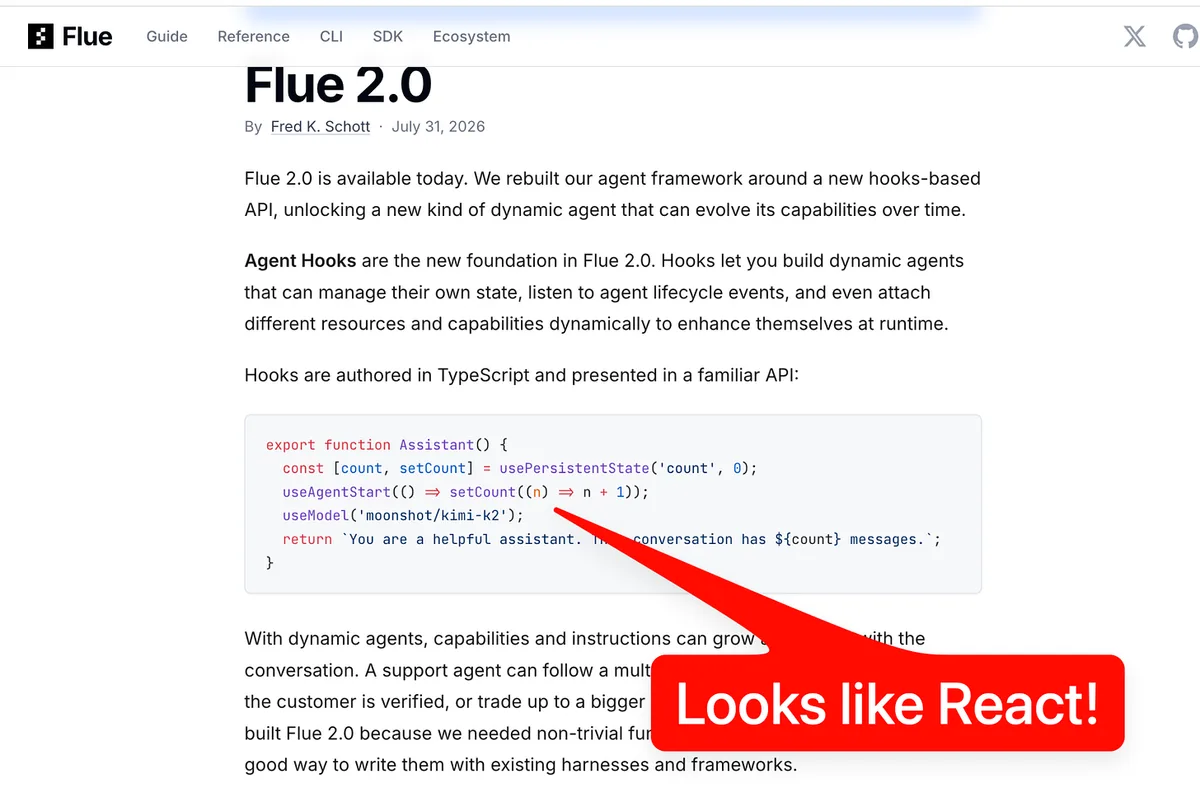
Latent Space; underlying launch post by Fred K. Schott on Flue.
In Flue, an agent is a JavaScript function that runs again before each model call. Hooks attach state, tools, skills and other capabilities to that function. Conditional code can change what the agent has available as a conversation progresses: a support agent can receive account-management tools after verifying a customer, or switch to a larger model when the work becomes harder. Custom hooks package these capabilities into reusable units.[1][2]
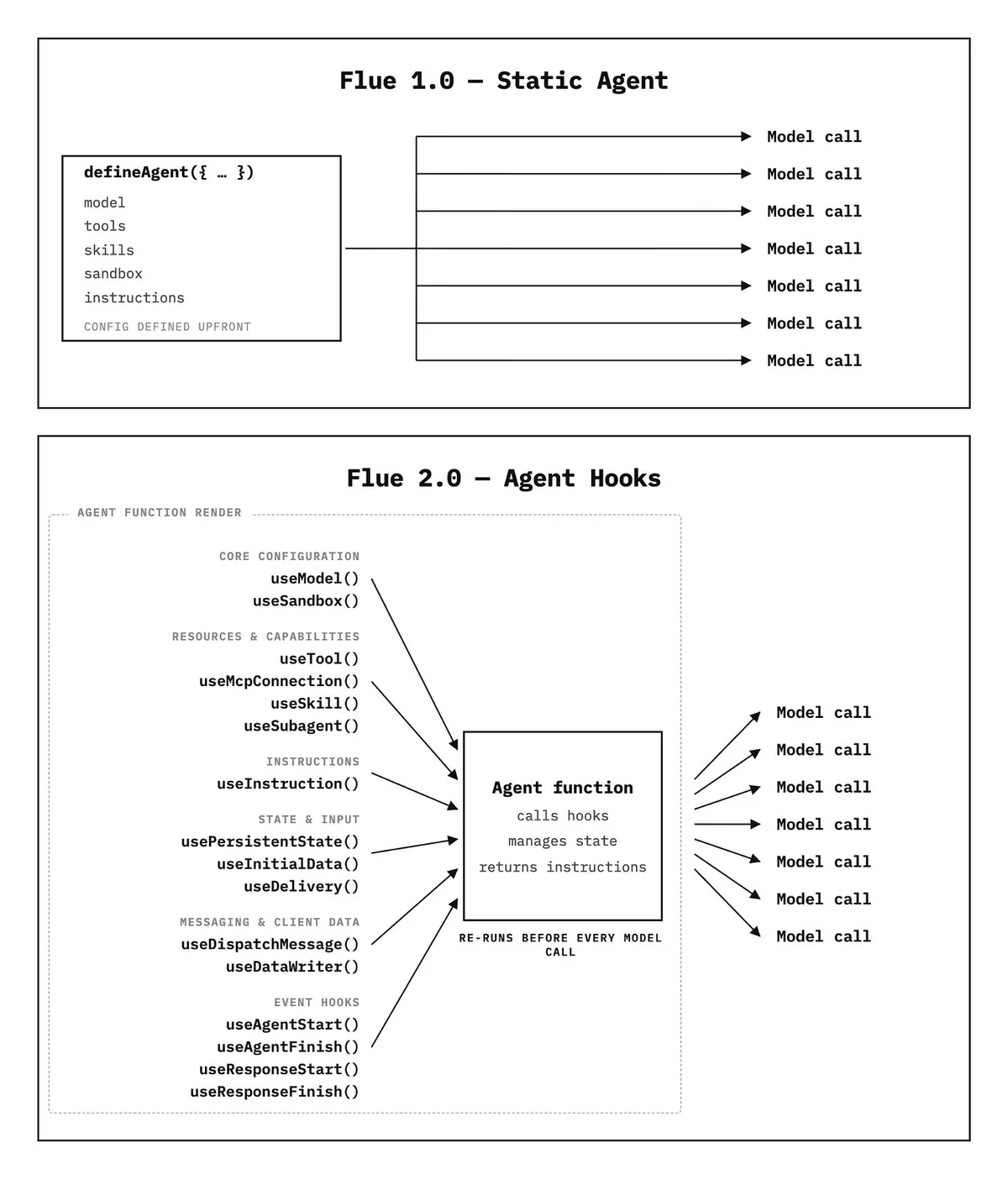
Richard MacManus / Latent Space
Schott’s launch example makes the mechanism concrete with a GitHub issue workflow: reproduce → diagnose → report. Persistent state records the current step; each step supplies its own tools and skills. A tool advances the state after reproduction or diagnosis, and the reporting step exposes a tool for posting a GitHub comment. The example expresses a workflow through state and conditional capabilities rather than one fixed agent definition.[2]
User feedback also changed which web-development ideas Schott carried into Flue. He initially borrowed file-based routing, imagining five agents in five files exposing five routes. But, he recalled, some larger customers treated their whole company as one agent and had little use for that structure. In his August 2026 interview, he explained the resulting change in emphasis: “maybe no one has even built the React for agents.” Composing capabilities became more useful than importing website routing conventions.[1]
The harness and the host
Schott argues that the harness is fundamental to an agent: “There is no agent without a harness.” Flue builds on Pi’s open-source minimal harness, adding an opinionated framework around it. He compares Pi’s place beneath Flue to Vite’s place beneath Astro. Flue 2 also delegates builds to Vite, routing to Hono and model providers to Pi, reducing its own API surface where existing ecosystem tools already serve the purpose.[1][2]
Schott designs Flue’s onboarding for AI coding agents as well as human developers. Its launch instructions invite users to pass a setup prompt to their coding agent, and its documentation supports Markdown. As he put it in August, “We very much are building for them.”[1][2]
Although he works at Cloudflare, Schott advocates Flue as an open-source framework for every host. “The best tools are the ones that float above the host,” he said, arguing that this allows wider adoption and innovation. In August 2026, he said a managed agents product was outside Flue’s roadmap at that point: the priority was building the harness.[1]
Before Flue, Schott’s framework work centered on Astro. Its 2021 launch and the subsequent effort to fund its development provide context for both his experience designing developer tools and his January 2026 move to Cloudflare.[6][5]
Historical foundations: Astro and the move to Cloudflare
Schott and Nate Moore coauthored Astro’s June 8, 2021 introduction, crediting the team behind Snowpack and Skypack and community contributors. The public beta rendered sites to static HTML during the build and loaded JavaScript selectively for interactive components. This islands architecture kept the rest of a page as lightweight HTML; the authors did not claim to have coined the term. Their design position was that poor performance could be a tooling failure, and that fast websites should be the default.[6]
The team raised money and formed The Astro Technology Company in 2021. In his January 16, 2026 announcement, Schott said attempts to introduce paid hosted products had failed to resonate as Astro itself did. He described those experiments as taking his and colleagues’ time away from the framework. Joining Cloudflare, he argued, would let the team stop spending cycles on building a business around Astro and concentrate on its code.[5]
Schott dated his more serious conversations with Cloudflare’s CTO, Dane, to 2025. Their questions included how frameworks should adapt to AI coding and agents. The January 2026 announcement confirmed that all full-time Astro company employees had become Cloudflare employees. Schott described openness as a non-negotiable condition: Astro would remain free, open-source, MIT-licensed and platform-agnostic, with support for deployment targets beyond Cloudflare.[5]
Timeline
- founding
Forms The Astro Technology Company with the team
The team raised money and formed The Astro Technology Company in 2021.[5] - release
Introduces Astro with Nate Moore
Schott and Nate Moore coauthored Astro’s June 8, 2021 introduction, crediting the team behind Snowpack and Skypack and community contributors.[6] - project
Starts Flue as Astro’s issue-triage system
Flue began in 2026 as an issue-triage system inside Astro’s repository.[1] - role
Astro’s full-time team joins Cloudflare
The January 2026 announcement confirmed that all full-time Astro company employees had become Cloudflare employees.[5] - release
Launches Flue 2.0 with Agent Hooks
In his July 31, 2026 launch post, he said beta testing with developers showed that this approach worked for simple uses but broke down for more complex agents and multi-step workflows. The team chose to make a breaking API change while the project was still early. Flue 2.0, its first stable release, replaced that configuration with React-style Agent Hooks authored in TypeScript.[2]
Financing
Astro company funding
The team raised money and formed The Astro Technology Company in 2021.[5]
Sources
- 1React for Agents: Astro Creator Brings Hooks to his Meta-Harness, FlueAccessed 2026-09-20
- 2Flue 2.0Accessed 2026-09-20
- 3Fred Schott - Cloudflare BlogAccessed 2026-09-20
- 4FredKSchott (Fred K. Schott) · GitHubAccessed 2026-09-20
- 5The Astro Technology Company joins CloudflareAccessed 2026-09-20
- 6Introducing Astro: Ship Less JavaScriptAccessed 2026-09-20
Model source and teaching reviews passed. Human editorial review pending. This profile describes the sources as of 2026-09-20.