

Browse · People
Frank Coyle
AI educator at UC Berkeley who advocates combining language models with ontologies to constrain agent behavior.
Frank Coyle teaches generative AI and large language models at UC Berkeley. His work on agentic systems emphasizes combining probabilistic models with explicit domain knowledge: ontologies that describe entities, relationships, and rules. At the 2026 AI Engineer World’s Fair, he argued that these symbolic structures could provide “logical guardrails” for agents while preserving language models’ ability to interpret context and propose actions.[1][3]
Ontologies inside the agent loop
Coyle calls this combination neurosymbolic AI—neural networks working alongside symbolic mechanisms such as rules and knowledge graphs. He recommends building domain models with experts and extending them through information encountered in practice, including customer interactions. He also urges developers to reuse established vocabularies such as Schema.org and Dublin Core. As he put it in his ontology presentation, “This stuff has been out there underlying a lot of what we already do.”[1][3]
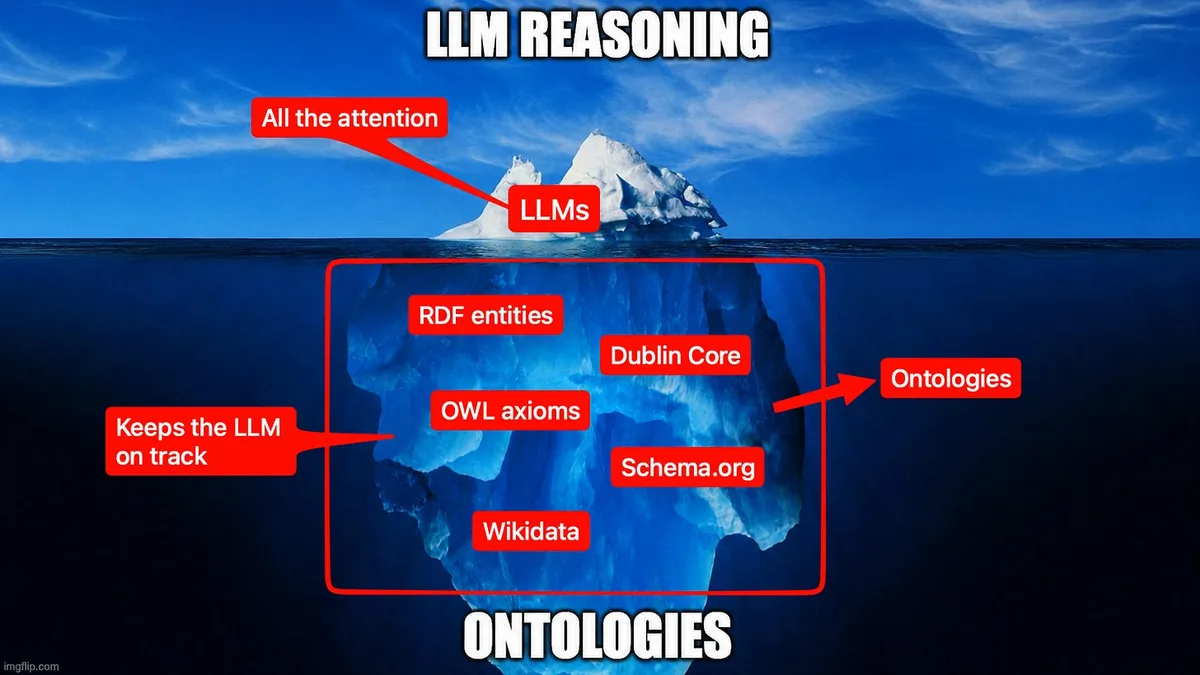
Latent.Space; image includes an imgflip.com watermark.
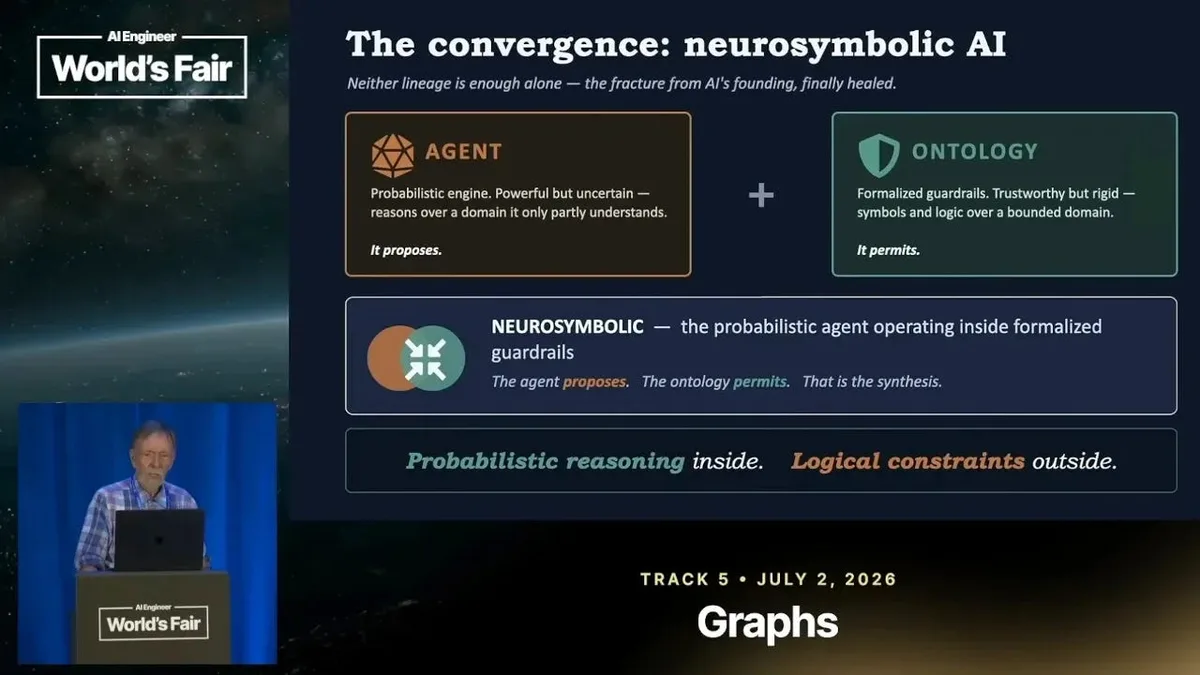
Latent.Space; screenshot of AI Engineer World’s Fair presentation.
His examples explain how a graph can support reasoning beyond storing facts. With RDFS, a teaching relationship whose domain is teacher and whose range is student lets a reasoner infer classifications from the statement that Bob teaches scooter: Bob is a teacher, and scooter is a student. A further rule that teachers are persons classifies Bob as a person. These conclusions follow from the specified relationships rather than additional language-model guesses.[3]
In his Claude agent-loop example, the model proposes a tool call and parameters; surrounding application code executes the tool. Coyle places an ontology check after tool execution and before accepting the returned information. The application translates the result into a representation that a domain-aware validator can evaluate, then continues with a reasonable result or sends an inconsistency back to the model or a human. He describes the role of these controls as “a bounded set of rules around an unbounded loop.”[1][3]
Coyle distinguishes type safety from business correctness. In his recommended architecture, Pydantic checks parameter types, while ontology-backed checks evaluate domain relationships and constraints. His illustrative failures include a second refund on the same order, a payout directed to a support representative rather than the buyer, and an invented order status outside an allowed set. He recommends delaying database changes and other consequential side effects until proposed behavior passes validation, while also controlling loops that can drift, run indefinitely, or accumulate token costs.[3]
Before his Berkeley focus on generative AI, Coyle worked across psychology, neuroscience, and computer science. His account of those earlier transitions provides context for the biological and computational models he brings to teaching.[2]
Earlier foundations: psychology, neuroscience, and SMU
On his personal website, Coyle recalls a summer internship at Modesto State Hospital followed by psychology at Fordham and neuroscience at Emory. He describes encountering McCulloch-Pitts neurons and identifies the arrival of a PDP-8 computer in his laboratory as a catalyst for exploring computational models. He says he subsequently spent 31 years as a professor of computer science at SMU, where he was known as “Dr. C,” before moving to UC Berkeley.[2]
Coyle uses the personal branding “drC” and advocates learning by doing. Addressing students and professionals concerned about AI’s effects on their careers, he encourages understanding and using AI as an assistant, adapting with curiosity, and finding connections and analogies that make technological change easier to understand.[2]
Timeline
Sources
- 1Ontologies Are So Back: Why AI Agents Are Reviving the Semantic WebAccessed 2026-09-20
- 2Frank Coyle (drC) | Empower Your AI Journey — Get Started TodayAccessed 2026-09-20
- 3Why Agentic Systems Need Ontologies — Frank Coyle, UC BerkeleyAccessed 2026-09-20
- 4
Model source and teaching reviews passed. Human editorial review pending. This profile describes the sources as of 2026-09-20.