

Co-founder and CEO of · as of 2026-09-15
Browse · People
Person · Latent Space wiki
Erik Bernhardsson
Modal’s co-founder and CEO works on making cloud computation easier to develop and scale. His earlier contributions include Spotify recommendation infrastructure, the similarity-search library Annoy, and the batch workflow engine Luigi.
Erik Bernhardsson is the co-founder and CEO of Modal, a cloud platform for data, AI, and other computational workloads. He founded Modal in 2021 and, with co-founder Akshat Bubna and their team, pursued faster cloud execution through custom infrastructure and a programmable Python interface. His consequential design choice was to bring application code and execution requirements together, shortening the path from editing a program to running it remotely.[3][2][4]
Modal: making cloud execution feel local
Bernhardsson initially considered tools across the data stack before concentrating on the compute layer. In his February 2024 Latent Space interview, he argued that developer productivity depends on fast feedback loops. Building and uploading containers could turn a quick local experiment into minutes of preparation. Data teams also faced bursty jobs, GPU requirements, and conflicting package environments—needs he thought conventional backend infrastructure served poorly.[4]
His SDK design lets developers define application logic alongside its container environment and hardware requirements, then call functions across those environments from Python. A function can request a GPU without the developer separately provisioning a machine. Bernhardsson described this as extending infrastructure expressed in code: the application and the resources it uses belong in one programmable definition. Modal’s team built a custom filesystem, container runtime, scheduler, and image builder to support that experience.[4][3]
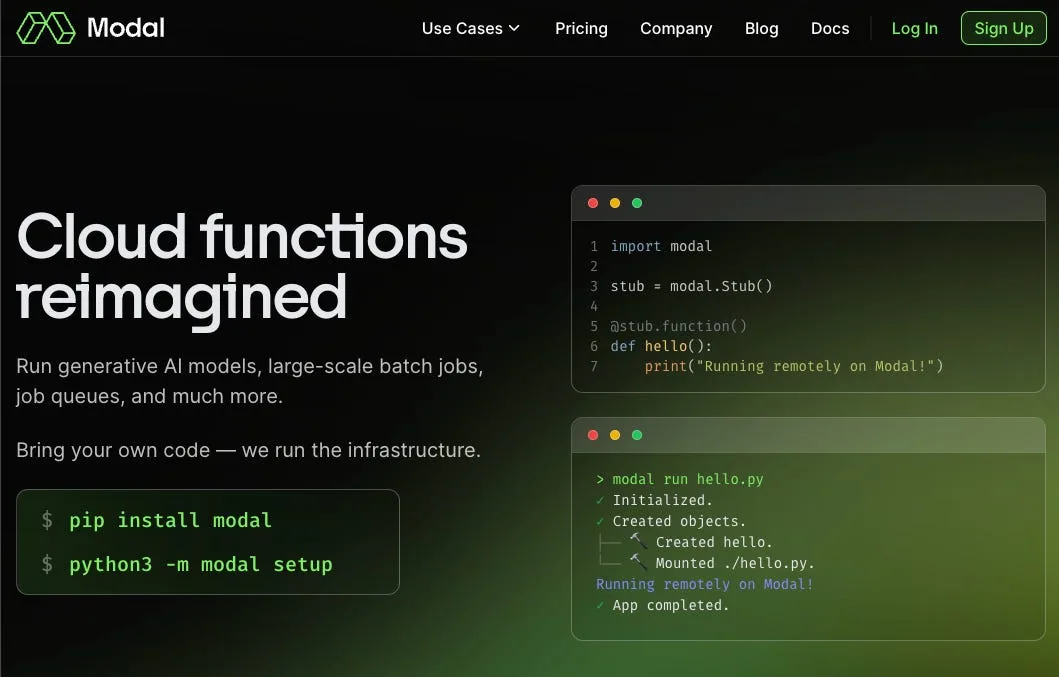
Modal; screenshot reproduced in Latent Space’s February 2024 interview.
Container startup became an early engineering focus. Bernhardsson described experimenting with a container runner pointed at a network-backed root filesystem, allowing execution to begin before a complete image had downloaded. Yiren Lu’s August 2024 explanation, adapted from his 2023 Data Council talk, describes Modal using gVisor with that approach. Files are fetched as needed and cached by content hash on local storage or in memory, so identical contents can be reused across images. Starting a container this way still leaves the application’s imports, initialization, and model loading to complete.[4][9]
Choosing Bubna was another consequential decision. In a September 2026 interview, Bernhardsson recalled committing after limited acquaintance, impressed by Bubna’s intelligence. His retrospective judgment was “bad process, good outcome”: he recommended knowing a prospective co-founder deeply before making that commitment.[12][3]
Bernhardsson recalls roughly eighteen months with little usage or revenue before Stable Diffusion and generative-AI inference supplied early traction. Inference suited the platform’s combination of GPUs, flexible environments, and rapid scaling, although he had conceived Modal as general-purpose compute. He remembers waking hourly to check GPU utilization during Mage’s major migration in early 2023. Modal launched general availability on October 10, 2023, alongside a $16 million Series A.[4][12][11]
GPU readiness: skipping initialization
Bernhardsson coauthored “How we achieved truly serverless GPUs” in May 2026 with Charles Frye, Jonathon Belotti, and Akshat Bubna. Their account combines four components: a shared buffer of healthy idle GPUs, lazy image loading through the custom ImageFS filesystem, CPU checkpoint/restore, and CUDA checkpoint/restore. Each addresses a different delay between requesting capacity and having an inference replica ready to serve.[10]
Modal uses gVisor’s process checkpoint/restore, rather than Linux CRIU, to save initialized host-side state. Nvidia’s driver can checkpoint device memory into host memory, allowing the host snapshot system to preserve and later restore it. Together, these mechanisms skip expensive inference-engine setup, including CUDA graph capture and compilation. Model weights still have to move into GPU memory; snapshotting does not eliminate that throughput bottleneck.[10]
The authors reported results for Qwen 3 0.6B in bf16, a roughly 1 GiB model, across more than ten thousand cold starts. Mean vLLM replica startup fell from 95,679 ms to 13,797 ms with snapshots; SGLang fell from 83,713 ms to 17,486 ms. These measurements included machine queues, container startup, and host/device preparation. At publication, GPU snapshots were restricted to a single GPU, and applications could require adjustments such as weight offloading or recreating an empty KV cache.[10]
Before founding Modal, Bernhardsson worked on Spotify’s recommendations and data infrastructure, then led Better.com’s technology organization. Those earlier roles supply concrete context for the similarity-search, workflow, and team-building experience he brought to cloud infrastructure.[1][5][6][4]
Earlier career: Spotify recommendations and data infrastructure, 2008–2015
Bernhardsson earned an M.Sc. in Physics at KTH in Stockholm. He recalls proposing a master’s thesis at Spotify when it had roughly thirty employees, spending six months building a music-recommendation prototype, and joining full-time after graduating. His contemporaneous departure announcement dates his joining Spotify in Stockholm to 2008 and his last Spotify day to February 6, 2015.[1][4][15]
His responsibilities expanded into reporting, A/B testing, business analytics, and the processing infrastructure around recommendations. He remembers a Hadoop cluster sitting on the floor of the foosball room. He managed Spotify’s analytics team in Stockholm and later built and managed its machine-learning team in New York. In his departure account, he emphasized that a small team shared the early data work.[1][4][15]
Annoy: similarity search with a distributable index
Bernhardsson built Annoy, a C++ approximate-nearest-neighbor library with Python bindings, in a couple of afternoons during Spotify Hack Week. Spotify used it to find similar users and tracks represented as vectors after matrix factorization. Annoy recursively divides vector space with random hyperplanes, building a forest of trees. More trees improve accuracy at the cost of index size and construction work; inspecting more nodes during a query trades speed for accuracy.[5]
Its distinctive deployment choice is the static, memory-mapped index. An index can be built once, saved as a file, distributed, and shared across multiple processes without each keeping a separate copy in memory. Items cannot be added after construction, so changing a collection requires rebuilding. Later contributors extended the library: Rene Hollander added on-disk index construction, while Peter Sobot and Pavel Korobov contributed dot-product distance support.[5]
Luigi: coordinating dependent batch jobs
Bernhardsson and Elias Freider were the principal builders of Luigi, open-sourced in late 2012. Luigi expresses task dependencies in Python and coordinates completion and failures across Hadoop, Hive, Spark, scripts, and other jobs. Its dependency model resembles GNU Make: underlying tools do the computation, while Luigi connects the steps. Spotify used it for recommendations, A/B-test analysis, reports, and dashboards. Arash Rouhani was chief maintainer from 2015 to 2019; Spotify’s Data Team subsequently maintained the project.[6]
Better.com: choosing management and practical automation, 2015–2021
Leaving Spotify involved an explicit career choice. After discussing machine learning and the CTO path with mentor Oskar Stål, Spotify’s CTO, Bernhardsson wrote in his February 2015 announcement: “I made a conscious decision right now to focus more on management and building teams.” He joined Better.com and led its technology team from February 2015 to January 2021, growing it to approximately 300 people.[15][1][4]
In “Why I went into the mortgage industry”, he explained the move through colleagues he trusted, belief in the business, and opportunities in an industry he considered underserved by software. His approach emphasized API-based data retrieval and automated rules. Many tasks, he argued, needed straightforward scripts and integration rather than advanced AI: “Let humans do what humans are good at, use computers for everything else.”[16]
A 2016 experiment: learning a space of font styles
During this period, Bernhardsson also published a neural-network experiment with fonts. He reported collecting 56,443 fonts and rasterizing 62 characters from each at 64-by-64 resolution. A Lasagne/Theano network generated glyphs from a learned 40-dimensional font vector joined to a 62-dimensional character indicator. Interpolating between font vectors produced intermediate designs; perturbing or sampling vectors generated variations.[8]
The experiment made continuous changes in a learned representation visible, while exposing limits of the data and reconstruction objective. Bernhardsson reported missing characters in some collected fonts and difficulty reproducing thin strokes under pixel loss. His held-out tests reconstructed glyphs from fonts whose other characters had appeared in training; they did not test entirely unseen fonts.[8]
Public views on developer tools, agents, and cloud economics
Bernhardsson’s April 2021 infrastructure wishlist stated an aspiration for elastic resources without advance provisioning: “I don’t ever want to provision anything in advance of load.” He also advocated usage-based billing, programmable client libraries, production-like test infrastructure, and shorter feedback loops.[14]
His September 2024 essay on writing code for humans treats API design as a problem of understanding another person’s mental model. “Getting started is the product!” captures his concern that feedback from successful power users excludes people who never manage to begin. He recommends examples users can modify, errors with recovery guidance, familiar concepts, and programmable interfaces. Simplification should preserve expressive ability; unreliable defaults and hidden behavior can make tools harder to understand.[7]
In September 2026, Bernhardsson argued that coding agents need much the same developer experience as humans: descriptive errors, clear method signatures, and fast feedback. He added that agents handle API deprecations poorly and therefore need greater API stability. In his 2024 interview, he also rejected a simple replacement account of AI’s effect on engineers, arguing that cheaper software development could increase demand for engineering work.[12][4]
Bernhardsson favors software differentiation and capital efficiency over owning hardware. In 2024 he emphasized custom models and workflows as a stronger basis for differentiation than interchangeable model endpoints, while acknowledging that Modal had added capacity reservations. In September 2026 he still preferred the software layer above GPU supply, but explicitly left open buying GPUs. That month he described sandboxes, batch jobs, and training as extending Modal toward its original general-purpose compute ambition.[4][12]
From the Latent Space archive
Original posts and separately reviewed explanations.
Sources
- 1About — Erik BernhardssonAccessed 2026-09-17
- 2Runtime — a conference by ModalAccessed 2026-09-17
- 3Company — ModalAccessed 2026-09-17
- 4Truly Serverless Infra for AI Engineers — with Erik Bernhardsson of ModalAccessed 2026-09-17
- 5spotify/annoy — Approximate Nearest Neighbors Oh YeahAccessed 2026-09-17
- 6spotify/luigi — Python batch workflow managementAccessed 2026-09-17
- 7
- 8Analyzing 50k fonts using deep neural networksAccessed 2026-09-17
- 9How Modal speeds up container launches in the cloudAccessed 2026-09-17
- 10How we achieved truly serverless GPUsAccessed 2026-09-17
- 11Modal Labs announces Series A financing roundAccessed 2026-09-17
- 12AI Infra Obsessed With the Developer ExperienceAccessed 2026-09-17
- 13Modal — Business Breakdown & Founding StoryAccessed 2026-09-17
- 14Software infrastructure 2.0: a wishlistAccessed 2026-09-17
- 15Leaving SpotifyAccessed 2026-09-17
- 16Why I went into the mortgage industryAccessed 2026-09-17
Model source and teaching reviews passed. Human editorial review pending. This profile describes the sources as of 2026-09-17.