

cofounded by; led by as CEO · as of 2026-09-15
Browse · Organizations
Organization · Latent Space wiki
Elicit
Elicit builds AI tools for scientific evidence synthesis, developing from a literature-review assistant into structured reviews, research agents, and evidence-backed decision support.
Elicit is an AI research company whose tools find scientific papers, extract evidence, and organize it into reviews and decision support. Its workflows expose intermediate work—paper selection, screening decisions, extracted information, and supporting passages—so users can inspect how an answer was produced. Developed within the nonprofit Ought, it became an independent public benefit corporation in September 2023. As of September 17, 2026, its leadership directory identifies cofounders Andreas Stuhlmüller as CEO and Jungwon Byun as COO, with James Brady heading engineering.[1][3][12][13]
Elicit’s product work began before its independent-company spinoff. Its earlier development at Ought supplies context for the task decomposition and human supervision built into its research workflows.[2][5][3]
At Ought: supervision experiments and the 2021 product decision
In a 2024 interview, Byun recalled Ought experiments in which people had unequal access to text: a less-informed participant evaluated the work of someone who could read more. These experiments simulated the difficulty of supervising a more capable system before suitable language models were available. She dated the decision to build a product to the start of 2021, describing product development as a more direct way to help users than publishing research for others to implement.[5]
Byun described an early forecasting assistant that helped turn uncertain beliefs into probability distributions. After several months, the team concluded that users’ larger obstacle was gathering information rather than expressing probabilities. GPT-3’s capabilities helped prompt a move toward research assistance. The team experimented with researcher workflows, including data labeling, finding experts, and developing questions; signup responses repeatedly requested help with literature review. Stuhlmüller recalled an initial weekend prototype that returned frequently irrelevant claims and papers, followed by expanding the abstract-summary feature into broader extraction.[5]
By April 2022, Elicit composed search, question-relevant abstract summaries, classification, extraction, and citation critique into a literature-review workflow. Stuhlmüller and Byun’s plan explained choosing research because it mattered across domains and offered established standards and explicit reasoning processes. Before the literature-review launch, around 30% of researchers signing up named literature review as their greatest need. Extraction let users compare populations, locations, interventions, and outcomes across papers.[2]
The early architecture treated research as a network of smaller tasks. Engineers specified dependencies, and an executor scheduled work across compute nodes, ran independent tasks in parallel, and streamed partial results to the interface. This supported compositions of language-model calls while letting researchers see results before the entire workflow finished.[2]
Abstract summarization exposed a separate problem: fluent answers could be poorly grounded. In Q4 2021 experiments, initial GPT-3 fine-tuning improved the relevance and readability of one-sentence answers but worsened hallucinations. Successive training runs on higher-quality datasets reduced unsupported claims without sacrificing relevance. In April 2022, the founders still wrote, “We still haven’t fully solved this problem.”[2]
Independence, financing, and concept discovery
On September 25, 2023, Ought spun off Elicit, selling its intellectual property and transferring most staff, while retaining an equity stake. The decision was made by an independent board comprising Owain Evans, Paul Christiano, and Owen Cotton-Barratt, with nonprofit legal advice and an independent IP valuation. The board’s stated rationale was to enable Elicit to raise funding and scale its work; it also judged the retained equity financially prudent for Ought.[3]
Elicit simultaneously announced $9 million in seed funding, led by Fifty Years, with participation from Basis Set, Illusian, Mythos, Julian, and angel investors. The accompanying product version discovered concepts across papers, answering questions such as which effects creatine has or which datasets researchers have used to study logical reasoning. The useful unit could become an effect, intervention, argument, or technique supported by papers, rather than a paper occupying one row.[4][5]
Notebooks make research workflows editable
Elicit launched Notebooks on March 29, 2024, combining multiple paper searches and uploads with selected-paper chat, paragraph summaries, and systematic filtering on one page. Byun described this as the fourth attempt to make composable workflows work, following early-2021 composite tasks and later experiments. Computational notebooks supplied a model for flexible workflows built from reusable operations. Stuhlmüller explained the intended interaction: debug a process on a small set of papers, then apply it to a larger set.[11][5]
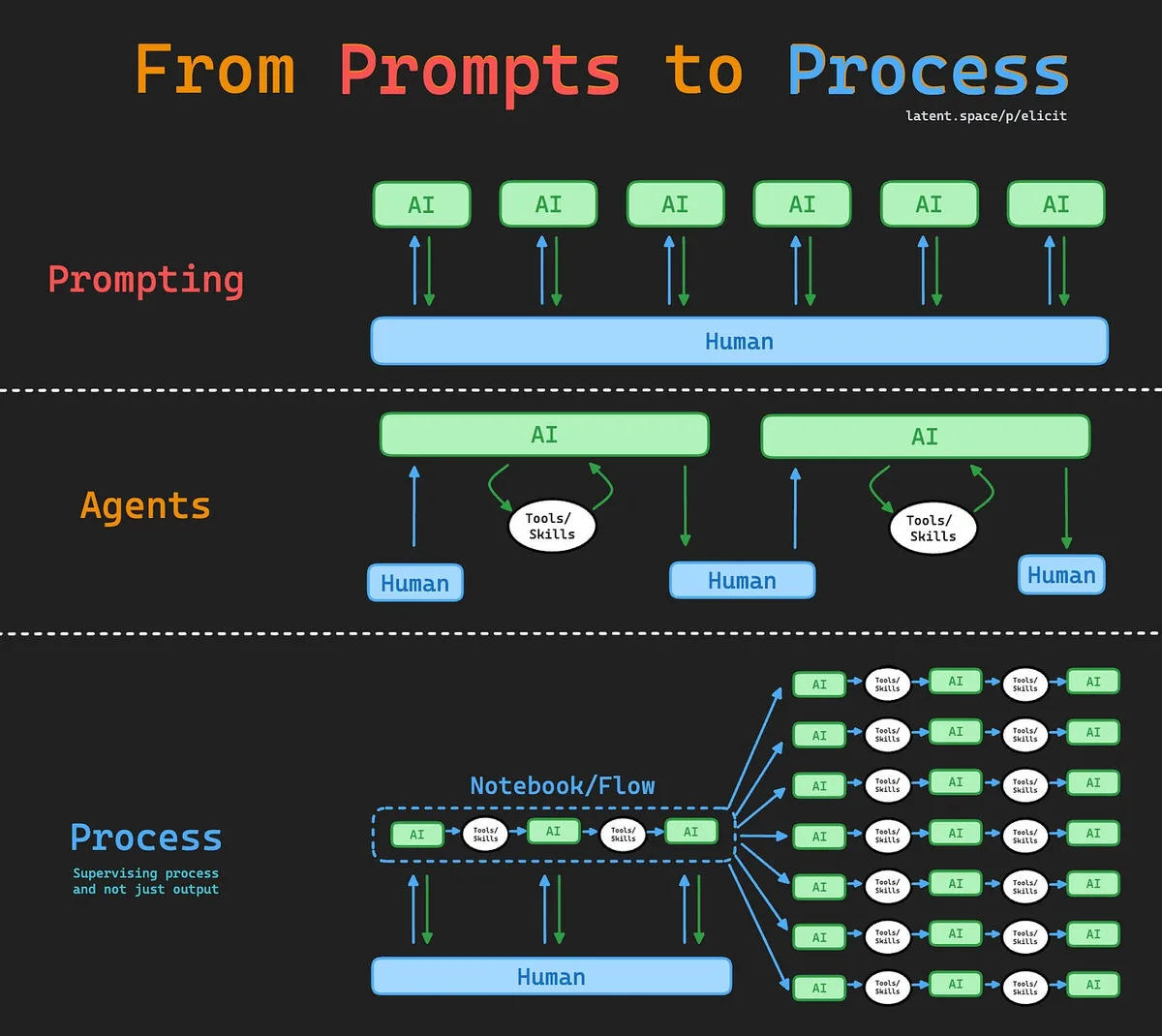
Latent.Space, https://www.latent.space/p/elicit
Extraction columns made that flexibility concrete. In April 2024, Byun described more than 30 predefined fields whose underlying instructions users could inspect and edit. Users could adapt a population field to ask specifically about rats, add custom questions, or classify methodology as prospective, retrospective, or a case study and then filter the resulting column. Citations and highlighted supporting passages helped users check answers in context.[5]
Brady brought conventional application-engineering experience into this work. In his June 2024 account with Adam Wiggins, he described pursuing an interpretability startup in 2021, contacting Stuhlmüller as a possible advisor, and becoming more excited about Elicit than his own startup ideas. Their hiring guide combined software-engineering skills and hands-on language-model experience with a “defensive, fault-first mindset”: handling errors, asynchronous calls, retries, streaming, parallelization, cancellation, and fallbacks.[6]
Reliability sometimes required withholding a result. In the accompanying interview, Brady described replacing a degraded search fallback with an explicit error because the fallback gave users unsuitable results. Elicit retained selective fallbacks for other crucial functions, where a substitute could deliver sufficiently similar performance. The decision distinguished keeping a feature available from preserving the quality of its answers.[6]
Guided reviews, automated reports, and expansion beyond academia
On February 20, 2025, Elicit introduced Systematic Review, guiding users through paper gathering, eligibility screening, and full-text extraction. It suggested screening and extraction criteria from the research question, encouraged calibration on a small sample, and exposed supporting quotes. Users could edit suggestions, override decisions, or enter their own information. At launch, Elicit advised publication- or regulatory-grade reviews to import traditional keyword-search results, using its semantic search as a supplement of up to 500 papers.[12]
Reports followed on February 26, 2025. Using the same review engine, they automated a rapid review through search, screening, extraction, and report generation. Users could inspect and edit intermediate paper selections and extracted information, examine exact supporting quotes, and ask follow-up questions.[13]
That day, Elicit also announced a $22 million Series A at a $100 million valuation, led by Spark Capital and Footwork, with existing investors Fifty Years, Basis Set, and Mythos participating. The announcement set out plans to expand beyond academic research into evidence-backed organizational decisions. Elicit reported more than 400,000 monthly researchers in February 2025, following over 200,000 in September 2023 and over 1,500 monthly users in April 2022. These historical usage figures describe users, rather than paying customers or revenue.[7][4][2]
Screening policy and bounded performance evaluations
Elicit’s May 2026 evaluation described a deliberate screening policy: each eligibility criterion receives yes, no, or maybe. A paper advances if every criterion is yes or maybe; any no excludes it. Retaining uncertain candidates reduces the risk of missing a paper that belongs in the review, at the cost of additional checking later.[8]
An independent proof-of-concept study published December 3, 2025 illustrates how extraction schemas shape results. Frederic Hilkenmeier, Marie Pelzer, Christian Stierle, and Jakob Fink-Lamotte calibrated autumn 2024 high-accuracy mode on three studies from a psychodermatology review. When Main Results underrepresented information, they added an Interpretation column and combined the two for comparison. Across seven fields in 43 subsequent studies, consensus validation found average accuracy of 81.4% for Elicit and 86.7% for human extraction. Validators were unblinded review coauthors, and the evaluation was not prospectively registered. The authors proposed Elicit as a second reviewer with prompt calibration and human resolution of discrepancies.[9]
Elicit’s own May 2026 Cochrane-based evaluation reported 95.0% mean included-study recall per review for title-only semantic searches on DOI-resolved targets, 96.89% abstract-screening sensitivity, 99.5% paper-level full-text recall, 94.8% full-text per-criterion accuracy, and 95.6% correct extraction for Methods, Participants, and Interventions. These are separate metrics from task-specific subsets. The independent study and company evaluation used different configurations, tasks, domains, and grading methods; their percentages do not establish a before-and-after accuracy improvement.[8][9]n1
Research agents and programmatic access
Elicit launched Research Agent workflows in beta on December 9, 2025. The four initial workflows covered competitive landscapes, research landscapes, clinical-trial analysis, and topic exploration. They extended sources beyond academic publications to web material, clinical trials, regulatory information, press releases, and product labels. The beta described clarifying a request, converting it into a systematic research program, showing progress, and allowing follow-up iteration on outputs.[14]
On July 15, 2026, Elicit announced Search, Reports, and Systematic Review APIs and an MCP server, making those capabilities available to external agents and workflows on Pro and higher plans. The announcement described semantic and keyword search over a company-reported 138 million academic papers and ClinicalTrials.gov records, reports in Markdown, PDF, or DOCX, and stage-level review exports.[15]
The August 4, 2026 Research Agent announcement presented a broader environment for scientific decisions, combining literature, public web sources, specialized databases, and uploaded internal data. Elicit described reasoning guidance and process verification, sentence-level citations, and persistent projects retaining context, sources, instructions, and outputs. It also introduced its own BioDecisionBench for pharmaceutical decision advice, including preclinical and observational study design. The benchmark’s comparative performance claims are company evaluations.[10]
Timeline
- release
Notebooks brings editable research workflows onto one page
Notebooks[11] - release
Elicit launches guided screening and full-text extraction
Systematic Review[12] - release
Reports automates rapid reviews with inspectable intermediate work
Reports[13] - funding
Elicit announces $22 million to expand evidence-backed decision support
Series A[7] - release
Research Agent combines scientific sources and internal data in persistent projects
Research Agent[10]
Financing
Seed funding
Elicit simultaneously announced $9 million in seed funding, led by Fifty Years, with participation from Basis Set, Illusian, Mythos, Julian, and angel investors.[4]
Series A
That day, Elicit also announced a $22 million Series A at a $100 million valuation, led by Spark Capital and Footwork, with existing investors Fifty Years, Basis Set, and Mythos participating.[7]
From the Latent Space archive
Original posts and separately reviewed explanations.
Conversation
Supervise the Process of AI Research — with Jungwon Byun and Andreas Stuhlmüller of Elicit
ConversationHow To Hire AI Engineers — with James Brady & Adam Wiggins of Elicit
Grounded writeupElicit: Making AI Research a Process You Can Inspect
Grounded writeupHiring AI Engineers for the Work Between Models and Users
Notes
- The May 2026 evaluation began with 994 unique Cochrane reviews, then applied different filters for each task. Full-text screening used 377 papers from 74 reviews and excluded 138 criterion-level judgments where all tested models disagreed with review labels, following investigation. PDF availability reduced extraction candidates from 3,241 studies to 198 before further field filtering. Extraction questions were reconstructed from gold answers, creating possible answer leakage; a separate language model graded outputs. Outcomes were excluded from the extraction benchmark. These results may not generalize to paywalled literature, non-medical domains, or other review methods.[8]
Sources
- 1Our team — ElicitAccessed 2026-09-17
- 2The Plan for ElicitAccessed 2026-09-17
- 3Ought has spun off ElicitAccessed 2026-09-17
- 4Elicit Raises $9 Million and Becomes a Public Benefit CorporationAccessed 2026-09-17
- 5
- 6How To Hire AI Engineers — with James Brady & Adam Wiggins of ElicitAccessed 2026-09-17
- 7
- 8Evaluating Elicit’s Systematic Literature Review CapabilitiesAccessed 2026-09-17
- 9
- 10Introducing Elicit Research Agent: Rigor that powers decisionsAccessed 2026-09-17
- 11Introducing Notebooks: A New Way to Analyze Papers in ElicitAccessed 2026-09-17
- 12Introducing Elicit Systematic ReviewAccessed 2026-09-17
- 13Introducing Elicit ReportsAccessed 2026-09-17
- 14New in Elicit: Research AgentsAccessed 2026-09-17
- 15The Elicit API and MCP: Powering autonomous research enginesAccessed 2026-09-17
Model source and teaching reviews passed. Human editorial review pending. This profile describes the sources as of 2026-09-17.