

Browse · People
Dex Horthy
HumanLayer founder and author of 12-Factor Agents, focused on context management, human oversight, and reliable AI-assisted software development.
Dex Horthy, also listed as Dexter Horthy, is the founder and CEO of HumanLayer and the author of 12-Factor Agents. His work addresses how engineers can give AI systems consequential tasks while retaining control over execution, context, and architectural decisions. HumanLayer combines coding-agent sessions, plans, and code diffs in a collaborative IDE and cloud environment.[3][4]
Engineering reliable agents
In 12-Factor Agents, Horthy argues that useful AI applications often consist of mostly deterministic software with LLM steps placed at selected points. His preferred route is to incorporate small, modular agent concepts into existing products. The guide emphasizes owning prompts, context windows, and control flow; contacting humans through tool calls; and building small, focused agents. He credits early reviewers and the SF MLOps community for feedback.[4]
Horthy describes the basic agent loop as a division of responsibilities: the LLM selects a next step through structured output, deterministic code executes the tool call, and the result enters the context window before the next decision. His criticism concerns relying on that loop alone for production quality. He recommends retaining explicit engineering control over the software surrounding the model.[4]
Context engineering and human review
In his August 29, 2025 essay, Advanced Context Engineering for Coding Agents, Horthy describes “frequent intentional compaction”: distilling searches, code exploration, edits, and tool logs into structured artifacts rather than carrying an increasingly noisy conversation forward. His workflow separates research into code and information flow, planning precise changes and verification, and implementation phase by phase. He gives 40–60% context utilization as a problem-dependent working heuristic.[5]
Horthy says Sean Grove’s “Specs are the new code” talk helped shape his team’s adoption of spec-driven development. Faced with frequent 2,000-line Go pull requests, he shifted attention toward reviewing specifications and plans while continuing to read tests carefully. He adopts Blake Smith’s framing of code review as maintaining mental alignment: shared understanding of how and why the system changes. The same essay announced CodeLayer’s private beta as a tool for collaborative agent workflows.[5]
A BAML bug gave Horthy a concrete comparison. In his account, Claude’s initial research incorrectly concluded that the bug was invalid; he discarded it and requested another pass with more steering. He then implemented two plans, one with research and one without. He judged the research-informed version better because it placed the fix appropriately and followed the codebase’s testing conventions. That pull request received maintainer approval the following morning, and he closed the alternative.[5]
Horthy subsequently paired with Vaibhav, identified in the essay as @hellovai, on BAML cancellation and WebAssembly support. He reported approximately 35,000 lines of work in seven hours, including three hours of research and planning and four of implementation. At the essay’s August 2025 publication, cancellation had been merged after further work; the WebAssembly pull request remained open with a working browser demo. Vaibhav estimated each feature would ordinarily require three to five days from a senior BAML engineer.[5]
Horthy also reported an unsuccessful seven-hour attempt with @blakesmith to remove Hadoop dependencies from Parquet Java. He attributed the failure to research that did not follow the dependency tree deeply enough and to neither participant being a codebase expert. His lesson was that hard tasks still require engaged human review and relevant expertise; compaction does not substitute for understanding the problem.[5]
Automation with oversight
In Gergely Orosz’s July 2026 interview summary, Horthy recounted an experiment begun in July 2025 in which humans did not review generated code. He said the team abandoned the system four months later after production failures that the model could not diagnose. Finding a wrongly routed primary key took days, followed by three weeks of learning a codebase no human had read.[6]
By the July 2026 interview, Horthy favored slower automation loops. His team had expanded a nightly agent that opened one improvement pull request into four agents producing four code-quality pull requests by morning. A person still read each before merging. He advocated concentrating human effort on design, architecture, and consequential decisions, where review could prevent larger implementation mistakes.[6]
At the 2026 AI Engineer World’s Fair loop debate, Horthy argued that “the hype is outrunning the discipline”. He explicitly was not against loops: Kubernetes, he noted, uses deterministic control loops. He questioned whether autonomous coding justified moving to a higher abstraction level and recommended starting small, iterating, and building intuition before attempting end-to-end automation.[1]
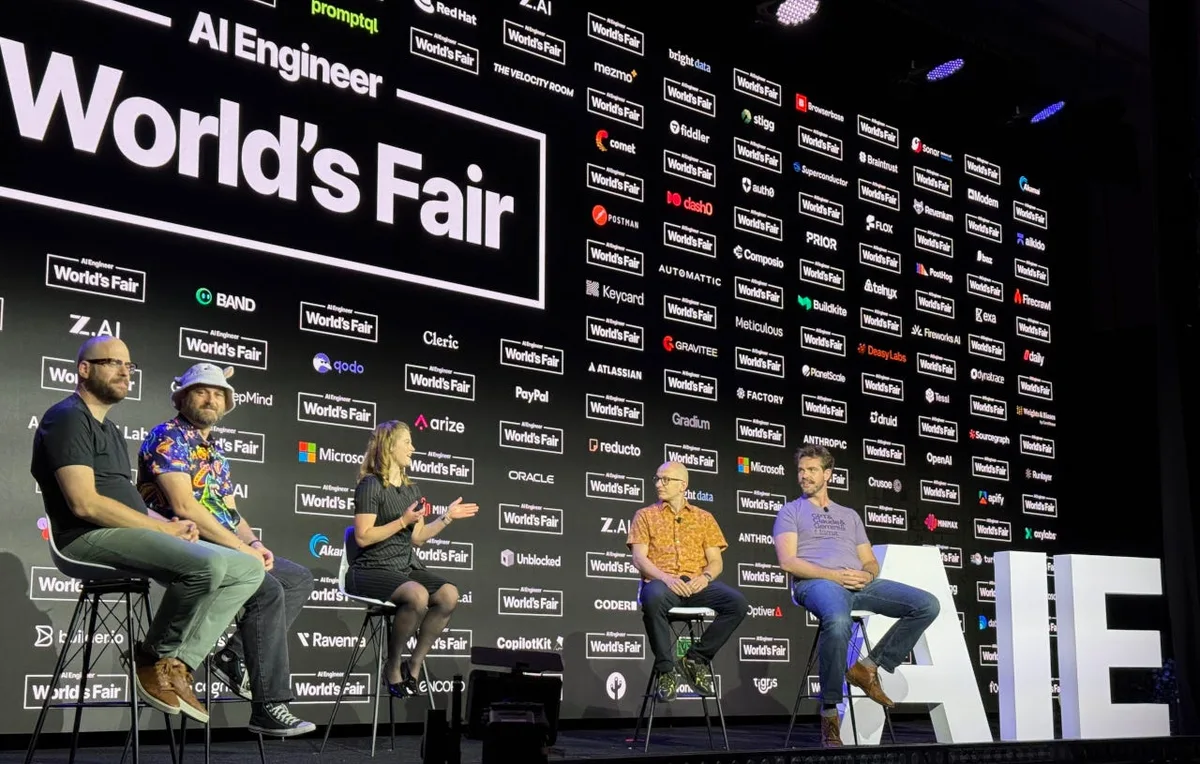
Latent.Space; photographer not identified in the supplied source.
Earlier foundations: infrastructure and approval tooling
Before HumanLayer, Horthy worked on developer infrastructure and self-hosted software. His founder biography says he began coding in high school at NASA’s Jet Propulsion Laboratory and spent seven years at Replicated across engineering, solutions engineering, product, and executive roles. He describes working on container orchestrators, leading product teams, founding the go-to-market organization, and helping teams including DataStax and H2O.ai launch Kubernetes-native versions of their self-hosted products.[3]
HumanLayer’s original approval tooling grew out of a proposed Slack-coordinated agent that could drop Snowflake or SQL tables unused for more than 90 days. Horthy says his team had already built recommendations but wanted the agent to perform the cleanup itself. Uncomfortable giving an AI application unsupervised destructive SQL access, they added human approval steps. That experience led him to build tools through which software could request human feedback, input, and authorization for consequential actions.[3]
Timeline
- project
Begins an experiment without human code review; later abandons it after production failures
In Gergely Orosz’s July 2026 interview summary, Horthy recounted an experiment begun in July 2025 in which humans did not review generated code. He said the team abandoned the system four months later after production failures that the model could not diagnose.[6] - release
Publishes Advanced Context Engineering for Coding Agents
In his August 29, 2025 essay, Advanced Context Engineering for Coding Agents, Horthy describes “frequent intentional compaction”: distilling searches, code exploration, edits, and tool logs into structured artifacts rather than carrying an increasingly noisy conversation forward.[5] - milestone
Calls for discipline in autonomous coding at the World’s Fair loop debate
At the 2026 AI Engineer World’s Fair loop debate, Horthy argued that “the hype is outrunning the discipline”.[1]
Sources
- 1AIEWF Daily Dispatch: The great loops debate and the state of AI engineeringAccessed 2026-09-20
- 25 Trends That Defined AI Engineering at World’s Fair 2026Accessed 2026-09-20
- 3HumanLayer: The multiplayer control plane for your software factoryAccessed 2026-09-20
- 412-Factor Agents - Principles for building reliable LLM applicationsAccessed 2026-09-20
- 5Advanced Context Engineering for Coding AgentsAccessed 2026-09-20
- 6Context engineering with Dex HorthyAccessed 2026-09-20
Model source and teaching reviews passed. Human editorial review pending. This profile describes the sources as of 2026-09-20.