

Browse · People
David Hsu
Retool’s founder and CEO on AI-enabled internal software, developer control, and governance beneath generated code.
David Hsu is the founder and CEO of Retool. His AI work centers on how businesses build and operate internal software: first helping developers incorporate AI into applications and workflows, then opening Retool to externally generated code while centralizing permissions and deployment controls.[2][1][3][4]
Opening the platform, governing the resources
In his March 26, 2026 essay, “Code is free. Now what?”, Hsu announced a move toward React frontends and building with tools outside Retool. He explained that Retool’s proprietary Toolscript format, which serialized applications built in its visual canvas, was poorly suited to LLM generation. Moving to familiar code would let builders use their own tools and bring existing React applications into Retool. At that point, its MCP server was in beta for administrative functions.[3]
Hsu argued that faster generation exposes a bottleneck between creating software and operating it securely. Code review, security checks, and deployment gates, he wrote, were designed for human pace. His proposed answer was permissions beneath generated code: customer-configured controls attached to resources, rather than security logic entrusted to each application an LLM writes.[3]
His June 17, 2026 announcement described the resulting builder as using React on the frontend and TypeScript on the backend, with code teams could inspect and edit. It also introduced MCP app building and deployment of existing React apps. According to the announcement, imported data connections map to resources customers have already configured, while a shared governance layer enforces data access, permissions, environments, and deployment rules. Hsu summarized the separation: “The security doesn’t live in the AI-generated layer. It lives underneath it.”[4]
Earlier AI strategy: editable workflows
Before that architectural shift, Hsu distinguished two AI opportunities in his February 2024 Latent Space interview: accelerating application construction and helping developers build AI-enabled applications. He said the second received the bulk of Retool’s investment. His reservation about coding assistants was that developers still had to read generated code, verify its behavior, and fix subtle bugs; faster generation alone did not remove that work.[1]
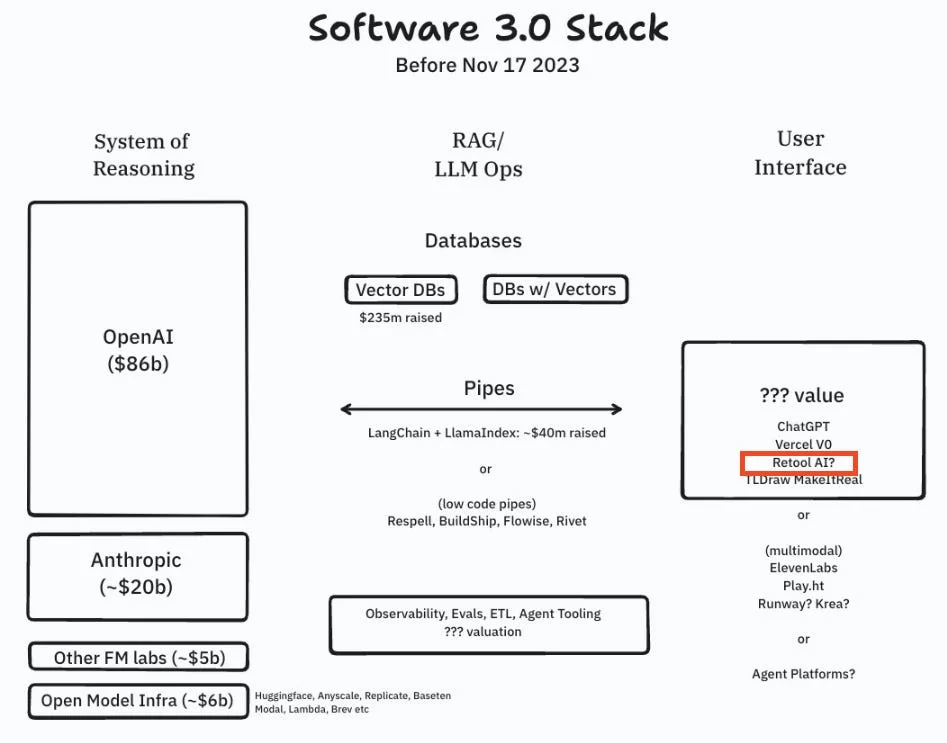
Latent Space, “Why StackOverflow usage is down 50% — with David Hsu of Retool.”
Hsu favored workflows that developers define and modify, with AI operating inside individual steps. He linked this choice to errors compounding across multi-step agents. An unnamed clothing manufacturer supplied his concrete example: sales data fed SQL analysis, AI generated new pattern ideas, and analysts approved or rejected them. In his account, this integrated process offered more useful automation than repeatedly copying information into and out of a chatbot.[1]
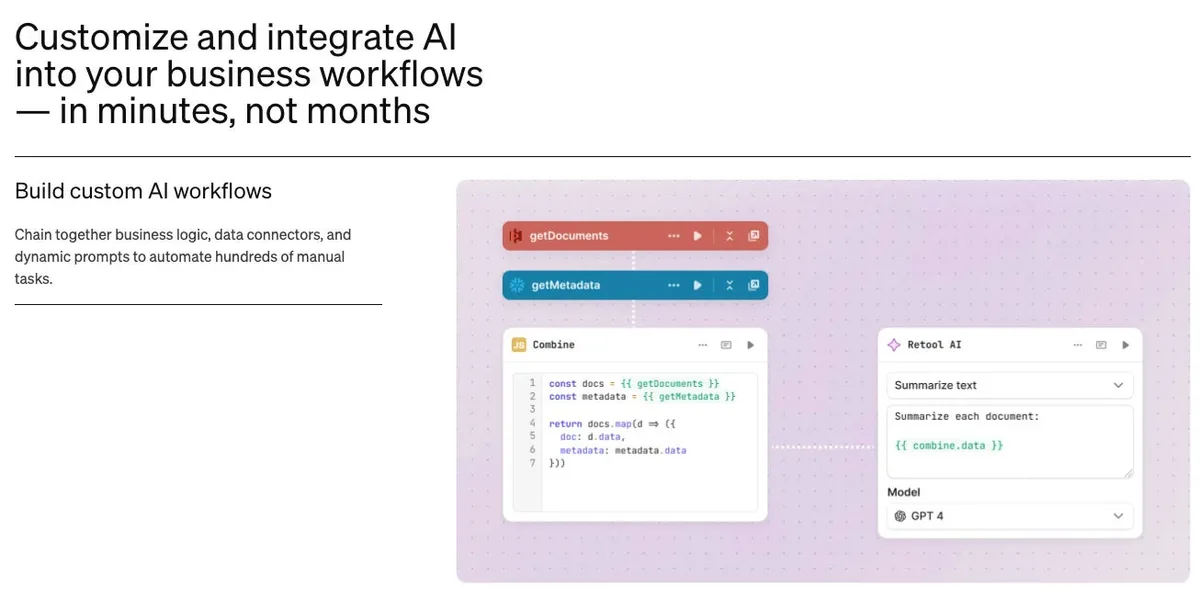
Published by Latent Space; interface labeled Retool AI.
He favored open-source supporting infrastructure because Retool could inspect its internals, fix bugs, and contribute changes back, while explicitly remaining uncertain about which models would prevail. He also argued that adoption should be “business needs driven, but then engineering driven after that”: businesses identify a function to improve, and engineers investigate model limitations, prompting, and implementation.[1]
That emphasis on engineering judgment extended to hiring. In 2024, Hsu described competent use of ChatGPT or Copilot as a plus, while retaining assessments of critical thinking and computer-science fundamentals. He encouraged AI tools internally but wanted engineers to understand what they were doing rather than depend entirely on generated answers.[1]
Historical foundations: internal tools and finding developers
The internal-software focus predates Retool’s AI work. Hsu studied Computer Science and Philosophy at Oxford before starting Retool. In a 2023 retrospective, he recalled building fraud, identity-verification, and regulatory tools for a UK payments startup. Repeatedly assembling tables, buttons, dropdowns, and forms suggested an opportunity to make those interfaces faster to build through drag-and-drop components.[2][5]
Hsu’s early adjustments concerned the audience and message as well as the product. After unsuccessful outreach to FileMaker users, he concluded that Retool’s market was React developers and developers building internal applications. He recalled an immediate shift toward inbound interest after posting Retool on Hacker News on August 9, 2018. To support early trials, Hsu and the team combined usage alerts, error events sent to Slack, and shared customer channels so they could intervene and debug while customers were working.[5]
Hsu described early sales as a way to work closely with customers and establish product-market fit. In the 2024 interview, he said Retool had changed its guiding metric in the preceding year from revenue to the number of developers building on the platform, reflecting a greater emphasis on broad adoption. His fundraising policy similarly favored smaller rounds at lower valuations; he argued that this limited dilution and preserved employee upside rather than maximizing headline fundraising figures.[1][2]
Timeline
- milestone
Hacker News launch brings inbound interest
He recalled an immediate shift toward inbound interest after posting Retool on Hacker News on August 9, 2018.[5] - milestone
Prioritizes helping developers build AI-enabled applications
Before that architectural shift, Hsu distinguished two AI opportunities in his February 2024 Latent Space interview: accelerating application construction and helping developers build AI-enabled applications. He said the second received the bulk of Retool’s investment.[1] - milestone
Opens Retool toward React and external building tools
In his March 26, 2026 essay, “Code is free. Now what?”, Hsu announced a move toward React frontends and building with tools outside Retool.[3] - release
Introduces editable React builder and MCP app building
His June 17, 2026 announcement described the resulting builder as using React on the frontend and TypeScript on the backend, with code teams could inspect and edit. It also introduced MCP app building and deployment of existing React apps.[4]
From the Latent Space archive
Original posts and separately reviewed explanations.
Sources
- 1Why StackOverflow usage is down 50% — with David Hsu of RetoolAccessed 2026-09-20
- 2David Hsu | Retool BlogAccessed 2026-09-20
- 3Code is free. Now what?Accessed 2026-09-20
- 4Ship vibe-coded apps to productionAccessed 2026-09-20
- 5Retool's CEO on the operations behind winning early sales dealsAccessed 2026-09-20
Model source and teaching reviews passed. Human editorial review pending. This profile describes the sources as of 2026-09-20.