

acquired OpenPipe in 2025 · as of 2026-09-15
Browse · Organizations
Organization · Latent Space wiki
CoreWeave
CoreWeave combines GPU infrastructure, model-serving tools, shared-cluster scheduling and agent execution in a capital-intensive AI cloud.
CoreWeave is an AI cloud company headquartered in Livingston, New Jersey, and listed on Nasdaq as CRWV. Its platform supplies infrastructure for training and serving models, with software for model loading, workload scheduling and agent execution. Acquisitions of Weights & Biases and OpenPipe extended its strategy toward evaluation, monitoring, reinforcement learning and fine-tuning. Michael Intrator was its co-founder, chairman and CEO as of August 11, 2026.[3][6][7][8][4][5][10]
Tensorizer separates model weights from serving containers
CoreWeave’s Tensorizer addresses a practical delay in serverless model serving: a new worker must load model weights before it can serve requests, making loading time part of Knative scale-up latency. Tensorizer stores serialized models and tensors separately from container images and streams them from HTTP, HTTPS or S3 without an intermediate download to the container’s local filesystem. This reduces image size and lets a team update model weights without rebuilding the serving container.[6]
The project reports loading a roughly 20 GB GPT-J model at approximately 5 GB/s over a 40 GbE network. That deployment-specific result illustrates the intended network-bound loading behavior; it is not a universal loading-speed guarantee.[6]
SUNK shares hardware between Slurm and Kubernetes workloads
Slurm manages computing resources and queues large research jobs; Kubernetes manages containerized workloads. CoreWeave developed SUNK to run Slurm on Kubernetes, deploying its components through Helm. Each logical Slurm node is a Kubernetes Pod running a slurmd container. This lets Slurm training jobs and native Kubernetes workloads, including inference, share the same compute resources.[7]
The SUNK Pod Scheduler propagates events between Slurm and Kubernetes and coordinates preemption, partitions and priorities across workloads. Slurm compute nodes can scale with workload requirements, while researchers retain familiar Slurm job-management workflows. The architecture provides shared scheduling rather than requiring independently managed Slurm and Kubernetes deployments.[7]
Sandboxes provide controlled execution for agents
CoreWeave Sandboxes, in public preview, provide execution environments for reinforcement-learning rollouts, agent commands, file edits, tool calls and evaluation benchmarks. Researchers use a Python client; policies constrain network access, resources, security settings and lifetime. Default serverless placement uses CoreWeave-operated runner pools and policy. Customer CKS placement runs on a customer’s CoreWeave Kubernetes Service cluster, with administrators responsible for runner deployment and policy.[8]
Sandboxes use Kata Containers to place execution inside a hardware-virtualized guest, creating a virtual-machine isolation boundary. Administrators may permit alternative runtime classes through an explicit allow-list. On clusters using the SUNK Pod Scheduler, sandbox Pods can run alongside Slurm training jobs and use otherwise idle CPU resources on shared GPU nodes.[8]
Acquisitions extend the model lifecycle
CoreWeave announced completion of its Weights & Biases acquisition on May 5, 2025, following an agreement announced in early March. CoreWeave said the combination would connect compute and model training with AI application and agent evaluation and monitoring. It also committed to keeping Weights & Biases interoperable across infrastructure providers, deployment options, models, frameworks and protocols.[4]
On September 3, 2025, CoreWeave announced a definitive agreement to acquire OpenPipe. Its subsequent quarterly filing records shares issued on September 5 in connection with the acquisition closing. OpenPipe brought reinforcement-learning and fine-tuning technology, including its open-source Agent Reinforcement Trainer (ART) toolkit. CoreWeave described the acquisition as a further step toward vertical integration after Weights & Biases, allowing developers to train and adapt agents to their own workflows.[5][3]
In its August 11, 2026 results announcement, CoreWeave reported additional platform launches: CoreWeave Interconnect, initially linking directly to Google Cloud; SUNK Anywhere, for scheduling across customers’ AI cloud portfolios; and LOTA Cross-Cloud, for data access across clouds. It also introduced ARIA, an AI research and iteration agent intended to read experiment data and support model improvement, alongside Sandboxes.[10]
These AI services followed an earlier GPU business in mining and rendering. CoreWeave was founded in September 2017 and launched its Cloud Platform in 2020. Before 2022, its revenue was limited and came mostly from cryptocurrency-mining offerings that were subsequently discontinued.[12]
2016–2021: from mining and rendering to a cloud platform
In his November 3, 2021 retrospective, Intrator recalled a first Ethereum-mining experiment in 2016: “In 2016, we bought our first GPU, plugged it in, sat it on a pool table”. He described the operation expanding from a Manhattan office to a garage and then a New Jersey data center, followed by purchases of distressed hardware during the 2018–2019 crypto winter. The experiment preceded CoreWeave’s legal formation as a Delaware LLC in 2017 and conversion to a corporation in 2018.[2][3]
Rendering provided an intermediate business. Intrator reported that CoreWeave purchased Leonardo Render in 2019 and introduced Concierge Render afterward. His account described businesses seeking GPU acceleration and the development of a specialized cloud serving visual effects, AI and early-stage drug-development workloads. In the same November 2021 announcement, CoreWeave reported raising $50 million from Magnetar Capital, with Galaxy Digital as exclusive financial adviser and sole placement agent.[2]
2025: public listing and an unsuccessful infrastructure acquisition
CoreWeave completed its IPO in March 2025, selling 36,590,000 Class A shares at $40 each. It reported $1.4 billion in net proceeds after underwriting discounts and commissions, before $31 million in offering costs. A partial exercise of the underwriters’ over-allotment option in April added 1,760,000 shares and $68 million in net proceeds after underwriting discounts and commissions.[3]
CoreWeave entered an agreement to acquire Core Scientific on July 7, 2025. The proposed merger would have made Core Scientific a wholly owned subsidiary, but the requisite Core Scientific stockholders did not approve it at their October 30 meeting. Core Scientific terminated the agreement that day, effective immediately.[13]
Customer commitments, financing and infrastructure obligations
CoreWeave sells access through committed, take-or-pay contracts and on-demand, pay-as-you-go services. Committed contracts accounted for 98% of revenue in the quarter ended June 30, 2026. In an April 2025 interview, SF Compute CEO Evan Conrad compared CoreWeave’s economics with banking and real estate, arguing that long commitments from creditworthy customers can support cheaper borrowing.[12][11]
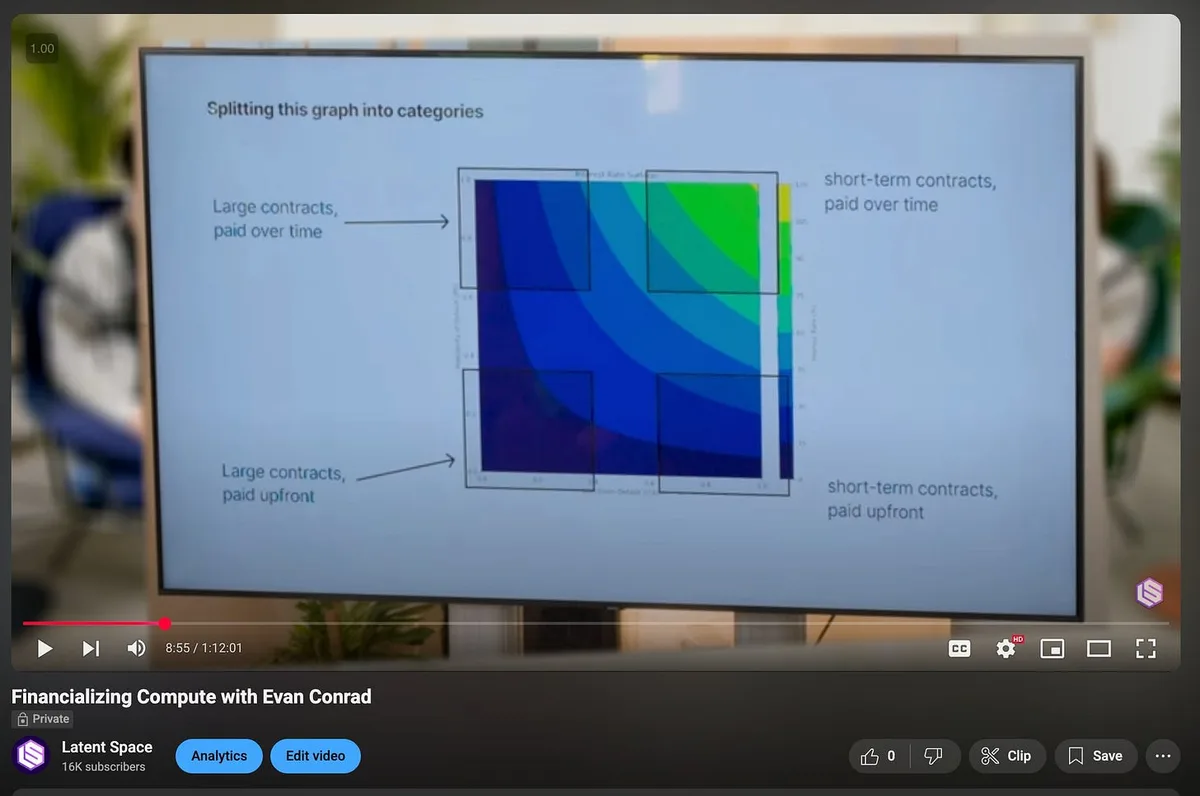
Latent Space, “Financializing Compute with Evan Conrad,” screenshot published at latent.space/p/sfcompute.
A concrete example is the DDTL 4.0 facility, entered on March 30, 2026 and announced as closed on March 31. Secured by computing infrastructure and an associated customer contract, it provided approximately $7.5 billion in initial borrowing capacity, expandable to $8.5 billion as underlying assets stabilized. It matures in March 2032 and is non-recourse apart from limited customary guarantees. These amounts describe facility capacity, not funds already drawn.[9][12]
Demand remained concentrated: the three largest customers represented 36%, 26% and 10% of revenue in the quarter ended June 30, 2026. CoreWeave also expects to commit substantial operational and financial resources, including long-term power contracts before securing customer contracts, for potential new data centers and expansion sites. Its data-center leases generally have initial terms of five to fifteen years.[12]
At June 30, 2026, CoreWeave reported $35.6 billion in total indebtedness and $16.3 billion in operating lease liabilities. The company warns that debt service, refinancing and access to additional capital can constrain operations and investment. Contract-backed financing therefore coexists with substantial obligations and expansion commitments that can precede contracted demand.[12]
Second-quarter 2026 scale and cost
For the three months ended June 30, 2026, CoreWeave reported $2.575 billion in revenue, a $49 million operating loss, $640 million in net interest expense and a $626 million net loss. Approximately 93% of the year-over-year revenue increase came from expansion within its existing customer base.[10][12]
CoreWeave reported approximately $104 billion in revenue backlog as of June 30, 2026. Its definition includes remaining performance obligations plus estimated future revenue under committed contracts, subject to delivery and service availability; it excludes more than $25 billion in net new commitments added in early Q3. In its second-quarter highlights, the company also reported 1.5 GW of active power and approximately 3.7 GW of contracted power. Backlog represents future contracted business, while contracted power is distinct from active capacity.[10]
Financing
Magnetar Capital financing
In the same November 2021 announcement, CoreWeave reported raising $50 million from Magnetar Capital, with Galaxy Digital as exclusive financial adviser and sole placement agent.[2]
Initial public offering
CoreWeave completed its IPO in March 2025, selling 36,590,000 Class A shares at $40 each. It reported $1.4 billion in net proceeds after underwriting discounts and commissions, before $31 million in offering costs.[3]
IPO over-allotment option exercise
A partial exercise of the underwriters’ over-allotment option in April added 1,760,000 shares and $68 million in net proceeds after underwriting discounts and commissions.[3]
From the Latent Space archive
Original posts and separately reviewed explanations.
Sources
- 1Mike Intrator | CoreWeave Executive LeadershipAccessed 2026-09-16
- 2CoreWeave: Past, Present & FutureAccessed 2026-09-16
- 3CoreWeave Form 10-Q, quarter ended September 30, 2025Accessed 2026-09-16
- 4CoreWeave Completes Acquisition of Weights & BiasesAccessed 2026-09-16
- 5CoreWeave To Acquire OpenPipe, Leader in Reinforcement LearningAccessed 2026-09-16
- 6
- 7About SUNKAccessed 2026-09-16
- 8About CoreWeave sandboxesAccessed 2026-09-16
- 9CoreWeave Closes Landmark $8.5 Billion Financing FacilityAccessed 2026-09-16
- 10CoreWeave Reports Strong Second Quarter 2026 ResultsAccessed 2026-09-16
- 11SF Compute: Commoditizing Compute to solve the GPU Bubble foreverAccessed 2026-09-16
- 12CoreWeave Form 10-Q, quarter ended June 30, 2026Accessed 2026-09-16
- 13
Model source and teaching reviews passed. Human editorial review pending. This profile describes the sources as of 2026-09-16.