

co-founded · as of 2026-09-15
Browse · People
Person · Latent Space wiki
Chris Lattner
Compiler and language engineer whose work on MLIR, TensorFlow infrastructure, and Modular connects AI programming with heterogeneous hardware.
Chris Lattner is a compiler and programming-language engineer whose AI work includes leading TensorFlow infrastructure, helping establish MLIR, and cofounding Modular with Tim Davis. His contributions address how developers express computations, preserve information during compilation, and run models across different hardware. His earlier work includes LLVM, Clang, and Swift. Following Qualcomm’s July 2026 acquisition of Modular, he moved into an executive role in AI software and platforms at Qualcomm.[1][3][11][10]n1
Modular: choosing inference and a general compute architecture
Lattner cofounded Modular in January 2022 after working at Google and SiFive. In his 2023 Latent Space interview, he recalled returning with Davis in mid-2021 to the problem of fragmented AI infrastructure. They had worked together at Google from 2017, with Lattner in engineering and Davis in product. At Modular, Lattner built the technology and engineering team while Davis concentrated on product, customer discovery, and business.[1][6][11]
They focused on inference rather than training. Lattner explained the decision in June 2025: “Training scales the size of your research team. Inference scales the size of your customer base.” His bet concerned getting research into production, where workloads grow with applications and users. He explicitly said he had not planned for generative AI or inference-time compute.[7]
Modular initially worked on CPUs to establish a general architecture before extending it to GPUs. Lattner described AI as heterogeneous parallel computation: data loading, preprocessing, networking, accelerator work, and postprocessing all matter. He argued that starting with a specialized accelerator stack and generalizing later was difficult. His preferred execution model treats CPUs and accelerators as independently running computers that communicate asynchronously, allowing their work to overlap.[6]
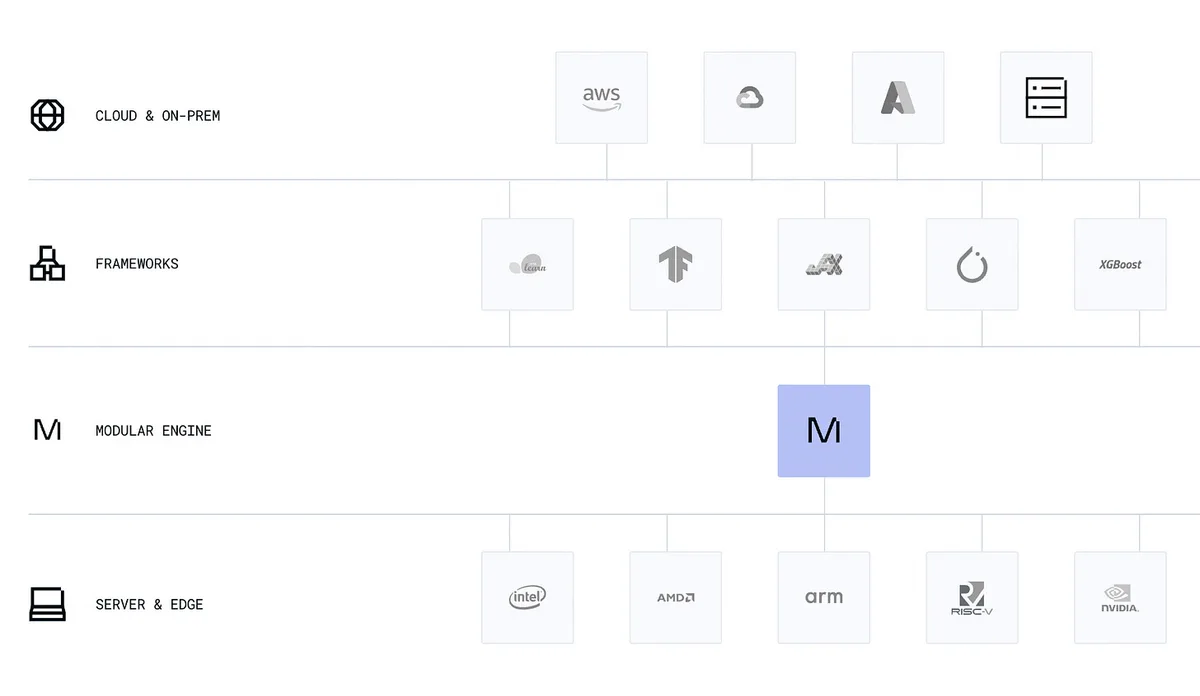
Published by Latent Space in its September 14, 2023 Modular interview; original image creator unspecified.
Mojo began as a tooling decision inside that effort. Lattner recalled that Modular had no initial intention of building a language. The team first wrote low-level MLIR representations by hand, then wanted a more usable way to express kernels. He chose a full programming language over an embedded DSL to support better tools and debugging. Python familiarity mattered because of its community and programmers’ existing knowledge; becoming a Python superset was a goal, rather than an accomplished compatibility claim.[6]
In his June 2025 architecture account, Lattner distinguished three layers designed to work together while fitting into existing workflows:[8]
- Mojo supplies Python-familiar syntax with low-level CPU and GPU programming control, including access to accelerator features.[8]
- MAX supplies modeling and serving infrastructure, including key–value cache management, paged attention, speculative decoding, and hardware-aware scheduling.[8]
- Mammoth, the cluster-management layer described at the time, uses Kubernetes to coordinate placement and scheduling across machines, including separate prompt-processing and token-generation stages.[8]
The architecture reflects Lattner’s view that efficient kernels must compose with model logic and serving infrastructure. He advocates compiler-based fusion to generalize beyond manually written combinations of operators. In the June 2025 interview, he described a hackathon team building training on infrastructure designed for inference, crediting both its hackability and AI coding tools. He also acknowledged that the system was early and still had bugs.[6][7]
Joining Qualcomm
Qualcomm completed its acquisition of Modular on July 28, 2026, and announced completion on July 29. The announcement named Lattner as the incoming Executive Vice President of Advanced AI Software and Platforms. He framed the move as expanding the reach of his work: “Joining Qualcomm gives us the scale to bring Modular’s software innovations to a broader portfolio of AI and compute platforms.”[12][10]
The acquisition changed the standalone-company position Lattner had defended in 2023. He had argued that an infrastructure company without its own hardware or LLM could align with customers across providers. He also contemplated convenient hosting alongside deployment on customers’ infrastructure. Qualcomm pledged to continue Mojo, MAX, and Modular Cloud as products and brands and maintain Modular’s open, heterogeneous ecosystem commitment.[6][10]
Before his AI infrastructure work, Lattner developed compiler components and programming tools in graduate research and at Apple. That earlier history provides context for the reusable libraries and multiple levels of representation used in his later work.[1][2][3]
Earlier work: LLVM and Apple’s developer tools, 2000–2017
LLVM began in December 2000 during Lattner’s graduate research at the University of Illinois Urbana-Champaign under Vikram Adve. Lattner and Adve coauthored the 2004 LLVM paper. Lattner built fundamental parts of its architecture, optimizers, and code generation, and completed his PhD in 2005 before joining Apple that June.[2][1][3][5]
LLVM separates the language front end, optimizer, and hardware back end through reusable libraries and a shared intermediate representation, or IR—a form of a program that tools can inspect and transform. A front end translates source code into LLVM IR; optimization passes transform it; a back end generates target machine code. A new language can therefore reuse existing optimizations and hardware support instead of requiring a complete compiler for every language–processor pairing.[2]
In his LLVM architecture chapter, Lattner explains how readable textual IR supports focused tests of individual optimization passes, while binary bitcode allows compilation to be saved and resumed. Clients can select useful passes and add domain-specific transformations. He described modularity as a way to replace implementations when better ones emerged, and defended changing internal APIs to keep the architecture evolving.[2]
At Apple, Lattner drove LLVM productization, architected and began implementing Clang, and later led the Developer Tools department from January 2013 to January 2017. His work included bringing LLDB to production, driving Objective-C automatic reference counting, and leading ARM64 compiler-toolchain work. Xcode 5 completed the transition to an LLVM-based low-level toolchain, dropping its remaining GCC and GDB support.[1]
Swift began in 2010 as Lattner’s nights-and-weekends project. WIRED’s contemporary account describes him revealing it to Apple executives by the end of 2011, followed by additional engineers and a larger team effort before its 2014 debut. He drove language and compiler design, including Swift’s high-level IR, and coordinated IDE and documentation support. Swift worked alongside Objective-C and Apple’s existing tools; Lattner also helped drive its open-source release.[5][1]
Lattner helped design Swift’s REPL and Playgrounds, whose interactive feedback was influenced by Bret Victor and Light Table. In 2025, he recalled that Swift had launched with little significant internal use and regretted presenting it as a 1.0 release. He contrasted that experience with Mojo’s early 0.1 introduction and Modular’s use of the language for its own kernels: internal users could expose problems and drive improvements before wider adoption.[1][5][7]
Tesla, Google, and SiFive: AI software and hardware, 2017–2022
Lattner served as Tesla’s VP of Autopilot Software from January 30 to June 20, 2017, during its transition to an in-house vision stack. His résumé describes work on the feature roadmap, fleet image and video collection infrastructure, and a rewrite of the vision network architecture. In August 2017, he joined Google as Senior Director and Distinguished Engineer for TensorFlow Infrastructure and Technologies, remaining until January 2020.[1]
At Google, Lattner led TensorFlow infrastructure spanning CPU, GPU, TPU, and mobile execution, including the XLA compiler team, graph transformations, quantization, and kernels. He drove cross-functional TPU software productization and worked on TensorFlow’s next-generation runtime. In his 2023 interview, he emphasized that the compiler approach to TPU support predated his arrival and clarified his own role: he contributed to XLA rather than writing the whole system.[1][6]
MLIR addressed the fragmentation of machine-learning compilers and runtimes and the cost of repeatedly building infrastructure for domain-specific representations. Lattner helped establish the project and coauthored its 2020 paper with Mehdi Amini, Uday Bondhugula, Albert Cohen, Andy Davis, Jacques Pienaar, River Riddle, Tatiana Shpeisman, Nicolas Vasilache, and Oleksandr Zinenko.[1][3]
MLIR groups operations, types, and attributes into dialects that can coexist in one program. Progressive lowering translates computations through multiple abstraction levels while preserving structure needed for optimization. For example, mathematical vectors and hardware vectors can have different representations, and loop structure can remain explicit until transformations no longer need it. Reusable passes obtain meaning through traits, hooks, and interfaces; compiler builders still supply domain semantics, transformations, and hardware mappings.[3]
Lattner also conceived and implemented the initial [Swift for TensorFlow](https://github.com/tensorflow/swift) prototype and recruited its team. The project integrated differentiation into Swift for numeric and user-defined types. Its example model computes w * input + b: at w = 4, b = 3, and input = 2, the parameter derivatives are 2 and 1, and the input derivative is 4. The project was archived in February 2021; its archived README records that language-integrated differentiation continued in the official Swift compiler.[1][4]
From January 2020 to January 2022, Lattner was SiFive’s President of Engineering and Product. He led its RISC-V product and engineering organizations during a reorganization, focusing projects and teams on high-performance products. He describes creating SiFive Intelligence through a software-first approach to AI acceleration and cofounding CIRCT, applying MLIR compiler infrastructure to hardware design. He later recalled joining SiFive to learn the hardware, commercial, and company-building sides of the field.[1][6]
AI-assisted implementation: design and stewardship
Lattner argues that programming languages remain important when AI writes code because humans still need to understand behavior and reason about latency, memory, cost, and changes to a product. In his February 18, 2026 essay on the Claude C Compiler, he wrote: “AI coding is automation of implementation, so design and stewardship become more important.” He regarded the compiler as progress in implementing established techniques while distinguishing that achievement from inventing new abstractions.[7][9]
He translated that position into expectations for Modular’s staff: actively adopt AI tools while remaining accountable for correctness and maintainability, move human effort toward clear intent and design, and invest in documentation, interfaces, and community. Work produced with AI, he argued, should be understood, validated, and owned as deeply as work written by hand.[9]
From the Latent Space archive
Original posts and separately reviewed explanations.
Notes
Sources
- 1Chris Lattner's ResuméAccessed 2026-09-17
- 2The Architecture of Open Source Applications: LLVMAccessed 2026-09-17
- 3MLIR: A Compiler Infrastructure for the End of Moore's LawAccessed 2026-09-17
- 4tensorflow/swift: Swift for TensorFlow (Archived)Accessed 2026-09-17
- 5Why Apple's Swift Language Will Instantly Remake Computer ProgrammingAccessed 2026-09-17
- 6
- 7The Shape of Compute — with Chris Lattner for ModularAccessed 2026-09-17
- 8How is Modular Democratizing AI Compute? (Democratizing AI Compute, Part 11)Accessed 2026-09-17
- 9The Claude C Compiler: What It Reveals About the Future of SoftwareAccessed 2026-09-17
- 10Qualcomm Completes Acquisition of ModularAccessed 2026-09-17
- 11Modular: About UsAccessed 2026-09-17
- 12QUALCOMM Incorporated Form 10-Q for the quarter ended June 28, 2026Accessed 2026-09-17
Model source and teaching reviews passed. Human editorial review pending. This profile describes the sources as of 2026-09-16.