

Browse · People
Carlos Sanchez
Adobe scientist exploring intent-driven websites and AI-assisted deployment recovery, with a background in open-source software automation.
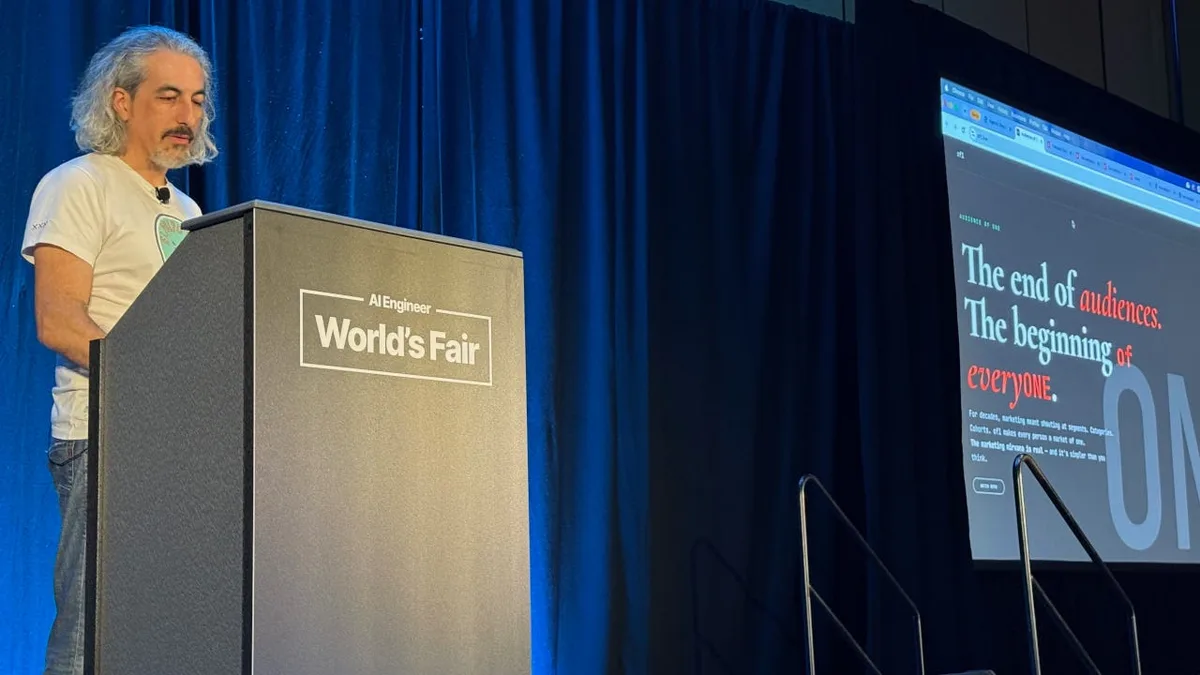
Carlos Sanchez is a Principal Scientist at Adobe Experience Manager whose work includes agentic applications and software automation. At the AI Engineer World’s Fair in San Francisco in 2026, he demonstrated websites that interpret a visitor’s intent and compose personalized pages from existing company content. His earlier work extended progressive delivery with AI analysis and coding agents that propose fixes for failed deployments.[4][2][5]
Latent.Space
Websites assembled around visitor intent
Sanchez’s demonstration used browsing behavior and search queries to classify visitors as exploring, researching or preparing to purchase. An LLM then assembled a page suited to that intent, retrieving relevant material from the site’s existing content. In one example, a visitor interested in camping received a coffee-machine page whose copy, product selection and supporting content had been reorganized around making coffee outdoors. He also showed an interface that composed a page in response to a query such as “Europe AI conferences.”[2]
The approach grounds generation in a company’s existing material, while leaving brand consistency as an important constraint. Sanchez cautioned that “You cannot just generate the whole site”, because the result may stray outside brand guidelines. Model selection also involved speed: in the July 2, 2026 account, he stated a generation target of no more than one or two seconds and estimated inference costs at “one to two cents per page.”[1][2]
Technical feasibility did not settle the question of demand. As of the July 2, 2026 interview, Adobe had not broadly deployed these experiences on production customer sites and was seeking customers willing to experiment. Sanchez acknowledged uncertainty about widespread adoption: “With AI, it’s very easy to build things, but it’s hard to know what to build”. He expected websites to serve both people and their agents, while leaving open whether that would require separate versions.[2]
Before the 2026 website demonstration, Sanchez had applied agentic AI to deployment recovery. His October 2025 work supplies a concrete example of how he combined model decisions, automated actions and human review.[5][2]
2025: AI-assisted rollout recovery
In his October 15, 2025 technical article, Sanchez described an Argo Rollouts plugin he developed using Google’s Gemini. The plugin gathers logs from stable and canary versions, asks the model to compare their behavior, and obtains a promotion or rollback recommendation with a confidence level. Argo Rollouts then acts on that recommendation according to the configured threshold. The confidence value is a model output, rather than a demonstrated measure of reliability.[5]
After a failed rollout, the workflow creates a GitHub issue containing the model’s analysis and recommended fixes, then labels it to trigger a coding agent. The agent proposes a correction through a pull request; once merged, the new version passes through the rollout process again. Sanchez described both an inline mode, which calls the LLM directly and creates issues, and an agent mode, which uses agent-to-agent communication to call specialized agents with their own knowledge and tools.[5]
Sanchez reported demonstrating a broken canary that returned random colors and panic errors. The system detected the problem, rolled back to the stable version, generated an issue and assigned it to Jules; he reported receiving a fix pull request within three to five minutes. He also demonstrated GitHub Copilot, and said the coding agents corrected the getColor() function and added tests. These were results from his live demonstration, not a general recovery-time guarantee.[5]
His practical guidance kept review in the loop: “Human oversight is still crucial: Review pull requests before merging.” He advised starting with basic metrics before adding AI analysis, adjusting confidence thresholds to risk tolerance and monitoring the analysis system itself. He also noted that an agent had ignored his instruction about color variations during the demonstration.[5]
Earlier foundations in open-source automation
Sanchez’s software-automation background predates these AI applications. By FOSDEM 2026, he had more than 20 years of open-source involvement, had authored the Jenkins Kubernetes plugin, belonged to the Apache Software Foundation and had contributed to Kubernetes, Jenkins and Apache Maven. His specialization spanned build tools, continuous delivery and progressive delivery—the deployment techniques underlying his later rollout-recovery work.[4][5]
Timeline
- project
Describes AI-assisted rollout recovery using Gemini
In his October 15, 2025 technical article, Sanchez described an Argo Rollouts plugin he developed using Google’s Gemini.[5] - project
Demonstrates websites assembled around visitor intent
At the AI Engineer World’s Fair in San Francisco in 2026, he demonstrated websites that interpret a visitor’s intent and compose personalized pages from existing company content.[2]
Sources
- 1
- 2The website of the future may assemble itself for every visitorAccessed 2026-09-20
- 3Carlos Sanchez's Speaker Profile @ SessionizeAccessed 2026-09-20
- 4FOSDEM 2026 - Carlos SanchezAccessed 2026-09-20
- 5
Model source and teaching reviews passed. Human editorial review pending. This profile describes the sources as of 2026-09-20.