

Browse · People
Brian McCullough
Technology podcaster, internet historian and investor whose AI work centers on product differentiation, usable interfaces and practical tools for creators.
Brian McCullough is a technology podcaster, author and investor who teamed up with Chris Messina to launch the Ride Home AI Fund in 2023. His AI investment judgments emphasize capabilities that new technology makes possible, while his podcasting offers concrete examples of adopting AI in production. He hosted Techmeme Ride Home in January 2025; Morning Brew announced him as host of Tech Brew Ride Home on August 5, 2025.[4][1][5]
Investing in newly possible products
McCullough brought experience investing through his rolling Ride Home Fund to the collaboration with Messina, an angel investor. The pair offered communications and marketing experience to help startups explain themselves in a crowded AI market. Their published fund strategy prioritizes product-led initiatives, arguing that technology alone is insufficient to win a market.[4][3]
In an October 2023 interview, McCullough urged founders to create things that had not been possible before, comparing the opportunity to Uber's dependence on the iPhone. Rather than merely add generative AI to Excel, he asked: “Why even have a spreadsheet? What is possible now, that wasn't possible before?” His argument was that software should abstract complications so people can accomplish new tasks.[4]
Messina recalled a shared conversation with founders pitching a generative architecture tool as a “Figma for architects.” The investors asked whether they had spoken to architects and understood their workflows, required data formats and compliance issues. In Messina's telling, impressive generated rooms were only a starting point: the outputs still had to solve practitioners' problems.[4]
AI interfaces and editorial responsibility
In the January 2025 Ride Home crossover, McCullough interviewed Simon Willison with swyx, whom he credited with making the connection. McCullough said he had regularly quoted Willison's blog in his AI coverage. He pressed for a “GUI moment” for LLMs, arguing that the prevailing chat interface could not be the final design and asking how interfaces could make results easier to control precisely.[1]
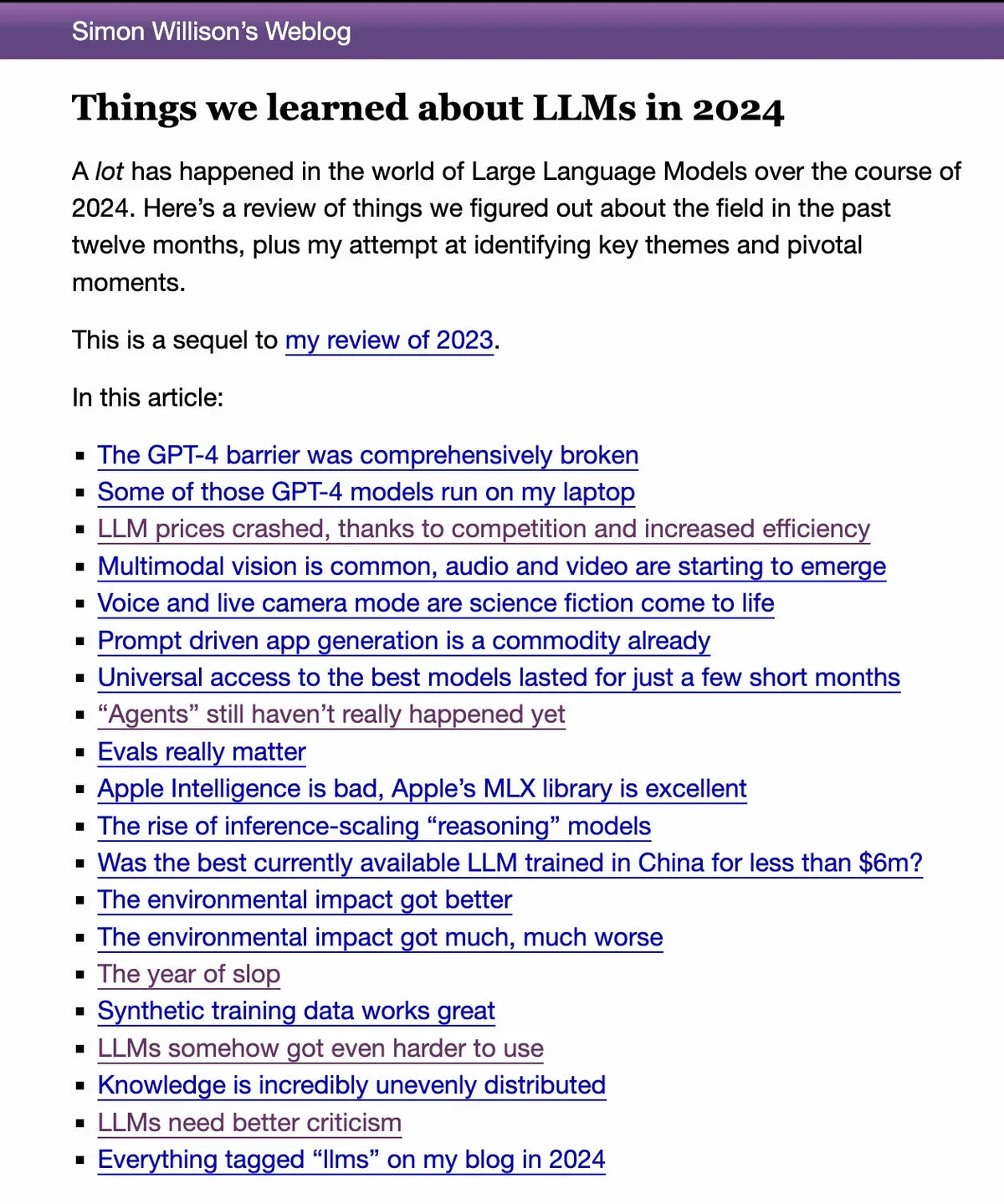
Simon Willison’s Weblog; screenshot reproduced by Latent.Space.
McCullough described using HeyGen for talking-head clips while retaining his own recorded voice. He supplied an MP3 to an avatar trained on him and used the system for lip synchronization. He acknowledged that the result did not entirely overcome the uncanny valley, but saw avatars as a way to remove camera setup, lighting and editing work from a creator's workflow.[1]
He also described Riverside's automatic editing of separately recorded participant tracks: the software selected a speaker's full shot or a group view according to the conversation. McCullough estimated that this saved him three or four hours of work for recordings he posted. He used the example to explain AI's practical value through a task he had previously performed manually.[1]
For McCullough, production shortcuts still required an editorial mind behind the result. He distinguished generating every element—words, voice and video—from using tools for selected steps while remaining willing to sign off on the output. He also cautioned AI insiders against expecting everyone to follow the technology closely: people concerned about losing their jobs, he argued, should not be blamed for responding emotionally.[1]
Earlier foundations: internet history
Before the AI fund collaboration, McCullough wrote How the Internet Happened: From Netscape to the iPhone. The book's UK edition was published on November 27, 2018. The book follows the technology and culture surrounding the internet's rise; he also hosted the Internet History Podcast. This historical work provides context for the comparisons he later drew between AI products and earlier changes in computing.[2][3][4]
Timeline
- release
How the Internet Happened published in the UK
Before the AI fund collaboration, McCullough wrote How the Internet Happened: From Netscape to the iPhone. The book's UK edition was published on November 27, 2018.[2] - founding
Launches Ride Home AI Fund with Chris Messina
Brian McCullough is a technology podcaster, author and investor who teamed up with Chris Messina to launch the Ride Home AI Fund in 2023.[4] - milestone
Urges AI founders to build newly possible products
In an October 2023 interview, McCullough urged founders to create things that had not been possible before, comparing the opportunity to Uber's dependence on the iPhone.[4] - milestone
Interviews Simon Willison with swyx on LLMs
In the January 2025 Ride Home crossover, McCullough interviewed Simon Willison with swyx, whom he credited with making the connection.[1] - role
Announced as Tech Brew Ride Home host
Morning Brew announced him as host of Tech Brew Ride Home on August 5, 2025.[5]
From the Latent Space archive
Original posts and separately reviewed explanations.
Sources
- 1[Ride Home] Simon Willison: Things we learned about LLMs in 2024Accessed 2026-09-20
- 2How the Internet Happened — From Netscape to the iPhoneAccessed 2026-09-20
- 3Ride Home AI Fund — Ride Home FundAccessed 2026-09-20
- 4How startups should think about A.I. pitchesAccessed 2026-09-20
- 5Morning Brew Inc. announcement of Tech Brew Ride HomeAccessed 2026-09-20
Model source and teaching reviews passed. Human editorial review pending. This profile describes the sources as of 2026-09-20.