

Browse · People
Beyang Liu
Sourcegraph co-founder and Amp co-founder whose work on AI coding tools emphasizes code context, transparency, and reliable automation.
Beyang Liu is a co-founder of Sourcegraph and Amp, known publicly as @beyang. His AI coding work includes explaining Cody’s context architecture, advocating for open developer tools, and coauthoring research on retrieving and evaluating code recommendations. Amp’s December 2, 2025 founding announcement named him among its co-founders and announced its separation from Sourcegraph as an independent research lab. Sourcegraph’s board directory lists him with the affiliation Amp.[1][3][2][4][5][7]
Working with coding agents
In his workflow account updated September 9, 2026, Liu estimated that his interactions with Amp were split 80:10:10 between web, phone, and Slack. He described spinning off a “sub-orb” for an orthogonal change and reviewing results in three ways: examining screenshots or video and using the portal for user experience; reading intelligently ordered commit diffs for understanding; and using the Oracle review button for confidence.[3]
A recurring prompt makes his emphasis on understanding concrete: “Explain in plain English what each commit does and why it's necessary for the overall changes.” He also uses a plain-English explanation plugin, which he thought he had obtained from Thorsten. Liu still edits news-post prose by hand because, in his judgment, frontier models’ default writing style does not communicate clearly and concisely.[3]
Before Amp’s separation, Liu’s public work at Sourcegraph focused on Cody and the problem of supplying language models with useful code context. His 2023 explanations and a 2024 coauthored paper describe that earlier approach to coding assistance.[2][5][6][7]
Cody, 2023–2024: context and reliability
In the December 2023 Latent Space interview with Steve Yegge, Liu explained the team’s intuition: context useful to human developers would also help AI developers. He named its hybrid architecture Normsky, meaning “non-agentic, rapid, multi-source code intelligence.” Search indexes, parsers, and reference graphs would gather context without waiting for a sequence of language-model decisions. He also argued for looking beyond Git repositories to documentation, product specifications, logs, and chat as sources of technical knowledge.[1]
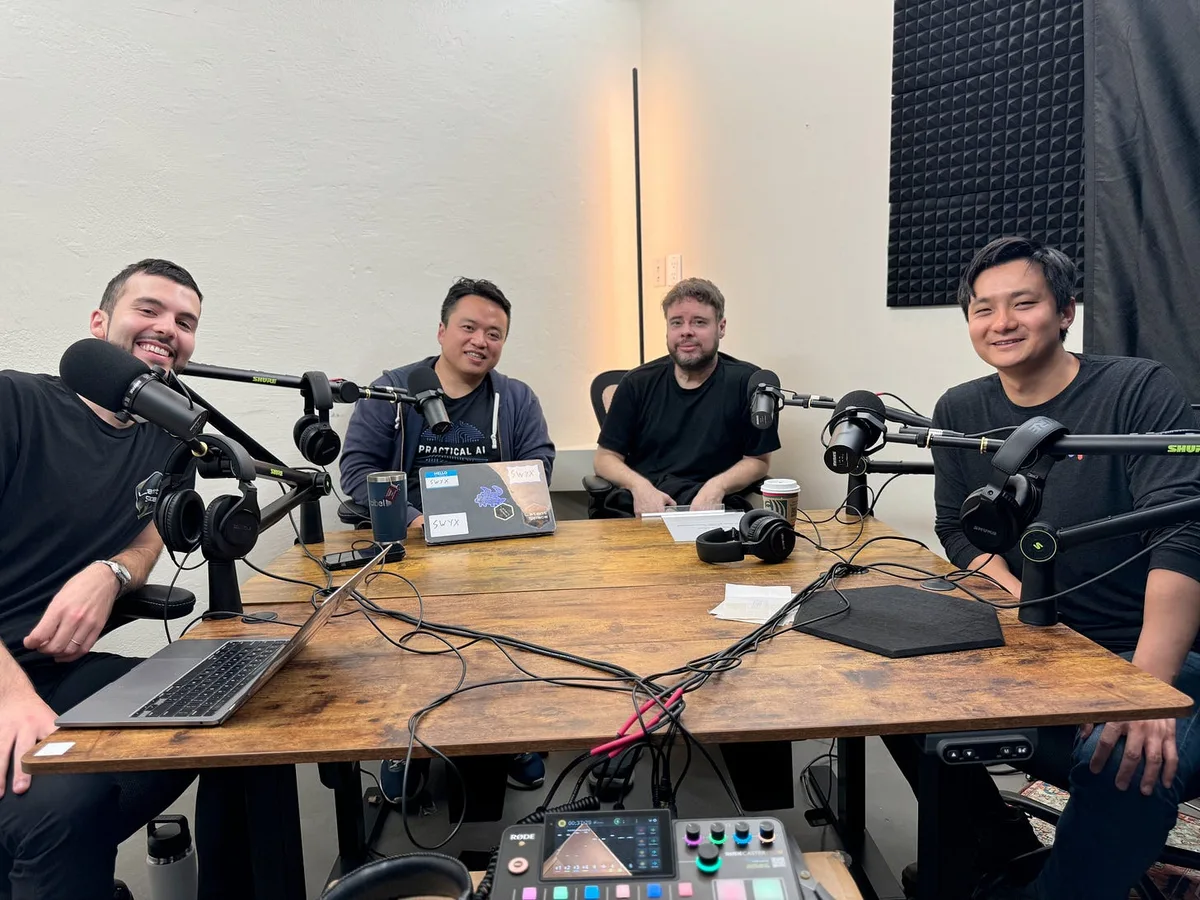
Latent Space, via latent.space/p/sourcegraph; photographer unspecified.
Liu’s December 14, 2023 Cody announcement reported that semantic code-graph context reduced errors such as invented function names and type mismatches. In the interview, he illustrated the mechanism with a completion that suggests a previously defined variable of the wrong type: fetching definitions and references gives the model information it otherwise lacks. The team’s principle of “no invisible magic” meant exposing the context used in each request so users could check responses and identify relevant files. Liu explicitly acknowledged that context did not eliminate hallucinations.[6][1]
Liu explained that the team had narrowed Cody’s inline interactions toward targeted fixes, such as resolving a compiler error or generating unit tests. General code generation was not reliable enough for users to leave it unattended, and user feedback favored quick, specific changes over long conversations inside source files. His December 2023 skepticism concerned transformer-only orchestration, while greater automation remained the goal. He proposed a search-based system in which an LLM supplies candidate actions or heuristics rather than controlling the entire workflow.[1]
Liu announced Cody’s release under Apache 2.0 on March 27, 2023. He argued that open tools offer developers “transparency and independence”: users can inspect, customize, and contribute to tools they depend on. He also explained the business incentive behind the collective decision. Sourcegraph had chosen to focus on enterprise sales, making free individual use an opportunity to demonstrate value to companies. He distinguished Cody’s open-source release from Sourcegraph’s broader open-core business.[5]
Liu described Cody’s model choice as an ongoing evaluation process. In December 2023, the team used StarCoder for completions and Claude and GPT-4 for chat and commands, selecting models against its current prompts and retrieved context. He credited Fireworks’ inference service with allowing the team to concentrate on context fetching, the knowledge graph, and fine-tuning. His launch announcement also credited Hugging Face and ServiceNow for StarCoder.[1][6]
Liu coauthored the August 9, 2024 Cody paper with Jan Hartman, Rishabh Mehrotra, Hitesh Sagtani, Dominic Cooney, Rafal Gajdulewicz, Julie Tibshirani, and Quinn Slack. It separates context selection into retrieval, which seeks high recall, and ranking, which selects relevant items within a token budget. Autocomplete imposes stricter latency constraints than chat. The authors also describe evaluation difficulties caused by private or ephemeral workspace state, and code-specific checks—parsing, type checking, running generated tests, and verifying that symbols exist—that can also serve as guardrails before recommendations reach users.[7]
Liu’s broader concern in the 2023 interview was the growing complexity of codebases. He argued that faster code generation could intensify the problem of understanding how a system fits together and changing it without introducing architectural damage. For engineering leaders, he envisioned AI helping connect commits, reviews, and collaboration to delivered features and business outcomes, reducing the tedium of reconstructing that account from Git history.[1]
Earlier foundations: computer vision and Sourcegraph
Liu’s involvement in machine learning predates Cody. He recalled beginning in computer vision around 2009–2010, before neural networks’ resurgence. That experience had left him pessimistic about the field; by December 2023, he said subsequent progress in vision models and LLMs had arrived faster than he expected.[1]
The earlier code-search work supplies context for Cody’s emphasis on understanding existing software. Liu recalled using Google Code Search as an intern and missing it more than any other developer tool afterward. At Palantir, he and Quinn Slack shared difficulties navigating complex codebases, including those of large clients; he described those problems as the impetus for founding Sourcegraph in 2013. Steve Yegge had built Grok, part of the system Liu used at Google. Liu said he learned of Yegge’s involvement through a Stanford talk and later wanted to recruit him to Sourcegraph.[1]
Timeline
- founding
Co-founds Sourcegraph with Quinn Slack
At Palantir, he and Quinn Slack shared difficulties navigating complex codebases, including those of large clients; he described those problems as the impetus for founding Sourcegraph in 2013.[1] - release
Announces Cody’s open-source release
Liu announced Cody’s release under Apache 2.0 on March 27, 2023.[5] - project
Explains Cody’s Normsky context architecture
In the December 2023 Latent Space interview with Steve Yegge, Liu explained the team’s intuition: context useful to human developers would also help AI developers. He named its hybrid architecture Normsky, meaning “non-agentic, rapid, multi-source code intelligence.”[1] - research
Coauthors research on Cody’s context retrieval and evaluation
Liu coauthored the August 9, 2024 Cody paper with Jan Hartman, Rishabh Mehrotra, Hitesh Sagtani, Dominic Cooney, Rafal Gajdulewicz, Julie Tibshirani, and Quinn Slack.[7] - founding
Named Amp co-founder as it separates from Sourcegraph
Amp’s December 2, 2025 founding announcement named him among its co-founders and announced its separation from Sourcegraph as an independent research lab.[2]
From the Latent Space archive
Original posts and separately reviewed explanations.
Sources
- 1
- 2Amp Frontier CorporationAccessed 2026-09-20
- 3How Beyang Liu Uses AmpAccessed 2026-09-20
- 4About SourcegraphAccessed 2026-09-20
- 5Open sourcing CodyAccessed 2026-09-20
- 6Sourcegraph Cody is generally availableAccessed 2026-09-20
- 7
Model source and teaching reviews passed. Human editorial review pending. This profile describes the sources as of 2026-09-20.