

Browse · People
Arvind Jain
Glean co-founder and CEO focused on company context, enterprise retrieval, and the cost and reliability of AI at work.
Arvind Jain is the co-founder and CEO of Glean, which began with enterprise search in 2019 and expanded into an enterprise AI platform. His work centers on making AI useful with private company knowledge: retrieving relevant information, respecting access permissions, and choosing models appropriate to the task. In an August 2026 Latent Space interview, he stated a practical constraint: “A big goal of Glean is to avoid using LLMs for tasks where we don’t need them,” citing simple arithmetic as an example.[2][1]
Company context before generation
In his Training Data interview, Jain explained enterprise search as more than matching a question to documents. Glean combines integrations with company systems, permissions governing each piece of content, and a knowledge graph connecting employees, roles, and documents. His onboarding-guide example makes the distinction concrete: a new marketing employee and a new engineer may ask the same question but need different guides.[3]
Jain described learning relevance from how people work, including document engagement, recency, and usage within particular teams. One illustrative signal comes from Slack: someone asks a question, a colleague answers with a document link, and the questioner gives a thumbs-up. That association can help rank the document for a later, similar question, even though the original interaction happened outside the search interface.[3]
This retrieval infrastructure also supplies context for retrieval-augmented generation (RAG). Jain used a question about an employee’s PTO policy to explain the mechanism: retrieve relevant private company documents or fragments, then ask a language model to answer using them. He cautioned that retrieval and generation introduce separate failure points. Missing or stale information can undermine an answer before the model’s own tendency to hallucinate enters the picture.[3]
Jain argued that a useful search product also provides a foundation for an AI application platform: customers have already connected their data and entrusted the system with access. In the same interview, he described training smaller customer-specific language models to understand internal terminology, acronyms, and code names, while partnering with other companies for very large models. He framed AI as “a tool in your arsenal,” with the business problem determining how to use it.[3]
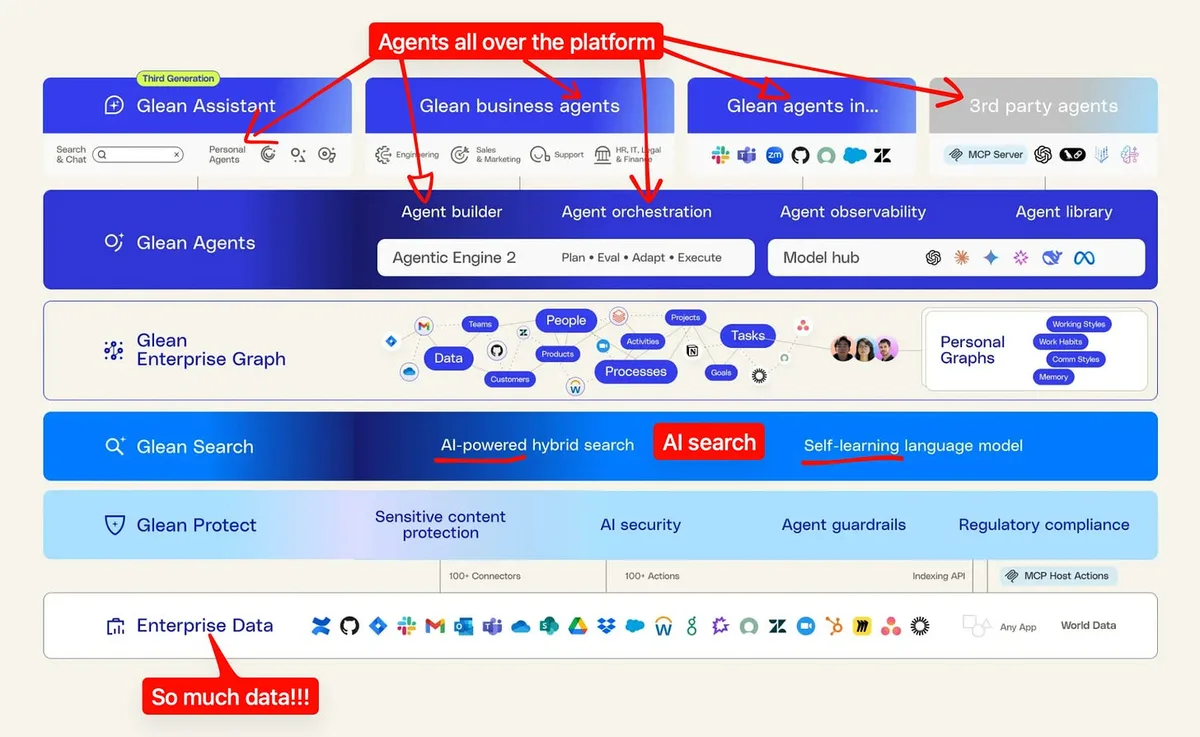
Published by Latent Space; image creator and annotation author not identified in the supplied source.
Model routing and learning from users
By August 2026, Jain identified cost as the main driver of interest in model routing. Glean allowed employees to select models, administrators to restrict them or set usage limits, and an automatic mode to choose dynamically for each task. The interview described Glean’s agentic search model, Waldo, gathering relevant context before frontier-model selection—assembling what Jain called the “raw materials” needed for the work.[1]
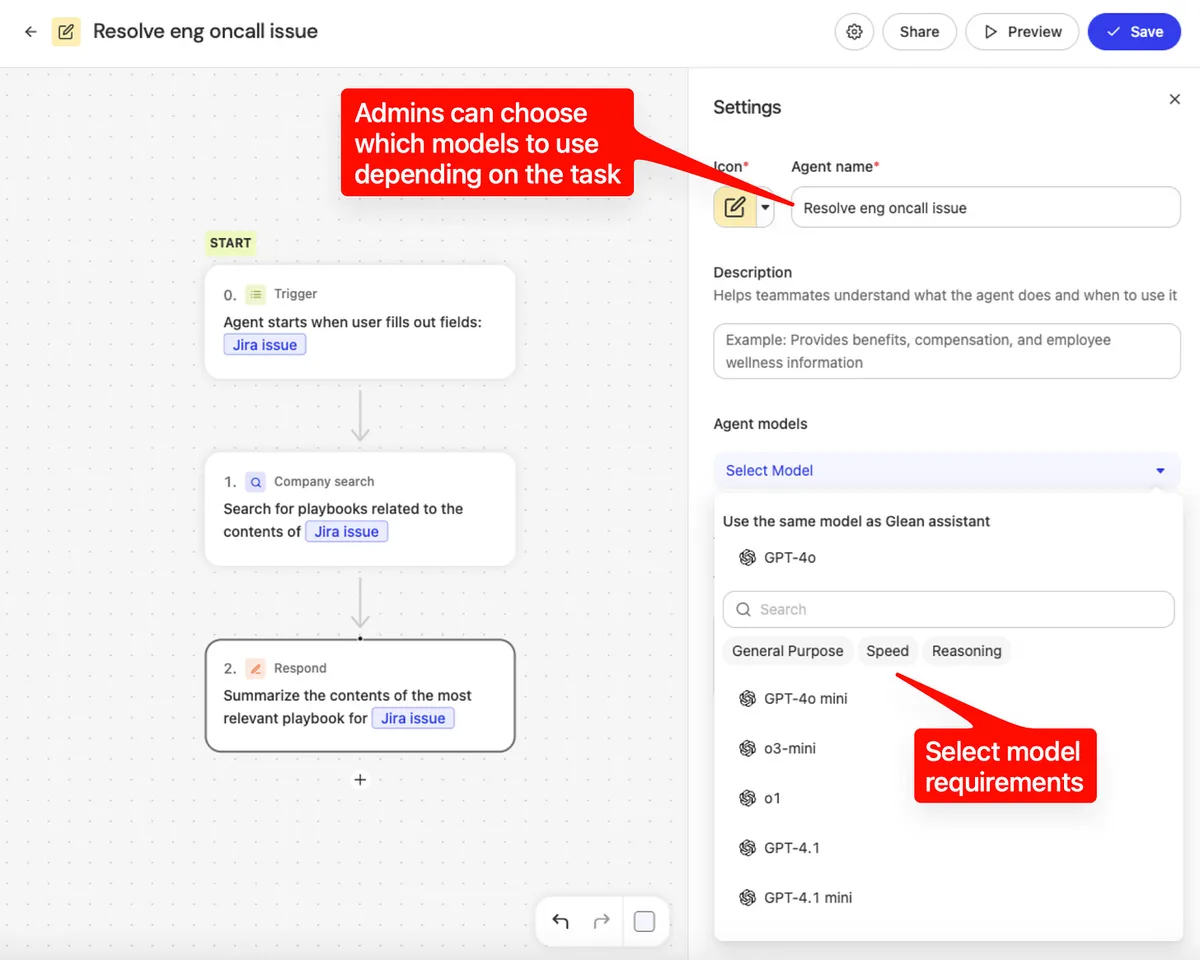
Published by Latent Space; screenshot of Glean.
Jain described two feedback sources for improving routing. Glean observes which models users choose and when dissatisfied users upgrade to another model. It also runs a small fraction of real workloads against alternative models, including cheaper and more expensive options, and uses AI-based judges to assess the router’s choices. He characterized this as continuous learning from real-world traffic.[1]
For broader agentic work, Jain’s Training Data account emphasized learning from workflows users create or correct. A weekly team status report, for example, requires identifying the team, locating where its members’ work happens, and collecting information across systems. He argued that human assistance remained critical because errors can compound as an agent breaks a complex task into multiple steps.[3]
Earlier engineering work and career
Before founding Glean, Jain co-founded Rubrik and led its R&D. Earlier, he spent over a decade at Google as a distinguished engineer, leading teams in Search, Maps, and YouTube. His career began at Microsoft and included a leadership position at Akamai. This earlier work provides context for his experience with search and software infrastructure.[2]
On November 9, 2009, Jain and staff software engineer Jason Glasgow co-authored Google’s “Use compression to make the web faster”. They explained how antivirus software, browser bugs, and proxies could remove or alter the Accept-Encoding header, preventing compressed delivery; misconfigured servers were another cause. Their article reported a 300-millisecond latency improvement in a randomized experiment that forced compression for some users who otherwise would not receive it, and recommended corrective action by browser users, software vendors, ISPs, and webmasters.[4]
Jain co-founded Glean in January 2019 with Vishwanath T R, Tony Gentilcore, and Piyush Prahladka. He recalls using BERT-based language models in its early search technology to match meaning rather than only exact keywords. The engineering work was collaborative: Glean identifies T.R. Vishwanath with technical infrastructure and data-source integrations, and Gentilcore with product engineering.[2][3]
Timeline
- research
Co-authors Google’s web compression guidance with Jason Glasgow
On November 9, 2009, Jain and staff software engineer Jason Glasgow co-authored Google’s “Use compression to make the web faster”.[4] - founding
Co-founds Glean with Vishwanath, Gentilcore, and Prahladka
Jain co-founded Glean in January 2019 with Vishwanath T R, Tony Gentilcore, and Piyush Prahladka.[2] - milestone
Identifies cost as the main driver of model routing demand
By August 2026, Jain identified cost as the main driver of interest in model routing.[1]
Sources
- 1
- 2About Glean | Enterprise AI Platform for WorkAccessed 2026-09-20
- 3
- 4Use compression to make the web fasterAccessed 2026-09-20
Model source and teaching reviews passed. Human editorial review pending. This profile describes the sources as of 2026-09-20.