

Historical affiliation with Anysphere · as of 2026-09-15
Browse · People
Person · Latent Space wiki
Aman Sanger
Cursor cofounder Aman Sanger connects model capability, inference economics and editor design to the practical work of writing software.
Aman Sanger is a cofounder of Cursor, the AI coding editor, alongside Michael Truell, Sualeh Asif and Arvid Lunnemark. His technical work and public explanations connect model selection, inference costs and interfaces for editing and reviewing code. In May 2025, he was identified as Cursor’s CTO. On his personal website, he states his purpose: “Software engineering bandwidth and genius ideas are the bottlenecks to rapid AI progress. Cursor is our attempt at solving the former.”[5][12][3]
Before Cursor: consultancy, CAD and the GPT-4 preview
Before building the coding editor, Sanger experimented with other AI applications. In his August 2023 Latent Space interview, he recalled learning to program after encountering ImageNet results and building a neural network in Java, the language he knew from AP Computer Science. He and Michael Truell attended the same high school and MIT, and worked together on an AI consultancy before their startup experiments.[1]
Their earlier project, also called Cursor, applied transformer models to computer-aided design. Sanger recalled limited training data and overfitting as they increased model size. The task also demanded tracking constructed geometry: drawing a rectangle and extruding it creates a volume, which later operations must reference correctly. In his account, their models struggled with those spatial relationships. Building plugins for existing CAD software posed another obstacle.[1]
After a brief text-to-image exploration, Sanger and Truell chose to build a tool they would use themselves. A non-production GPT-4 preview through OpenAI’s Converge program changed their assessment of coding assistance: Sanger recalled useful refactoring, editing and debugging, beyond autocomplete. He distinguished participation in Converge from receiving OpenAI investment before building Cursor. They later joined forces with Asif and Lunnemark, who had independently begun an AI editor under the Anysphere name.[1]
The consequential decision was to own the full editor by forking VS Code. Sanger argued that increasingly capable models would require different interactions for producing software, including edits above the cursor and deletions rather than simply completing subsequent lines. An extension would limit those interfaces and leave the team dependent on a platform controlled by a competitor. These were his reasons for the editor choice in 2023, rather than a description of present-day extension limits.[1][5]
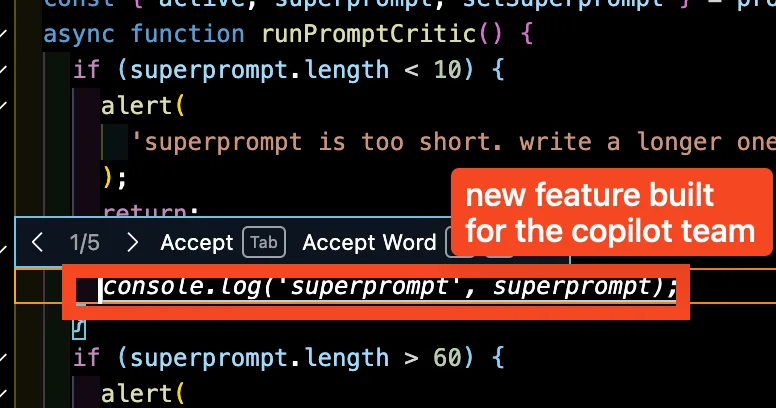
Latent Space; the source page credits the screenshot to McKay Wrigley.
Sanger had already experienced an AI feature changing his own workflow. In the Cursor team interview published by Lex Fridman in October 2024, he recalled switching from Vim to VS Code in 2021 to use GitHub Copilot. Although he enjoyed Vim, Copilot’s usefulness persuaded him to change editors.[5]
Inference economics shape model choices
Sanger’s July 20, 2023 essay on Llama inference analyzed prompt processing and output generation as different workloads. Prompt processing can parallelize matrix operations across input tokens. Autoregressive generation produces tokens sequentially, repeatedly reading model weights and cached attention keys and values; at small batches, memory bandwidth can become the bottleneck. Increasing batch size spreads the weight-reading cost across requests, but also increases prompt-processing latency and requires sustained demand.[6]
The essay compared Llama-2-70B at 16-bit precision on two 80-GB A100 GPUs with then-current GPT-3.5-turbo pricing and latency. Sanger recommended open models for prompt-heavy classification or reranking, and closed models for generation-heavy interactive work, while allowing exceptions for offline batches and workloads with negligible prompts. He said the findings informed Cursor’s model choices. The two-GPU results were measured; eight-GPU performance was projected. The prices and comparisons belong to 2023, and the analysis explicitly set aside fine-tuning as a separate reason to use Llama.[6]
Tab, Apply and speculative edits
In the 2024 interview, Sanger described Cursor Tab as eliminating predictable editing actions once the programmer’s intent was established. Its workload combined long code inputs, short outputs and tight latency requirements. He identified small, sparse mixture-of-experts models and speculative edits as team developments that helped serve it, alongside prompts designed to reuse the attention KV cache across requests. His model-selection view was that no model was best across every relevant dimension, including speed, editing ability, context length and coding capability.[5]
Apply used a different division of labor. As Sanger explained it, a frontier model sketched the intended change and a trained application model incorporated it into the actual file. This addressed difficulties such as incorrect line numbers when frontier models attempted to produce diffs directly. It also reduced the tokens the more expensive model needed to generate, separating high-level planning from implementing the change.[5]
His explanation of speculative edits made the shortcut concrete: much of a revised file is identical to its original version, so existing code supplies candidate output. The model verifies chunks of that code together, generates new text where it disagrees, and resumes speculation after enough output matches the original again. Sanger conditioned the speed advantage of processing multiple tokens together on generation being memory-bound. This makes rewriting largely unchanged code faster without requiring a separate small model to draft those unchanged passages.[5]
Priompt allocates a finite context budget
Sanger also explained the team’s use of Priompt, a JSX-based library for composing prompts and deciding which inputs fit a token budget. A prompt can retain essential instructions and the latest user message, favor recent conversation history, and reserve space for generation. In his 2023 example, overflow rules first removed older messages, then truncated file content. He compared adapting prompts to different context lengths with designing websites for different screen sizes.[1][9]n1
Auditable agents and human review
In 2023, Sanger favored agents that worked in small, understandable steps whose outputs users could inspect and correct. Producing a large body of code at once could make verification so difficult that writing it manually would have been more efficient. He advocated giving models execution, tests and language-server tools—such as going to definitions and finding symbols—rather than relying solely on semantic search.[1]
For local command execution, Sanger described plans to ask for user approval; for unattended background agents, he favored contained environments. He identified prompt injection through code comments or documentation as a route to dangerous command execution. In 2024, he argued that reviewing model-generated code could be designed around the human reviewer, including directing attention to significant regions, rather than reproducing conventional code review. He credited Arvid Lunnemark with examples of that approach.[1][5]
Composer 2 research
Sanger is credited among the research-team contributors to Composer 2, whose technical report was announced on March 27, 2026. The team adapted Kimi K2.5 through code-dominated continued pretraining, context extension, a short supervised coding phase and large-scale agentic reinforcement learning. Training used the deployed Cursor harness and equivalent tools in realistic coding environments. CursorBench drew tasks from the engineering team’s actual coding sessions, including terse, ambiguous requests and changes across multiple files. The report credits Sanger collectively without allocating individual implementation responsibilities.[7][8]
From the Latent Space archive
Original posts and separately reviewed explanations.
Conversation
Cursor.so: The AI-first Code Editor — with Aman Sanger of Anysphere
ConversationICLR 2024 — Best Papers & Talks (Benchmarks, Reasoning & Agents) — ft. Graham Neubig, Aman Sanger, Moritz Hardt)
Grounded writeupBenchmarks, Self-RAG, and Step-by-Step Verification — Part 3 of 5
Grounded writeupCursor’s early bet: redesign the editor around the model
Grounded writeupFrom the Reversal Curse to DSPy: ICLR 2024, Part 5 of 5
Grounded writeupICLR 2024, Part 1 of 5: Finding the Tasks Agents Still Cannot Do
Grounded writeupICLR 2024, Part 2 of 5: Compute, Context, and Benchmarks for Working Agents
Grounded writeupICLR 2024, Part 4 of 5: Verifiers, Safety Systems, and Agents
Notes
- Priompt’s README warns that assigning priorities everywhere can become an anti-pattern and make prompts difficult to cache. It gives roughly 10,000 scopes as a practical rendering limit, recommends grouping distant file lines more coarsely, and documents latency and imperfect cutoff selection in certain fallback configurations.[9]
Sources
- 1Cursor.so: The AI-first Code Editor — with Aman Sanger of AnysphereAccessed 2026-09-17
- 2
- 3Aman SangerAccessed 2026-09-17
- 4Aman Sanger — ThoughtsAccessed 2026-09-17
- 5
- 6Inference characteristics of LlamaAccessed 2026-09-17
- 7Composer 2 Technical ReportAccessed 2026-09-17
- 8A technical report on Composer 2Accessed 2026-09-17
- 9anysphere/priompt — Prompt design using JSXAccessed 2026-09-17
- 10Cursor is now a part of SpaceXAccessed 2026-09-17
- 11Our decision on Cursor following its acquisition by SpaceXAccessed 2026-09-17
- 12How Cursor is pioneering new coding frontiers with Claude Opus 4Accessed 2026-09-17
- 13Aman Sanger — 2021-22 MIT Men's Squash RosterAccessed 2026-09-17
- 14
Model source and teaching reviews passed. Human editorial review pending. This profile describes the sources as of 2026-09-17.