

Browse · People
Aarush Selvan
Product manager who helped create Gemini Deep Research, with an emphasis on editable plans, visible sources and research grounded in users’ needs.
Aarush Selvan helped create Gemini Deep Research, an AI research assistant that browses the web and produces reports users can question and refine. In February 2025, he was its lead product manager, working alongside tech lead Mukund Sridhar. His product decisions emphasized showing users a proposed research plan, making source websites visible during browsing and keeping the report beside the conversation so learning could continue after the first answer.[1]
From scattered information to a research report
The starting challenge was concrete: finding a suitable summer camp meant gathering prices, availability and schedules scattered across websites. Selvan and Sridhar proposed a system that would research the options and assemble a report. In Google’s account, Selvan recalled that Sridhar demonstrated a prototype after several weeks of work with his team. Sridhar reported that a query comparing soccer and art camps for children in the New York area returned details for more than 20 camps.[3]
Selvan described the editable research plan as a deliberate response to users who might not yet know which questions to ask. Rather than only request clarification, the assistant would lay out relevant facets of the topic and invite users to steer the work. In the February 2025 Latent Space interview, he explained that the aim was to teach the user something about the topic while eliciting direction. His later advice was simple: “Don’t overthink it.” Users could express their end goal and adjust the plan before research began.[1][3]
Transparency also shaped the interface. Selvan said the team wanted agents to explain their intended work upfront and to be “very publisher forward”: users could open the websites being read while research was underway. The side-by-side report and chat supported further questions. He described retaining research material in long context for faster follow-up answers, returning to planning when more research was needed and using retrieval beyond the available context.[1]
Judging agents by the experience they deliver
Selvan argued that benchmark success did not automatically establish research-product quality. In February 2025, he said the team’s primary goal was solving the user’s research use case: “The benchmarks, at least the ones that we are seeing, they don't directly translate to the product.” He nevertheless recognized benchmarks’ value in the wider AI field. His distinction was between measuring particular technical capabilities and demonstrating that an assistant could do useful research.[1]
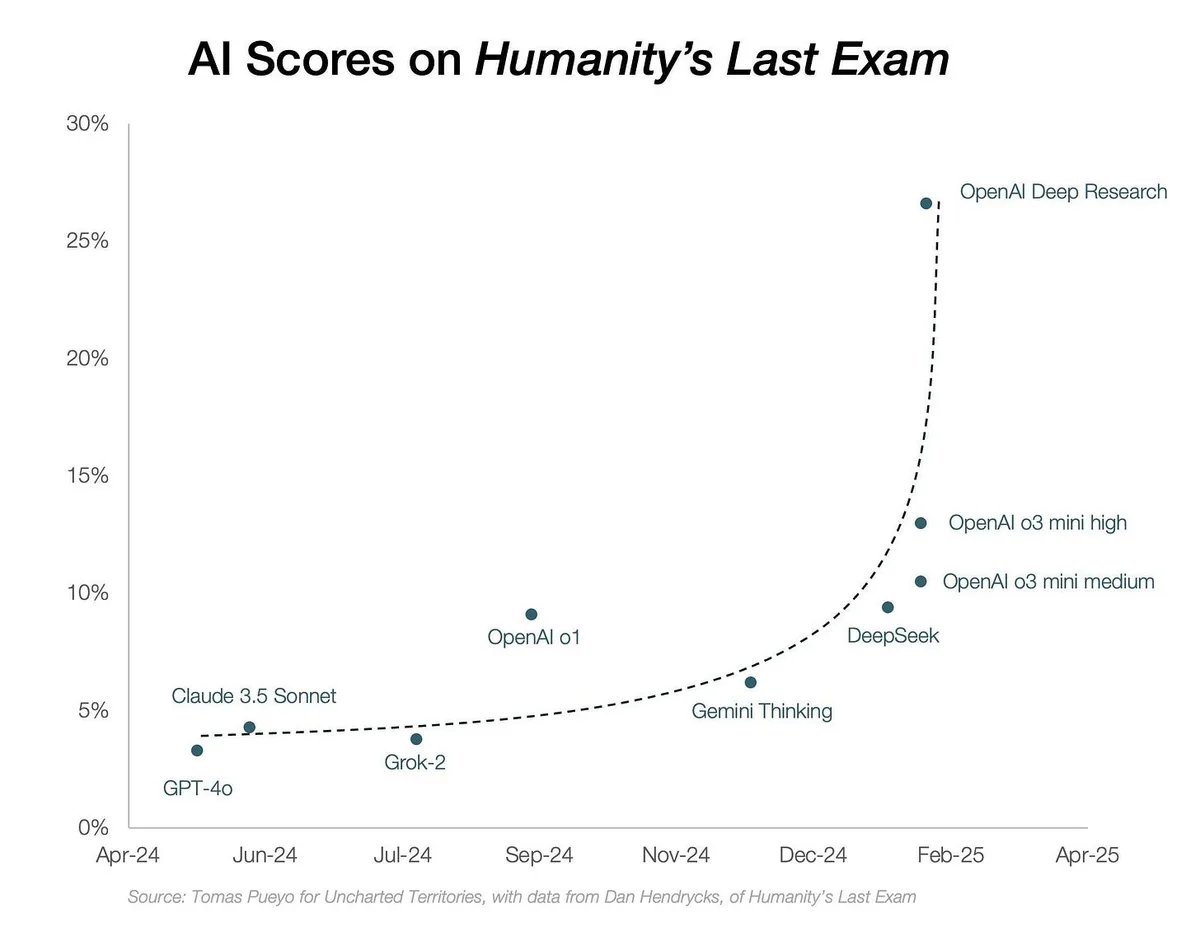
Tomas Pueyo for Uncharted Territories, with data credited to Dan Hendrycks; reproduced by Latent.Space.
His advice to agent builders was similarly focused. He considered it premature to assume that a few interchangeable platform components could produce a compelling agent. While acknowledging that existing tools helped developers get started, he favored curating one experience before extracting common components or expanding broadly: “I would start from the idea and try to just just do that one thing really well.”[1]
Earlier work: Gemini Extensions and ML infrastructure
Before Deep Research, Selvan says he started Gemini Extensions, the platform connecting Gemini with apps and services to inform its responses. His personal website describes earlier product work spanning ASICs, compilers, frameworks, and speech and natural-language technology for Google Assistant. That history places his research-assistant work alongside experience with the infrastructure and services underlying machine-learning products.[2]
A dated example is his December 1, 2021 Cloud TPU v4 article, coauthored with Pankaj Kanwar. They reported Google’s MLPerf Open-division benchmarks: a 480-billion-parameter TensorFlow model on 2,048 TPU chips and a 200-billion-parameter JAX model on 1,024 chips, with approximate training times of 55 and 40 hours. Both reportedly achieved 63% computational efficiency, calculated with compiler rematerialization included. The article explicitly qualified training time and computational efficiency as unofficial MLPerf metrics; these were team results, rather than Selvan’s individual engineering accomplishments.[4]
Selvan’s own career account says he earned a BS and MS in Symbolic Systems at Stanford University and began his career as a management consultant at McKinsey & Company.[2]
Timeline
- research
Coauthored Cloud TPU v4 article with Pankaj Kanwar
A dated example is his December 1, 2021 Cloud TPU v4 article, coauthored with Pankaj Kanwar.[4] - role
Led Gemini Deep Research product alongside Mukund Sridhar
In February 2025, he was its lead product manager, working alongside tech lead Mukund Sridhar.[1]
From the Latent Space archive
Original posts and separately reviewed explanations.
Sources
- 1The Inventors of Deep ResearchAccessed 2026-09-20
- 2Aarush SelvanAccessed 2026-09-20
- 36 tips to get the most out of Gemini Deep ResearchAccessed 2026-09-20
- 4Google showcases Cloud TPU v4 Pods for large model trainingAccessed 2026-09-20
- 5Benchmarking FLOPs utilization on TPU v4Accessed 2026-09-20
Model source and teaching reviews passed. Human editorial review pending. This profile describes the sources as of 2026-09-20.